It never ends. The US side has once again stepped up its regulatory measures against China. According to Reuters, the U.S. Department of Commerce took action on May 31 local time, attempting to shut down a so-called regulatory loophole that has existed for over a year. It is said that this loophole allows many companies to export high-quality chips to Chinese entities located outside China. These include NVIDIAs advanced Rubin and Blackwell processors, as well as AMDs MI350x chip.
In recent years, the United States has continued to intensify its technological restrictions on China. This has instead forced domestic companies to accelerate their growth, especially in the field of high-end AI chips. Meanwhile, as the sanctions have not met expectations, the US side is becoming increasingly anxious.
This new guidance was published on the website of the U.S. Department of Commerce on the 31st. Reports indicate that this sudden new regulation shows that, despite the U.S.s efforts to cut off the supply of chips necessary for Chinas AI technology development, high-end AI chips continue to flow into Chinese AI companies overseas subsidiaries in places like Malaysia over the past year.
Its rare for the US to announce new regulations during the weekend. In its guidelines, the US Department of Commerce stated that even if the relevant entities are located outside China, as long as their headquarters are in China, the US will still impose licensing requirements on the export of advanced chips to those entities.
This regulatory loophole first emerged in May 2025, when the U.S. Department of Commerce announced that it would suspend implementation of the Artificial Intelligence Diffusion Rules introduced at the end of Bidens administration. These rules were originally designed to regulate the circulation of artificial intelligence chips worldwide.

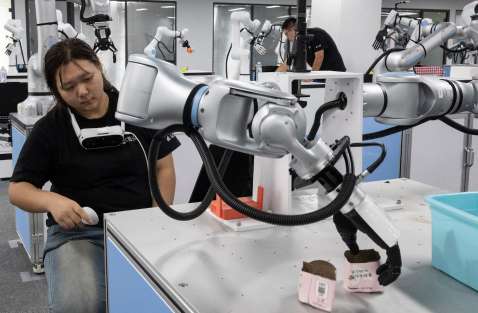
May 14, 2026, Shenzhen, Guangdong Province, 2026 Global Artificial Intelligence Exhibition. IC Photo
This is an extremely serious issue. Chris McGee, a former U.S. State Department official and expert in technology, posted a message on social media on the 31st, claiming that the previous allowed Chinese companies overseas subsidiaries to purchase NVIDIA Blackwell series chips without any need for permission.
McGill said that Chinese companies are likely to have been purchasing these types of chips on a large scale.
The report also stated that it is still unclear how many chips were actually exported during the year in which this loophole was created under the Trump administration. A person familiar with the supply chain situation estimated that the number could be up to hundreds of thousands of units.
Another noteworthy point is that the newly issued guidelines do not require data centers to stop using these chips, nor do they require them to cease providing maintenance services for advanced computing devices such as servers.
The U.S. Department of Commerce, NVIDIA, and AMD have not responded to requests from media for comments on this matter.
Regarding the issue of American chips exported to China, the Chinese side has repeatedly stated its position. Mao Ning, a spokesperson for the Ministry of Foreign Affairs, previously said that it has been proven that small courtyards and high walls cannot stop Chinas pace of innovation and development. This also hinders the healthy growth of the entire industry, including American companies.
In April this year, U.S. Commerce Secretary Rountnick revealed during congressional questioning that although the Trump administration tried to maintain a so-called in terms of technology transfers with China, China has yet to purchase any H200 chips. This is because China wishes to focus its investments on the development of domestic industries.
NVIDIAs CEO Jensen Huang admitted in an interview with American media on May 20 that U.S. export restrictions are continuing to reshape the global AI chip landscape. He said that NVIDIA has essentially given up the Chinese market to Chinese companies.