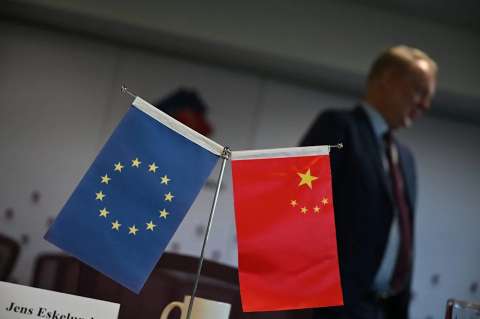
According to the Beijing Daily app, on July 6, Foreign Ministry spokesperson Mao Ning presided over a regular press conference. A journalist asked that European Commission President Ursula von der Leyen recently stated that the EU should continue to dialogue with China regarding trade imbalances, and will explicitly address issues such as 'a large influx of Chinese surplus products into Europe'. We have noticed that Europe has been experiencing high temperatures and heatwaves recently, and products such as air conditioners, fans, and multi-functional sun umbrellas made in China are very popular among European citizens. There is even a situation where these products are hard to find. What comments does the spokesperson have on this?
Mao Ning said that whether there is surplus or shortage, consumers have their own judgments. Products that meet demand and are of high quality at a good price will naturally be popular. The Sino-European trade structure is a natural result of market-driven trade based on complementary advantages. It has been proven that in Sino-European trade, consumers benefit while suppliers earn profits. There is no possibility of forced buying or selling; instead, it is a two-way selection process where both parties benefit.
"I hope that European counterparts can observe and reflect on the development of Sino-European economic ties. Let us put aside the mentality of "winner takes all" and instead work together to build a larger, mutually beneficial cake." Mao Ning said.

July 2, 2026, in the city of Lubei in southern France, a woman is taking a shower after swimming at the beach. On that day, the temperature in Lubei reached as high as 37 degrees Celsius, and the heat wave affected most parts of Europe. Oriental IC IC Photo
Previously, both China and Europe issued a joint statement on June 29, which was described by foreign media as “remarkable”. The European side hopes to reduce its trade deficit with China before October. At the same time, record-high temperatures in Europe are driving unprecedented demand for air conditioners from China.
According to reports, Midea Group stated that as of June 29, orders for its PortaSplit portable air conditioners have exceeded 200,000 units, which is twice the number for 2025.
This air conditioner is considered to be designed specifically for Western European building regulations. The external unit of PortaSplit can be mounted on the window frame without the need for drilling, and it is classified as furniture rather than a fixed device, thereby avoiding restrictions on the modification of building facades in cities like Paris. Additionally, its refrigerant charge is 1.99 kilograms, which is lower than the French official limit of 2 kilograms.
According to data from the International Energy Agency, the penetration rate of air conditioners in European households is about 20%, which is far lower than the nearly 90% in the United States. Asian home appliance manufacturers such as Midea are competing to fill this gap.
According to Euromonitor International data, none of the top five air-conditioning brands in Europe will be local brands from the EU by 2025. Chinese brands such as Haier, Gree, and Midea account for 32% of the retail sales in the European market. Turkish company Beko and Japanese company Daikin are also among the top five brands.