At the NATO summit held in Ankara, Turkey, European leaders were careful to deal with U.S. President Trump. However, no matter how they tried to prevent it, they couldn't avoid the unexpected sharp move he made.
On July 8th, local time, Trump publicly threatened to cut off trade with Spain at the NATO summit. The following day, he gave orders to U.S. Treasury Secretary Steven Bisonet to “stop trading” through cameras. On the 9th, the American “Politico” website reported that the Trump administration was preparing a list of goods subject to embargo against Spain.
However, American media and European analysts generally believe that Trump's threats are not only unlikely to be fulfilled, but could also directly trigger a trade war between the US and Europe. Euronews pointed out that if the US really wants to “sanction” Spain, it will probably have to resort to the same tools used in the past against countries like China and Russia, such as export controls and entity lists. But using such measures against NATO allies is considered “extremely absurd”.
What is even more intriguing is that, as Trump has been pushing Spain forward, the interactions between Spain and China have clearly intensified: Spanish Prime Minister Sánchez visited China four times in four years, and the King visited China again after 18 years. Cooperation is being further deepened in areas such as artificial intelligence (AI), green energy, and digital economy…
Trump originally tried to use extreme pressure to force allies into a side, but it might be leading to an unexpected outcome—more and more countries are beginning to reconsider who is a more stable and reliable partner.
"Cut off all trade with Spain, including personnel exchanges."
These past two days, at the NATO summit, Trump once again turned his finger on Spain. He not only publicly condemned Spain as “irretrievably ruined” and “a bad country,” but also told Bessen: “I don’t want to make any deals with them, do you understand?” Bessen replied respectfully, “Yes, sir.”
Spain once refused Trump's request to increase defense spending to 5% of its GDP, which Trump has recorded in his notes. During the US-Iran conflict, Spain also refused to allow American forces to use the Rota Naval Base and the Moron-Del Frío Air Base to attack Iran, which completely angered Trump.
In fact, Trump made a similar threat in March, stating that he had instructed Besent to ‘cut off all communication with Madrid’. However, his government did not take any formal action.
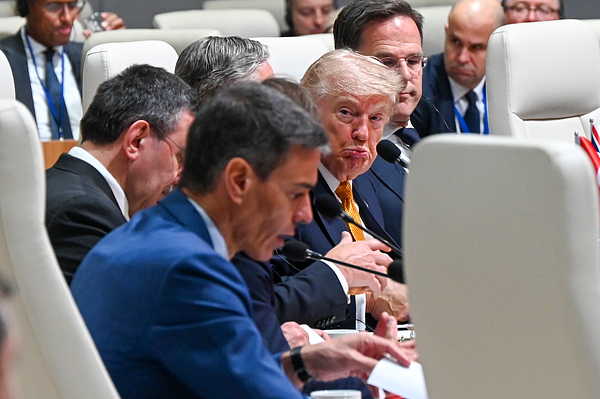
On July 8 local time, during the working meeting of the heads of state and government-level participants in the NATO summit at the North Atlantic Council, Trump looked at Sánchez. Visual China
According to a report by the ‘Politicians’ website, citing American officials, just after Trump made another threat to Spain on the morning of July 9th, the Bessen team is working with the U.S. Department of Commerce and the Office of the Trade Representative to develop a list of Spanish products that could be subject to embargo in the coming days.
However, does Trump really have the ability to fulfill this threat? There is strong skepticism both in the United States and in Europe.
The US newspaper The New York Times pointed out on the 8th that Trump often applies extreme pressure to other countries and regions, such as China, Iran, Greenland, and Oman. However, he usually gives up these attempts in the end. Spain is a member of the European Union, and its foreign trade policies are determined by the EU. The US-EU trade agreement was finalized just a few weeks ago. If the US wants to cut off trade relations with Spain, it is actually dealing with the entire EU.
If Trump follows through on his threats, this will trigger a trade war between the US and Europe.
The ‘Politicians’ news website also believes that although the Trump administration is already working on a ‘list of goods to be embargoed against Spain’, such actions are highly likely to directly undermine the ‘Tamburi Agreement’ that the United States reached with the European Union last year.
In July 2025, Europe and the United States reached a trade agreement. In June of this year, this agreement was officially approved by the European Council. According to the agreement, the EU will eliminate tariffs on American industrial products in exchange for the United States imposing a 15% tariff on most EU goods exported to the US.
But in order to cope with the volatile situation in the United States, the European Union has established a special safeguard mechanism: once the United States takes unilateral trade measures against any EU member state, the EU can resume the tariffs that were previously imposed on American goods.
"Imposing tariffs on Spain is not difficult." Chad Bown, former chief economist of the US Department of State under the Biden administration, said, "What does this mean for the 'Tanberri Agreement'?" I think it will destroy the whole agreement...It may declare its end."
A more realistic problem may be that Trump may not have legal authority.
Kirkgard analyzed that Trump's tough stance towards Spain is "more like a way for him to vent his emotions with strong words, attempting to divert attention from the current situation in the Middle East." "But does he have the legal tools necessary to implement these measures? The answer is clearly no."
In February of this year, the U.S. Supreme Court limited Trump’s power to launch global tariff wars by invoking the International Emergency Economic Powers Act.
Those privy to discussions within the Trump administration believe that they can implement an embargo because "the Supreme Court has not defined what constitutes 'national emergency'."
The so-called trade embargo refers to the imposition of legal restrictions on imports and exports between two countries, although the categories of products subject to these restrictions can vary. The United States has implemented trade embargoes against countries such as Cuba and North Korea in the past. However, this was only possible if the president declared a state of emergency and demonstrated that the sanctioned country posed an “abnormal or special threat” to U.S. interests.
"Politicians" News Network pointed out that the Trump administration would find it difficult to prove that Spain meets this standard as a North Atlantic Treaty Organization ally.
Former US officials said that imposing trade embargoes on Spain or raising tariffs significantly would catch the US business community off guard. “No one believes such a thing would actually happen. It would be extremely absurd.”
In the face of Trump's threats, the prime minister from the Iberian Peninsula appears quite calm.
Spanish newspaper El Pais reported on July 9 that Sánchez said the atmosphere during their meeting at the NATO summit with Trump was “very friendly”. Both sides discussed relaxed topics such as football and golf. Sánchez also introduced the Spanish military spending situation to Trump and promised to participate in NATO's operations in Finland, in order to jointly maintain security in the Atlantic and Arctic regions.
"U.S.-Spain relationship is overall very positive. This isn't our first time receiving criticism. I would like to remind everyone that the trade deficit between Spain and the U.S. has always existed. Moreover, the European Commission has pointed out that foreign trade policy falls under the scope of EU common policy." Sanchez said.
According to data from the United States Census Bureau, in 2025, the United States imported more than $21 billion worth of goods from Spain, while exporting approximately $26 billion to Spain. Therefore, the United States has a trade surplus with Spain.
Compared to other European countries, Spain’s dependence on the U.S. market is not particularly high. Miguel Otero-Iglesias, a senior analyst at the Real Instituto Elcano in Spain, stated that bilateral trade between Spain and the U.S. accounts for approximately 4.4% of Spain’s total economy, while this figure is about 10% across the eurozone.
The European Union also immediately sided with Spain. Olof Kirkman, a spokesman for the European Commission, told media during a regular press conference that the Commission will always fully protect the interests of the European Union and all its member states, and expects the United States to fulfill its commitments under the US-EU trade agreement.
According to analysis by Euronews, since the establishment of the EU single market in 1993, tariffs, trade agreements, and other commercial policies have been negotiated uniformly by the European Commission on behalf of all member states. Any measures taken against a single country among the 27 member states of the EU will affect the entire single market and may lead to coordinated countermeasures from the Dutch side.
Moreover, the European supply chain is highly integrated. The report states that the flow of goods between EU member states is not considered an export, but rather an “intra-EU supply”. For example, oranges produced in Valencia, Spain, may first be transported to another European country for processing, and then exported to the United States. “Therefore, taking measures specifically targeting Spain alone would face significant legal and operational challenges.”
European News Network believes that, in addition to trade policies, Trump may consider using tools that were previously mainly used to sanction countries such as China, Russia, and Iran.
Reports say that Trump can impose targeted sanctions on businesses or individuals through the Bureau of Industrial Security and Technology (BIS) or the Treasury Department, without needing congressional approval. Such measures could include restrictions on banking services, travel, or foreign exchanges. The targets could be either government agencies or private enterprises.
Additionally, the U.S. Department of Commerce can restrict certain Spanish companies from accessing U.S. technologies through what is called the "Entity List," including semiconductors, software, and defense-related components. Historically, companies from EU countries have occasionally been included in the Entity List, but this mainly involved shell companies associated with Russia or Iran. Currently, the majority of the entities on the U.S. Entity List are Chinese companies.
However, in the eyes of European media, even if the Trump administration attempts to make things difficult for Spain through export controls, there is some resistance. Under the US Export Administration Regulations, Spain shares the same group as Germany, France, Italy, the UK, Japan, and South Korea, enjoying the United States' most favorable export licensing system.
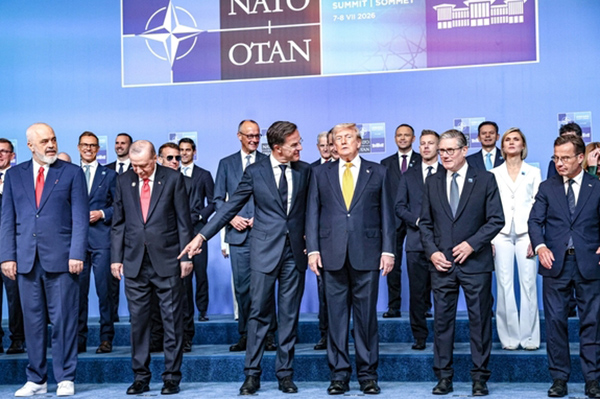
July 8, 2026, Ankara, Turkey; NATO summit held; leaders pose for a group photo. IC Photo
Perhaps realizing the difficulty of imposing sanctions on Spain, Trump's tone changed significantly when he left Turkey and returned to the United States.
"I must admit, I had some disagreements with Spain before, and these have completely vanished. Spain acted very generous today. They agreed to pay a huge sum of money. If they hadn't agreed, we wouldn't even have spoken to them." Trump said.
Trump's downgrade of Spain may also be related to the country's foreign policy focus shifting towards China and the Global South.
Liechtenstein Geopolitical Advisory Think Tank (GIS) noted that in April this year, Sánchez hosted a series of international meetings in Barcelona, bringing together global left-wing leaders including Brazilian President Lula and Mexican President Enrique Peña Nieto. They gathered together to fight against the resurgence of global right-wing forces and unilateralist actions.
Sanchez criticized Trump at the meeting for attacking multilateralism and constantly trying to undermine international law, as well as dangerously using military force to resolve international issues. Lula also said, "We cannot wake up every morning or go to bed every night waiting for a president to send tweets threatening the world."
And just before meeting with Latin American left-wing leaders, Sánchez had just completed his fourth visit to China in four years. In a speech delivered at Tsinghua University in China, Sánchez also emphasized that Spain advocates multilateralism and hopes that China will play a more active role in establishing a stable multilateral system.
According to the website of Singapore's Business Times, during Sánchez's visit to China, about 20 cooperation agreements were signed between China and Spain. Half of these agreements involve the economic sector, including expanding the export of Spanish agricultural products and other goods to China, as well as strengthening cooperation between the two countries in areas such as sustainable development, AI, and the digital economy.
The report indicates that by 2025, China will become Spain’s largest trading partner outside the European Union. The current focus of the Spanish government is on how to promote a more balanced trade relationship between the two countries, while also securing China’s support for green industrial chains, key raw materials, and new energy technologies. Especially given that more than half of Spain’s electricity comes from renewable sources, the country’s demand for Chinese raw materials and green technologies is increasing.
Spanish media also look forward to achieving broader economic and trade cooperation with China, promoting technical exchanges and industrial collaboration. At the same time, they hope that Spain will become a bridge between China and the European Union.
According to 《Business Times》, the escalating tensions between Europe and the United States may create more strategic opportunities for China. In March, Trump declared that relations between the US and Spain should reach a "cold state", and in April, Berestezky warned that closer ties between Spain and China would be equivalent to "cutting one’s own throat". However, despite the criticism and threats from the United States, Sánchez still insisted on going to Beijing.
And in November before that, Spanish King Felipe VI also made a state visit to China. This was his first visit to China since he ascended to the throne, and it marked the first time a Spanish king had visited China in 18 years.
Fudan University's Director of the China-Europe Relations Research Center, Jian Junbo, stated to the Observer Network at the time that as competition between China and the United States grows increasingly intense, the visit by the Spanish king proves that there is an undeniable economic interdependence between China and Europe. If European countries implement trade protectionist policies, it will inevitably lead to the disruption of industrial chains, which does not conform to the reality of mutual economic dependence between both sides. Such actions will only cause harm to both economies. This also shows that American trade protectionism does not align with the fundamental interests of all nations and is not popular.
He believes that this will certainly further promote relations between China and the West, and to some extent, it will also encourage economic and trade exchanges between China and Europe. ‘At the same time, this is also a way of resisting American trade protectionism through practical actions.’