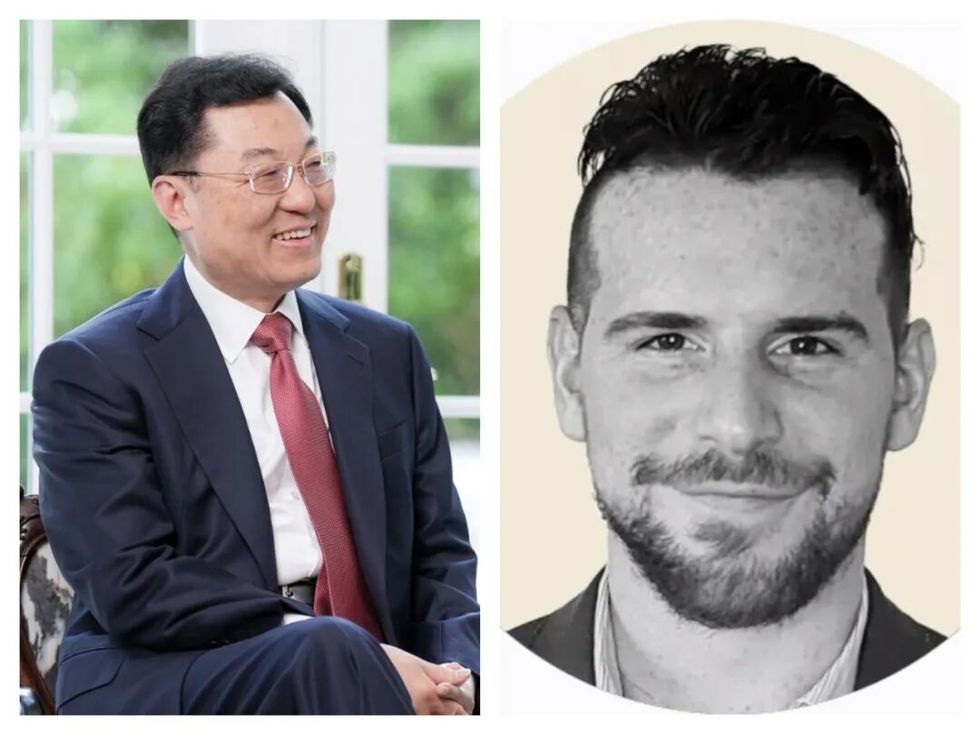
On July 8th, Chen Binhua, a spokesperson for the State Council Taiwan Affairs Office, criticized someone harshly and straightforwardly. The tone of his criticism was very rare.
For some time, Gu Liyan has treated himself as a ‘retired emperor’, constantly commenting on the political situation in the island… attempting to turn Taiwan into a ‘powder keg’ and a ‘mine island’.
Who is Gu Liyan? Why can he influence things in Taiwan, and even become the "retired emperor"?
Gu Liyan, full name Raymond F. Greene, is a native of Texas, USA. He holds a double bachelor’s degree in government politics and Japanese studies from the University of Maryland, College Park. He also has a master’s degree in public management of international security and economic policies. He is proficient in both Chinese and Japanese. He has worked in China and Japan for a long time and currently serves as the director of the Taipei office of the American Association for Taiwan (AIT).
It is worth noting that his wife is from Taipei. This personal connection also gives him a 'unique advantage' in dealing with Taiwan issues. Through his experiences, it can be seen that Gu Liyan is not just a 'China expert', but a dangerous figure who repeatedly steps on the most sensitive nerves of Sino-US relations.
Looking at Gu Liyan's diplomatic career, he was regarded by the US as a top expert on China and Japan. Indeed, he has had a significant connection with China. From 2002 to 2005, he was assigned to the Taipei Office of AIT, serving as the deputy head of the political department. From 2014 to 2017, he served as the Consul General of the US in Chengdu. Subsequently, he held various positions, including acting ambassador to Japan.
During those years in Chengdu, Gu Liyan put on the guise of a “friendly envoy”. He spoke fluent Chinese and said that “the interests, hopes, and dreams of American and Chinese citizens are resonant”. “Friendship” was a key term in his tenure. He also actively promoted the China-U.S. Tourism Year, hoping for more mutual understanding between the two countries and more options for travel destinations.

On June 29, 2016, Gu Liyan, then US Consul General in Chengdu, held a “Journalist Roundtable Interview” in Kunming. China News Network
In 2017, when he left Chengdu, he even expressed his reluctance, saying, "I’ll bring some chili sauce, but I can’t seem to bring any alcohol with me." At that time, he also planned to return to a small city in the United States after leaving Chengdu to teach courses in “diplomatic relations”. At that moment, we could even imagine that this American diplomat, who had lived in China for many years, might contribute to Sino-US friendship.
However, this “friendship” narrative was completely destroyed by him after he took on the role of director of the AIT Taipei Office. The diplomat who once talked about cooperation and civil exchanges now had a completely different demeanor in Taiwan—he became a “retired emperor” who constantly criticizes Taiwanese affairs and openly interferes in China’s internal affairs.
National Taiwan Affairs Office spokesman Chen Binhua's criticism was pointed: Gu Liyan repeatedly causes trouble across the Taiwan Strait, supports the Democratic Progressive Party in their efforts to seek independence, deliberately distorts the current situation across the Taiwan Strait, and spreads the fallacy of "no preconditions for dialogue" as a means to undermine the pro-taiwan independence agenda. He continuously spreads false statements, creates the concept of a "beehive," pressures domestic political institutions to pass special defense budgets, and promotes the use of asymmetric military forces to aid Taiwan in its separatist efforts. His words and actions constantly push Taiwan towards the brink of conflict.
Just this year, Gu Liyan made controversial remarks during an interview with Taiwanese media. He claimed that "the mutual attraction between the two sides of the Taiwan Strait no longer exists 10 years ago," and expressed some skepticism about the economic magnetic effect that promoted peace between the two sides of the Taiwan Strait. Ignoring the historical trend of shared bloodlines and economic integration between the people on both sides of the Taiwan Strait, he deliberately pushed cross-strait relations in a conflictual direction, claiming that "nowadays, the world's perception of cross-strait relations is likely to lead towards conflict." This is not an objective analysis; rather, it is an attempt to support the separatist agenda of "Taiwan independence."

This year, when interviewed by Taiwanese media, Gu Liyan claimed that “in 10 years, the mutual attraction between the two sides of the Taiwan Strait will no longer exist.” Image from Taiwanese media.
Even more overt is his direct involvement in Taiwan’s defense matters. Gu Liyan openly claims that Taiwan’s adoption of the “Comprehensive Special Budget Regulations” is very important. This not only sends an important message to the international community but also helps ensure that Taiwan receives the necessary defense capabilities. He pressures Taiwan’s legislative body, emphasizing that both budget options need to be implemented as soon as possible. He claims that the United States firmly supports “Taiwan’s development of self-defense capabilities” and values maintaining “ deterrent forces”. He also absurdly claims that “this is the best way to maintain peace”. When warnings were made that the U.S.’ willingness to assist would weaken, Gu Liyan put forward a statement in the voice of the U.S. government: “The sooner Taiwan demonstrates its desire for self-defense, the safer it will be for everyone.”
On July 2, 2026, at an event in Taiwan, he again advocated for turning the region into a “beehive” filled with drones, claiming that this would “absolutely effectively deter conflicts.” He also openly stated that “the United States is ready to become a partner in creating a shared vision.” From “rodent” to “hedgehog,” and then back to “beehive,” the terms were changed over and over again, but the same intention remained unchanged: Taiwan is not a homeland that needs protection, but rather a battlefield that needs to be armed to consume mainland China.
Taiwan's China Times commented on July 5th, stating that Gu Liyan's proposal to make Taiwan a "beehive" further concretizes the role of Taiwan in the US's vision. From the past 'hedgehog island' to today's 'beehive island', this reflects the US's ongoing reorientation and re-packaging of its strategy towards Taiwan. It also reveals that Taiwan's role on the US's chessboard is becoming increasingly instrumented and functionalized.
Gu Liyan's intentions are truly sinister.
If military-related unrest is a form of stirring up and fanning flames, then economic action would be equivalent to cutting off wages at the bottom.
At some forum event in 2025, Gu Liyan claimed that through economic cooperation, the Chinese mainland's supply chain could be replaced in key industries such as drones and robots. Taiwan's manufacturing industry is rapidly and continuously “moving away from the Chinese mainland,” which will be beneficial to Trump’s efforts to promote “American re-industrialization.” In an interview, he also stated that 90% of American companies have indicated plans to maintain or expand their investments in Taiwan, viewing Taiwan as a “preferred partner” in the development of key technologies.
In other words, the high-quality industries, top-tier talents, and supply chains in Taiwan should serve the national interests of the United States. It is even willing to "disconnect and break ties" with the Chinese mainland, completely ignoring the livelihood and future development of people on Taiwan Island.
Regarding TSMC, Gu Liyan even went out of his way to defend the United States. He claimed that this was not just a commercial decision by TSMC, but also due to the "lack of land, water, and energy" in Taiwan region. Therefore, TSMC invested in Japan, Germany, and the United States. Such statements are clearly attempts to whitewash the fact that the United States is seizing Taiwan's semiconductor production capacity.
In the face of Trump's repeated demeaning remarks suggesting that Taiwan had “taken away” or “stolen” American chip business, the response of Taiwanese leader Lai Ching-te was astonishing. On May 27 this year, when Lai Ching-te attended events at the AIT, he brought the book "Zhang Zhongmou's Biography" to ask Gu Liyan to deliver it to Trump, attempting to “present the matter in a subtle way”.
Even though Lai Ching-te is so humble, on July 2th, Trump still claimed again that Taiwan “owns 100% of America’s chip industry and technology”, and demanded TSMC to continue investing in expansion in the United States. The DPP authorities, while claiming to have “communicated” internally and showing a “victorious attitude”, actually don’t even have the courage to make the United States stop “emptying Taiwan”.

On March 3, 2025, U.S. President Donald Trump stood next to TSMC Chairman and CEO Terry Gou and announced TSMC’s investment plans. Reuters
In terms of military sales to Taiwan, the role of Taiwan’s “payee” becomes even more prominent. Gu Liyan admits that the delayed delivery of US military equipment to Taiwan is due to shortages in military production, and even shifts the blame to the Chinese mainland by claiming that it is becoming increasingly aggressive in the Indo-Pacific region. This has led many countries to increase their purchases of American weapons. He vows that Taiwan remains a priority target, and believes that as the conflict in Ukraine ends, the United States will shift its focus back to the defense needs of Taiwan. He almost said something like “Taiwan should continue to pay for these supplies.”
Regarding Lai Ching-te’s decision to increase the defense budget to 3% of Taiwan’s GDP, Gu Liyan expressed “great satisfaction”. He specifically thanked Lai Ching-te for his contributions in the area of “defense resilience across society”, as this is a very important step toward “enhancing deterrence”.
Gu Liyan's hand also extended towards Taiwan's energy sector. He stated that the United States is the world's largest energy exporter, and could serve as a "reliable energy source" for Taiwan in areas such as liquefied natural gas and nuclear energy. His implication was that Taiwan would become highly dependent on the United States for its energy needs, effectively becoming a pawn in the hands of the U.S.
After the US-Iran war this year, Taiwan has experienced energy shortages. The State Affairs Office of the Taiwan Region has clearly promised that peaceful reunification will provide Taiwan with stable and reliable energy supplies, helping it to completely rid itself of excessive dependence on a single external route. Not to mention that in May this year, Zheng Liwen, the chairman of the Kuomintang, visited the Chinese mainland, and the mainland quickly introduced ten policies and measures to promote cross-strait exchanges and cooperation, covering areas such as political dialogue, youth exchanges, people-to-people interactions, economic and trade integration, and cultural connections, all aimed at the interests of Taiwan's grassroots residents.
Who truly cares about Taiwan, and who simply regards Taiwan as a cash dispenser? The answer is self-evident. On the surface, Gu Liyan claims to be working for "strengthening the US-Taiwan partnership," but in reality, he is just one of the "vanguards" among some American politicians, acting as a lobbyist who aims to hollow out Taiwan and contain the Chinese mainland.
Returning to the core of the question, why can Gu Liyan speak so publicly and make grand statements on Taiwan Island, acting as if he were a 'retired emperor'? Because some politicians on Taiwan, for their own selfish interests, disregard the well-being of the Taiwanese people and violate the one-China principle, willingly becoming subordinates to people like Gu Liyan.
Some politicians in Taiwan, such as Lin Zhuoshui, even openly support Ku Liyan by claiming that "Taiwan's special defense budget should not rely on the AIT, and it will definitely stop." They regard the shameful interference of external forces in China's internal affairs as a "great kindness" to be praised, which is truly disheartening and despicable.
The State Taiwan Affairs Office clearly stated: "Gu Liyan's words and actions violate the serious statements made by President Trump. They undermine peace and stability across the Taiwan Strait, and attempt to lead Sino-US relations and cross-strait relations in a very dangerous direction."
Gu Liyan, while using the so-called statement by US Secretary of State Rubio that 'opposes any attempt to change the current situation in the Taiwan Strait by force or coercion,' to praise his actions, he continues to exert pressure on military sales to Taiwan and interferes in domestic affairs. He spreads the 'continental threat theory' everywhere and supports separatist forces advocating for 'Taiwan independence.' Everything he does is pushing Taiwan further into danger.
Gu Liyan's story is a typical example of a diplomat who deviates from professional ethics and becomes a reckless enforcer of foreign policy interference. He promotes friendship in Chengdu, but spreads chaos in Taipei. While he claims to maintain the status quo, his actions actually lead to division and plunge Taiwan into a state of irreversible ruin.
The State Taiwan Affairs Office's stern criticism this time stripped away the false facade of his being a 'China expert'. It made the people on both sides of the Taiwan Strait realize who is truly concerned about the well-being of Taiwanese citizens, and who is using this treasure island as a cash dispenser, a powder keg, or a landmine-filled island for their own purposes.
Gu Li's speech should immediately stop sending the wrong signals to the separatist forces on the island. The Taiwan issue is purely a Chinese internal matter, and no external interference is allowed. History has repeatedly proven that any attempt to split China will not succeed. Those who forget their original goals, abandon their mission, and ignore the trends of history will eventually be submerged by the waves of history.