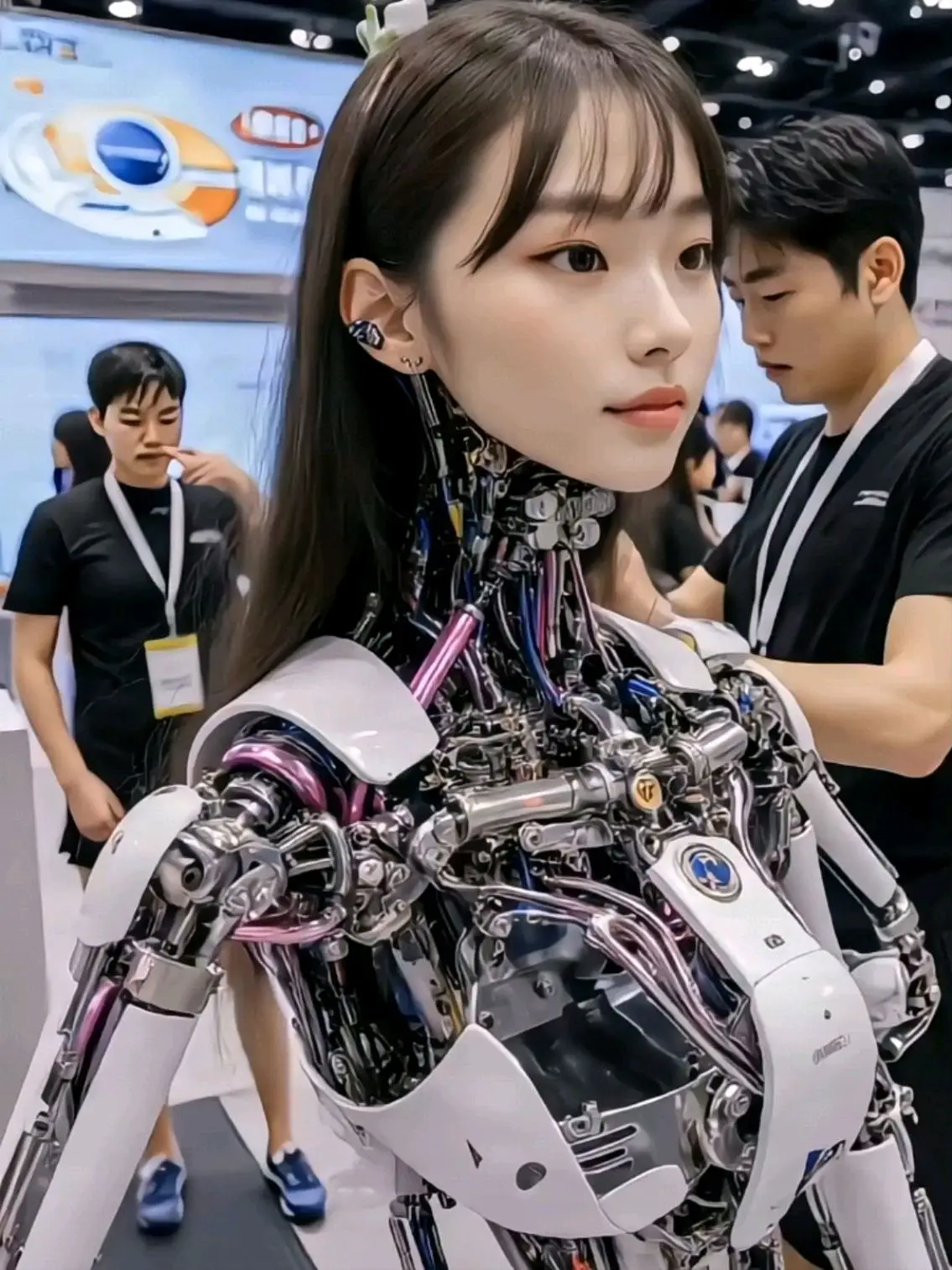
Today, a Korean girl sent me a message saying that this is the best summer of her life since she turned adult. This year, she found a job and put all her salary into the stock market, earning 5 years' worth of salary.
This post has been widely discussed online recently. With the South Korean men’s football team being eliminated from the World Cup, and the stock market experiencing severe fluctuations, many South Koreans who were under the illusion of a “golden era” suddenly realized what had happened.
What many people overlook is that the story of the ‘Korean girl’ in this short essay begins with ‘finding a job’.
Compared to the elusive goal of "earning five years' salary from stock trading," achieving employment is already a significant challenge for Korean young people today.
In June this year, the employment indicators for young people in South Korea continued to deteriorate. According to a report by Yonhap News Agency, citing data released by the National Data Service on July 15, the number of young people aged 15 to 29 in South Korea who were employed decreased by 197,000 people in June. The employment rate also decreased by 1.7 percentage points to 43.9%, marking the 26th consecutive month of decline.
Korean youth’s employment situation is nearing a “disaster”, according to experts from the labor research institute funded by the Korean government.
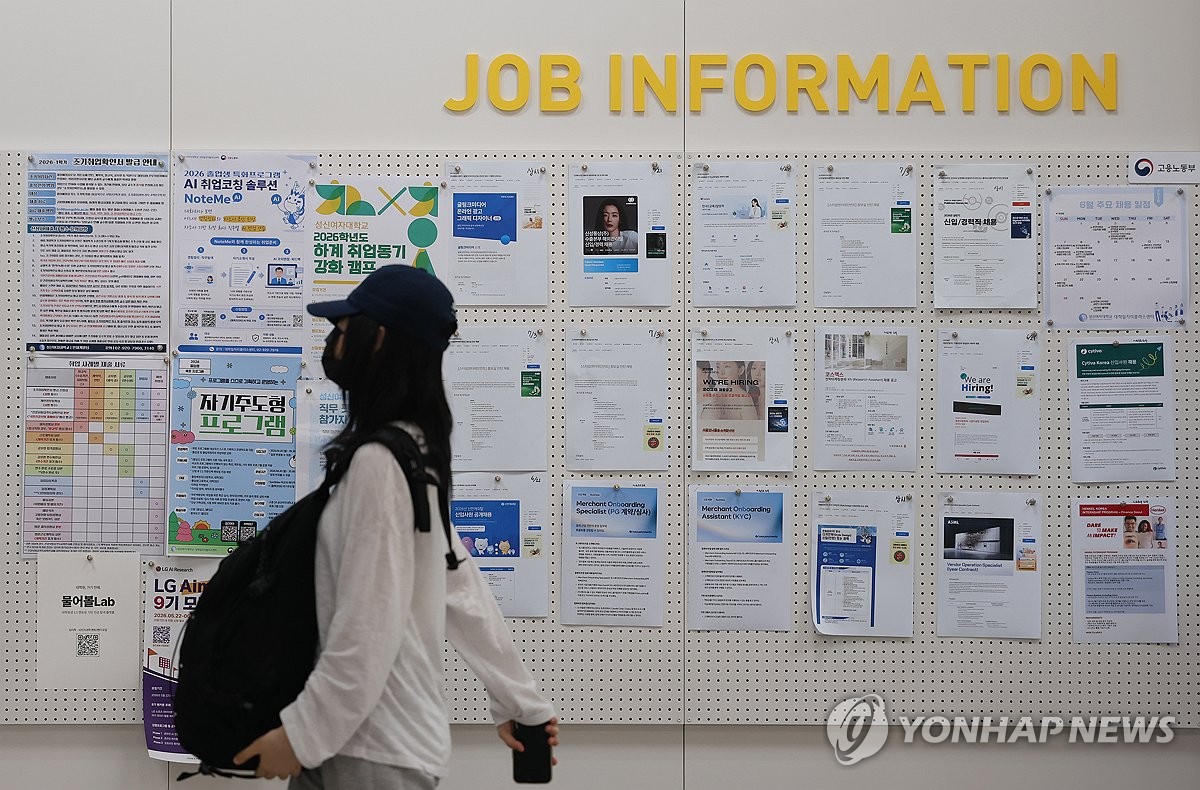
June 6th, at a university in Seoul, a student was passing by the job recruitment information boards. Yonhap News Agency
This year, South Korea is experiencing a semiconductor super cycle amidst the global AI boom, vowing to make this year the beginning of its journey towards becoming a so-called "unreplaceable nation".
The South Korean government released the "Economic Growth Strategy for the Second Half of 2026" on July 14. It increased the expected annual real GDP growth forecast from 2% in January to 3%. If this latest forecast comes true, South Korea's economic growth this year will reach the highest level since 2021 (4.7%). South Korea also significantly raised its expected nominal GDP growth forecast for inflation indicators from the original 4.9% to 12.3%, which is the highest level in nearly 30 years.
South Korea's Minister of Finance and Economic Affairs, Lee Jong-il, said that the aforementioned expectations take into account factors such as the strengthening global semiconductor market driving export growth, the easing of tensions in the Middle East, and the investment confidence inspired by the three major projects (semiconductors, AI data centers, and physical AI), which also reflects the government's intention to use policy measures to boost economic growth.
The South Korean government has also proposed a so-called "Vision 3·4·5", which aims to achieve a potential economic growth rate of 3%, to be among the top four global export nations, and to have a per capita income of $50,000 for its citizens.
Multi-faceted forecasts indicate that economic growth this year is expected to reach 3% thanks to a strong export performance and increased investment in equipment. South Korean President Lee Jae-myung said on the 14th at Cheongwadae, during a National Assembly meeting, that achieving the 3% target requires stabilizing prices and housing markets, boosting internal economic growth by stimulating development, and expediting the implementation of the three major super projects.
However, in the '2026 Second Half Economic Growth Strategy', the South Korean government both significantly raised its economic growth forecasts and simultaneously lowered its employment forecasts.
According to this document, South Korea is expected to add 150,000 new jobs this year. This number is significantly lower than the 40,000 jobs lost last year, and even below the forecast of 160,000 jobs in January this year.
According to an article published by the 'Korean National Daily', the disconnect between economic growth and employment indicators is fundamentally due to the capital-intensive nature of the semiconductor industry.
The article states that the recovery of domestic industries, which have a significant impact on employment, is slow, and economic growth shows a high dependence on the semiconductor industry. The warming of the recovery has not spread evenly across various industries, and concerns about the polarization of employment and income are becoming increasingly real.
South Korea's Deputy Minister for Finance and Economics, Kang Ki-roong, also stated, "The actual growth in economic indicators is largely due to the semiconductor industry. Since the employment multiplier of the semiconductor industry is relatively low, there are certain limitations in terms of creating job opportunities."
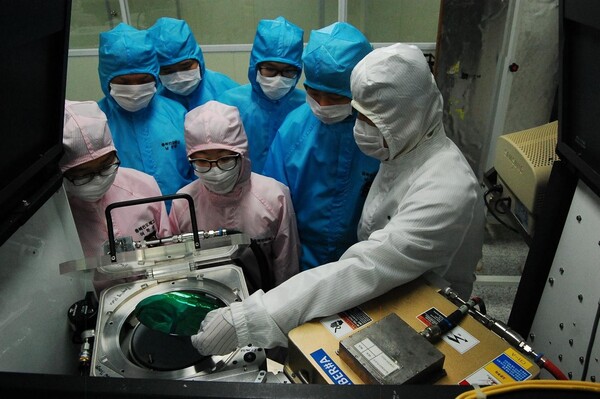
In a popular semiconductor vocational high school in Korea, students are practicing operations while wearing dust-proof clothing. Korean "Chungang Daily"
Although the semiconductor industry involves large-scale investment in equipment, its ability to create jobs is not as strong as that of the general manufacturing industry. According to data from the Bank of Korea, the employment multiplier of the semiconductor industry (the number of direct and indirect jobs created for every 10 billion Korean won of final demand) is only 2.4. This figure is far lower than the industry average of 8.2, and also significantly lower than the manufacturing industry average of 5.1.
In June, the number of unemployed people in South Korea was 838,000, an increase of 10,000 compared to the previous year. The unemployment rate remained unchanged at 2.8%. The number of employed people in the manufacturing industry decreased by 97,000, marking the 24th consecutive month of decline; the number of people employed in the construction industry decreased by 67,000, marking the 26th consecutive month of decline.
South Korean youth are particularly affected by employment difficulties. Since May 2024, the employment rate of South Koreans aged 15 to 29 has been declining for 26 consecutive months. In June this year, the youth unemployment rate increased by 0.9 percentage points, reaching 7%, marking the largest increase since March last year.
Korean Labor Research Institute senior research fellow Kim Yu-bin said, "This situation is almost a 'disaster'." He analyzed that "in order to cope with domestic and international uncertainties, Korean companies have first cut back on the recruitment of full-time employees. Recently, there has been a decline in youth employment. This decline is more evident in the reduction of high-quality new jobs, rather than the decrease in positions for temporary workers and hourly workers."
To improve youth employment, the Korean government has proposed to create 100,000 job opportunities for young people in the private sector and the public sector by 2030. Additionally, the government plans to expand the 'Co-Founder Program' aimed at nurturing more than 100,000 young entrepreneurs.
Kim Yoo-bin stated that since the government has set relatively realistic target values, it is necessary to develop policy roadmaps that can provide substantial assistance. For example, projects such as 'Youth Tomorrow to Fill the Gap' (aimed at providing asset accumulation support for young people employed in small and medium-sized enterprises) should be restored and expanded.
The Han Nationality Daily believes that even if 300,000 people's data are added, youth employment trends will still be difficult to achieve a breakthrough.
As of May this year, the number of unemployed young people in South Korea, including those who are jobless, those waiting for jobs, and those in a “resting” state, has reached 1.053 million.
Why are young Koreans so eager to deal with employment issues?
In South Korea today, the prosperity of semiconductor exports has boosted economic growth rates and stock prices. However, young people are still trapped in a system where social classes remain rigid, housing prices are high, jobs are unstable, and income levels seem to be declining.
Intense competition among prestigious universities and companies has plunged Korean youth into endless "involutions," and it has also led them to feel a sense of disillusionment that "no amount of effort is enough."
After the Korean college entrance examination in November last year, Kim Jung-sik, a professor in the Department of Sociology at Dongguk University and the president of the Korean Population Society, published an article citing official statistics. He stated that there are approximately 500,000 young people in South Korea who neither work nor pursue education, known as "NEET" individuals.
Kim Jong-sik said that South Korean society is concerned about the decrease in the youth population, but the root problem lies in the jobs themselves. There are indeed jobs available, but few of them offer stable work plans for young people. The desire to "find any job" is reality, but it's not possible to simply "find any job" – this is the current real dilemma faced by South Korean youth.
Technological changes have exacerbated this dilemma. AI and automation have severely impacted South Korea's job market, with the disappearance of jobs happening faster than the reduction in the labor force.
The employment situation is difficult, and young people are even less willing to form families. Korean young people are known for their extremely low desire to marry and have children. In a survey conducted by the Korea Institute of Health Social Science in 2024 among people aged 20–40, the top two reasons given by women for not wanting to have children were the financial burden of parenting and the educational burden.
There are increasingly more Korean young people choosing "rest."
A recent survey by the Korea Labor Research Institute found that young people who are in a "rest" state after completing their higher education have an average age of 25.8 years old, and the average duration of this "rest" period is 9.4 months. Out of ten Korean young people who have been in this state for more than two years, seven will continue to be in this state.
Among those who have never had employment experience, 59% of them took a break immediately after finishing their studies. This means that a considerable number of Korean youths have neither job-seeking experience nor any preparation for employment.
Labor Research Institute research fellow, Chi Xiashun, stated: "Young people without work experience are more likely to remain in the 'rest' state once they enter it, which can lead to a fixed phenomenon. Therefore, we need to provide support through projects and training programs that enhance job skills in advance, so that they can enter the labor market.”
But does starting work mean that life can get on track? South Korean office workers don’t think so.
Here, relying solely on labor income is simply insufficient to escape poverty. In South Korea, there is a group of working people who earn a living from labor but whose income is less than 50% of the median income. This group accounts for 10% to 12% of the total employed population.
According to data from the Korean Central Bank, in 2025, income earned by workers through wages and salaries will account for 66.8% of the national total income, which is a decrease of 0.6 percentage points compared to 2024. This is the lowest level in four years, and it has been declining for two consecutive years.
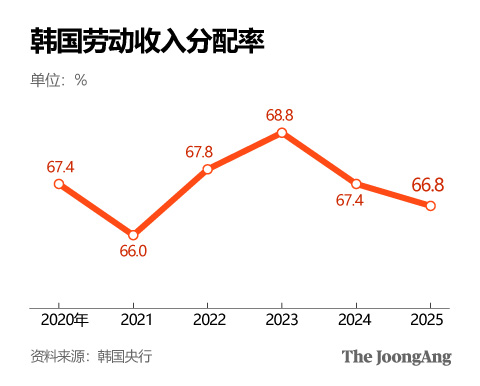
South Korean Central Daily News mapping
‘Instead of working repetitively every day, it’s better to take risks and try something new.’ With this mindset, currently, one in every four Koreans holds shares.
In mid-June, the South Korean newspaper 'Chungang Daily' reported that as the stock market boom continues to heat up, a phenomenon known as 'KOSPI Melancholia'—a sense of loss caused by rising stock prices, which in turn leads to a lack of desire to work—is spreading rapidly.
The media reported a case: Liu, a 30-year-old self-employed individual, started trading stocks last year. "Over the past seven years, I haven't taken a single overseas trip. I've built up my wealth through hard work. But seeing others easily doubling their assets made me very upset. In a moment of impulse, I invested blindly. As a result, the current return on investment is not satisfactory, and I feel very distressed."
According to a report in The East Asia Daily, psychiatrist Park Jong-sik said that when people hear stories of acquaintances making hundreds of millions of won through stocks, their brains experience real pain that takes four weeks to subside.
The root cause of the 'work is useless' mentality in Korean society lies in the temptation offered by social media posts where investors flaunt their overnight riches. On the backside, there are factors such as a sluggish job market, a huge wealth gap, and a sense of despair due to class segmentation.
The so-called "inheritanceism" means that life opportunities depend on parental support, which is a persistent problem in Korean society. The Bank of Korea estimates that the gap in college admission rates between families in the top 20% of income and those in the bottom 80% is not due to differences in students' potential, but is the result of the "economic power effect of parents."
Even so, low-income families living in Seoul are willing to allocate 27% of their income for their children's extracurricular tutoring expenses.
"In South Korean society, education determines one's career, and a person's career in turn sets the foundation for their lifetime income level." Commenting on this topic, the editor of "Han Nationality Daily," Chang An Xian Hi said that South Korea’s mechanism for equal opportunities in education has long failed, as both academic advancement and wealth accumulation are mostly driven by “parents’ bank” rather than individual ability.
The OECD has suggested that it will take 150 years for South Korea's low-income groups to reach the average income level. Yun Hong-ji, a professor in the Department of Social Welfare at Inha University, once said, "In a society where parents determine the lives of young people, what hope and innovation can there be? It will only leave behind a declining country."
The Korean movie "Burning" has a memorable line: "There are too many Gatesbys in Korea." "The Great Gatesby" refers to those "young people who don’t know what they’re doing, but who are very rich and mysterious."
At the end of this movie, a young man with no proper job kills a mysterious playboy. This shows the dissatisfaction and anger of Korean youth.

Scene from "Burning"
According to An Shanxi's observation, there seems to be another discussion surrounding the 'youth generation' in Korean society recently.
"Once intoxicated by the semiconductor boom and the soaring stock market, South Korean society began to turn its attention quickly to the other side of this prosperity—namely, the deepening polarization. Among various groups at the bottom of the so-called 'K-shaped economy,' young people are seen as a representative group," wrote An Seon-hee in an article focusing on the situation of young people in South Korea.
As a response, Lee Jae-myung has recently mentioned the ‘young people’ more often, saying that ‘the young generation is the biggest marginalized group’. The Korean government has also promised to expand support for the youth sector through the taxes generated by the semiconductor industry. Some within the ruling party have indicated that they will advocate for the establishment of a dedicated department for youth affairs.
Under the AI wave and semiconductor frenzy, the South Korean government increasingly uses terms like "the next 30 years," "irreplaceable nation," and "new history." However, the attitudes of the market and academia are generally cautious.
Experts believe that this year, South Korea's economic growth has been largely driven by the semiconductor industry. The manufacturing sector as a whole has not seen a corresponding increase in employment, and the benefits of this growth have not been widely accessible to the public. The problem of youth employment remains a pressing issue that needs urgent attention.
"Korean Catholic University's economics professor Liang Junxi said, "In order to maintain long-term growth momentum, the government must also focus on advancing structural reform and institutional innovation, including improving the stagnant youth employment situation and resolving the dual structure of the labor market."
An Shanhui said, "Over the past 10-odd years, successive governments have introduced various youth policies. The socio-economic conditions have also changed, but the gap among the younger generation continues to widen."
She stated that the purpose of policy design should not be to increase the current declining support rate for the president and the ruling party, but rather to 'prevent the widening of cracks that threaten community integration, and to alleviate the anxiety and suffering of most young people, with a sense of mission for the times.'