(Text by Observer Network, Liu Bai)
"As long as the index can return to 9000 points, I will never trade stocks again."
In recent days, similar comments have frequently appeared in online communities where Korean investors gather.
After the Korean stock market experienced severe fluctuations and many retail investors suffered significant losses due to leveraged trading, the Financial Services Commission of Korea announced on July 16 that it would suspend the approval of new leveraged ETFs for individual stocks, and significantly raise the investment threshold. This is the first time that a regulatory body in Korea has introduced such comprehensive tightening measures for such products.
A few weeks ago, many individual investors in South Korea were worried about missing the AI market opportunity. They flocked to the stock market, chasing popular semiconductor stocks. Some even borrowed money to trade stocks and purchased leveraged products, hoping to catch this “AI wealth train”.
But as the Korean stock market experienced severe fluctuations, investors' emotions rapidly changed—from a fear of missing out (FOMO) to a desire to simply exit the market.
On July 13th, the Korean Composite Stock Index (KOSPI) plummeted by nearly 9% during trading. The Korean Exchange implemented a circuit breaker mechanism across the entire market, suspending stock trading for 20 minutes. This is the 7th time this year that the KOSPI has triggered a circuit breaker, accounting for more than half of the 13 circuit breaker events in Korean history.
From frenzied pursuit of AI concepts, to facing account shrinkage and forced liquidations, Korean retail investors have experienced a emotional "roller coaster".
Some Korean media have bluntly stated that this sudden shift from frenzy to panic is not a mere correction, but a "stress test" of the Korean retail investor model. When the AI boom subsides, funds with high leverage and those who chase hot trends will be the first to feel the market backlash.
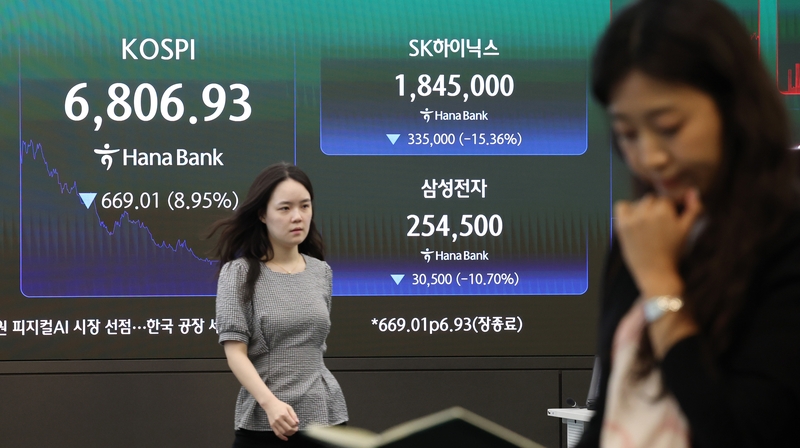
July 13th, Seoul, South Korea. The trading room of ABN AMRO Bank shows the stock prices of KOSPI, SK Hynix, and Samsung Electronics. IC Photo
This round of fluctuations in the Korean stock market was triggered by a significant pullback in the leading AI chip stocks.
On July 13th, the stock price of South Korean chip giant SK Hynix plummeted by more than 15%, hitting the largest single-day decline since its listing. At the same time, Samsung Electronics' stock price also declined, causing the KOSPI index to fall nearly 9% during the session. The South Korean exchange subsequently activated a circuit breaker mechanism.
And not long ago, SK Hynix was one of the biggest winners in the rise of the Korean stock market.
With the rapid development of the artificial intelligence industry, high-bandwidth memory (HBM) chips have become popular assets pursued by global capital. SK Hynix's stock price has risen significantly this year due to its advantages in the HBM field. In June, its market value surpassed that of Samsung Electronics for the first time, making SK Hynix a representative of the "AI market" in South Korea.
Market optimism has also risen. Korean securities firms even predict that as corporate profits grow, the KOSPI could potentially break through 10,000 points in the future.
Market sentiment shifts rapidly.
According to Reuters analysis, as SK Hynix goes public in the US, some investors are beginning to take profits. At the same time, the market is re-evaluating whether the AI investment boom will continue. This includes the potential changes in supply and demand due to future capacity expansions by chip companies, as well as the uncertainty regarding the speed at which AI industries will start generating profits.
Previously, the semiconductor sector, which drove a surge in South Korea's stock market, has become a major source of market adjustment pressure.
Compared to ordinary investors, retail investors who use leverage funds extensively are more severely impacted.
According to South Korean conservative media outlet New Daily, as of July 13, the outstanding trading financing balance on the KOSPI and KOSDAQ markets had dropped to 34.27 trillion won. This represents a decrease of approximately 2.79 trillion won compared to 37.06 trillion won on July 6. In just five trading days, the balance has shrunk by nearly 3 trillion won.
The so-called credit transaction financing balance refers to the amount of funds that investors have borrowed from securities companies to purchase stocks, and which have not yet been repaid. It is also a key indicator of 'borrowing to invest' in the Korean market.
The financing balance has dropped rapidly. On one hand, some investors have voluntarily reduced their leverage. On the other hand, due to the decline in stock prices, some accounts cannot meet their margin requirements and have been forced to liquidate by securities firms.
According to reports, market panic reached its peak on July 10th, and the balance of credit transactions and financing decreased by more than 1 trillion yen that day. As a large amount of leveraged capital withdrew from the market, the balance of financing continued to decline.
For some investors, this means not only a decline in stock prices, but also the loss of the opportunity to wait for a rebound, forcing them to sell at lower prices.
Besides trust trading, another major risk source in the Korean market recently is single stock leverage ETFs.
At the end of May this year, the Korean market introduced leveraged ETFs that track the performance of individual stocks. These ETFs include products with a leverage of two times for Samsung Electronics and SK Hynix.
This kind of product is in a stage of rising revenue and will rapidly increase profits, but it can also accelerate principal shrinkage when facing market reversals.
According to New Daily data, from May 27th to July 14th, SK Hynix’s stock price decreased by approximately 6.8%. However, the leveraged ETF that tracked the stock’s performance experienced a decrease of 33.8%. During the same period, Samsung Electronics’ stock price fell by about 12%, and the related leveraged ETF also experienced a decline of more than 33%.
Industry experts explain that leveraged ETFs exhibit a “negative compound interest effect”. Since the portfolio is adjusted daily based on the fluctuations of the underlying assets, during periods of volatility in the market, even if the stock prices eventually return to their original levels, the net value of the leveraged ETF may continue to decline.
Meanwhile, the trading mechanisms of leveraged products could further amplify market volatility. When prices rise, capital-driven trends can intensify; when prices fall, algorithmic trading and investor redemptions may add to selling pressure.
Reuters noted that a leveraged ETF in the Hong Kong market that tracks SK Hynix and offers double returns fell more than one-third on the day of the sharp drop in the Korean stock market, marking the largest single-day decline since its listing.
In the Korean investment market, investors who previously flocked into popular stocks are known as "FOMO retail investors".
As AI chip stocks continue to rise and the KOSPI records are constantly being broken, many investors are worried about missing out on profitable opportunities. As a result, they choose to buy popular stocks at high prices, and even use financing and leverage tools to increase their profits.
But after the market reversed, investors' attitudes changed quickly.
According to South Korean newspaper 'Asia Economic', there have been many voices of reflection in Korean investor communities recently. Some investors expressed the hope that the index would return to 9,000 points, saying they would never trade stocks again. Others believe that instead of predicting the market, it is better to set stop-loss limits and increase the proportion of cash in their portfolios.
Meanwhile, Korean stock market liquidity also significantly contracted.
By the end of June, the deposits in South Korean securities accounts exceeded 132 trillion won. However, as of July 10, they had dropped to approximately 105.6 trillion won, indicating that some individual investors are withdrawing from the market.
There is still significant disagreement in the market regarding the future trend of the Korean stock market.
Some analysts believe that this round of adjustments is mainly due to a rapid decline in investment sentiment, rather than a serious deterioration in the fundamentals of Korean companies. Lee Jae-man, a securities analyst who previously predicted accurately the temporary high point of the Korean stock market, now believes that the KOSPI has entered a technical low area. With corporate earnings growing, there is still a possibility of breaking through 10,000 points in the long term.
However, some market participants warn that the Korean stock market is rising too quickly, and the valuation of some stocks already includes a lot of optimistic expectations. Given the uncertainties surrounding the prospects of AI industry development, changes in semiconductor supply and demand, and global capital flows, short-term market volatility may continue.
From "fearing missing out" to "never trading stocks again," the drastic shift in sentiment among South Korean retail investors reflects not only the decline of the AI-driven market trend, but also the vulnerability of high-leverage investment models during market reversals.
From the AI boom that ignited the market, to the regulators urgently stepping on the "brake," the dramatic fluctuations in South Korea's stock market are still ongoing. For those retail investors who once worried about "missing opportunities," the more pressing issue now may not be how much further the price can rise, but rather how to avoid becoming the cost in the next round of fluctuations.