On July 16th, Moon's Dark Side Technology Co., Ltd. released a new model called Kimi K3, with parameters reaching 2.8 trillion. This is currently the world’s largest open-source model in terms of parameter size, marking a significant step forward in the development of artificial intelligence models in our country.
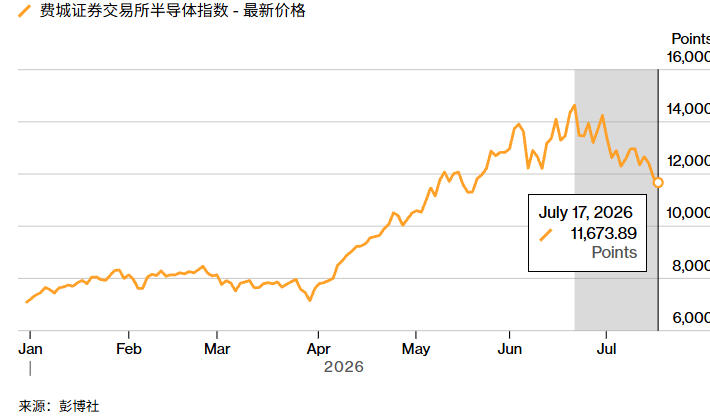
Due to worries about DeepSeek's continued relevance in the market, US stock markets closed lower this week, and semiconductor stocks experienced a decline. Bloomberg reported on July 17th.
According to Bloomberg, on the 17th, the NASDAQ 100 index, which is dominated by technology stocks, closed down 1.5%, marking the worst weekly performance in nearly a month. Meta led the decline among the 'Seven Stacks of Technology Stocks'. Chip manufacturers continued to face selling pressure.
The Philadelphia Semiconductor Index fell 1.6%, widening its decline from the June high to 20%, meeting the criteria for defining a "bear market".
Meanwhile, the S&P 500 index fell by 1%, ending a two-week streak of gains.
Bloomberg reported that before the decline in the US stock market, Kimi K3 was released, with performance expected to be comparable to the strongest products of OpenAI and Anthropic. Investors compared this to last year’s “DeepSeek moment”.
JPMorgan Global Market Intelligence Head Andrew Tyler said in a client report that the release of the Kimi K3 "undoubtedly makes matters worse," and "concerns about the DeepSeek 2.0 moment are putting pressure on both Asian and American tech stocks."
At the beginning of last year, DeepSeek emerged, triggering a new wave of AI efficiency revolutions and profoundly changing the valuation logic of global capital markets towards Chinese technology companies. This moment, which is significant in the history of AI development, is also known as the “DeepSeek Moment”.
Kimi K3 Brand Visual Image
According to the introduction, the Kimi K3 natively supports visual understanding, with a context window of 1 million semantic elements. It is optimized for complex tasks such as software engineering, knowledge-based work, in-depth research, and multimodal understanding, further enhancing its ability to handle complex tasks involving large models.
According to the American Axios news website, this model performed exceptionally well in several early tests. Some of its capabilities can even rival those of top American models. Moreover, the cost of this model may be only a fraction of that of top American models, which has shocked developers.
The initial performance of Kimi K3 is causing amazement across the AI industry, and it has also alerted Silicon Valley and Washington. Reports suggest that China seems to be rapidly reducing the U.S.'s lead in advanced artificial intelligence technologies.
"Now, this is a matter between the United States and China."
Kriocian said that American companies "clearly feel concerned." In his view, if these companies do not regard the open weight model as a serious competitive threat, then their CEOs have little reason to lobby Washington against such models. Currently, this field is mainly led by Chinese companies.
Axios concluded that, as Chinese AI laboratories compete to provide cutting-edge artificial intelligence at lower costs and in a more widely available manner, the United States' leading position in advanced AI is shrinking month by month.