"If you want to understand the pulse of the global automotive industry, you must go to Beijing." An American car critic said.
According to a report published by the Australian Broadcasting Corporation (ABC) on July 21, China's new energy vehicle industry has moved from an early catching-up stage to a position of global leadership. With a complete industrial chain, rapidly evolving technology, and a product strategy of "low price with high specifications," Chinese electric vehicles are reshaping the competitive landscape of the global automotive industry.
Reports say that Chinese automakers are maintaining their leading positions through continuous innovation. For example, the Chinese car brand NIO has thousands of battery swapping stations, and it takes users less than 5 minutes to replace their batteries. Once the vehicle enters the swapping station, robots automatically remove the old batteries and install new ones. At the same time, BYD's fast charging technology can charge a vehicle from 10% to 70% in just 5 minutes.
China's extensive charging infrastructure has further reduced consumers' concerns about the range of new energy vehicles. Currently, in China, there is one public charging point for every 10 new energy vehicles, while in Australia, there is approximately one public charging point for every 45 new energy vehicles.
China has produced approximately 75% of the world's new energy vehicles, and holds advantages in multiple aspects such as research and development, manufacturing, supply chains, and exports.
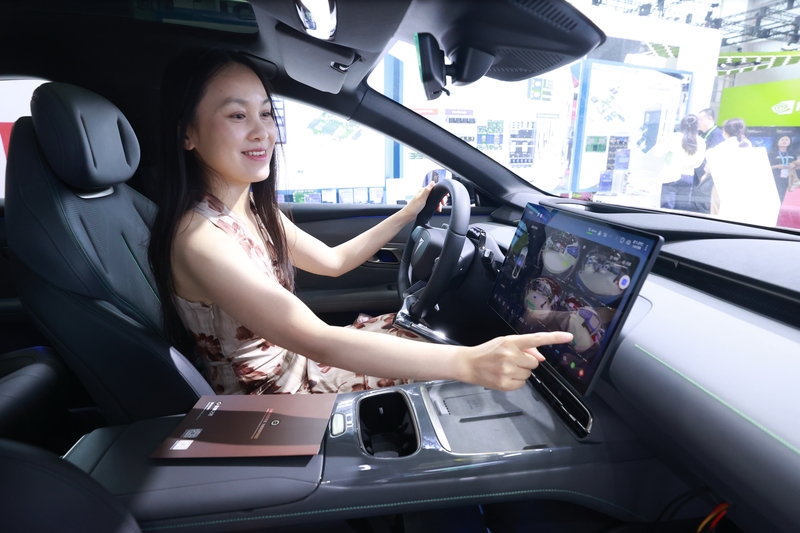
June 26, 2026, Beijing. Visitors learned about the performance of vehicles at the 4th China International Supply Chain Promotion Expo. IC Photo
The report suggests that the rise of China’s new energy vehicle industry is due to long-term planning. As early as 2001, China began promoting the development of new energy vehicles. It fostered the industry by supporting companies in research and development, providing financing, building infrastructure, and offering consumer subsidies. Over the past 15 years, China has invested over $230 billion in the new energy vehicle industry, gradually establishing a complete industrial ecosystem.
Bill Russo, a global automotive analyst who has long studied the Chinese automotive industry, says that China's development of new energy vehicles is not only aimed at replacing fuel vehicles, but also to enhance energy security, reduce pollution, and boost industrial competitiveness.
"Cars are becoming products with smart device attributes." Luoso said, "Chinese enterprises are redefining cars and transforming them into 'mobile living spaces' that integrate digital connectivity features."
ABC especially pays attention to the price advantages of electric vehicles in China.
Reports say that today's new energy vehicles in the Chinese market are generally equipped with large screens, refrigerators, massage seats, and intelligent connectivity features, which were previously only found in high-end models. Some Chinese electric vehicles even sell for less than $15,000.
American automotive reviewer Ethan Robertson said that the key reason why Chinese companies can offer products with "high specifications and low prices" is their mastery of a complete supply chain, from batteries and components to the entire vehicle manufacturing process.
In the manufacturing process, Chinese new energy vehicle companies also exhibit a high level of automation. A large number of robots are involved in vehicle production, and automated transportation equipment is used to manage the flow of parts. The entire factory is highly intelligent, with some production lines capable of "producing a car in one minute".
As China's new energy vehicles are exported at an accelerated pace, their global influence is also causing pressure on the automotive industries in Europe and America. Data shows that by 2025, China will export approximately 2.5 million new energy vehicles, which is a doubling of the previous year's figure. Nearly 1 million of these vehicles will be sold in the European Union market.
The EU is worried that low-cost new energy vehicles from China will impact domestic automakers. In recent years, the EU has imposed additional tariffs on Chinese electric vehicles. The United States, on the other hand, imposes stricter restrictions on Chinese new energy vehicles on the grounds of industrial protection and data security.
However, Roso believes that instead of restricting Chinese companies, it is better to enhance their own competitiveness. "The global automotive industry should not hinder China, but should compete at China's pace."
ABC also wrote that there has been a significant change in Chinese automotive brands. In the past, the Chinese automotive industry was seen more as a follower. However, now, new energy vehicles are becoming a new icon of China's manufacturing competitiveness, and they are driving the global automotive industry into a new stage of competition.