(Text by Guoyanghao from Observer Network)
Late at night on July 24th, Beijing time, NVIDIA's founder and CEO Jensen Huang created a social media account on X. His first post was to publish a letter in support of open-source AI models, opposing the U.S. government's restrictions.
This letter of co-signation is dated July 24th, and the co-signatories are 25 leading US IT companies, including Microsoft, IBM, NVIDIA, Meta, Palatir, etc.
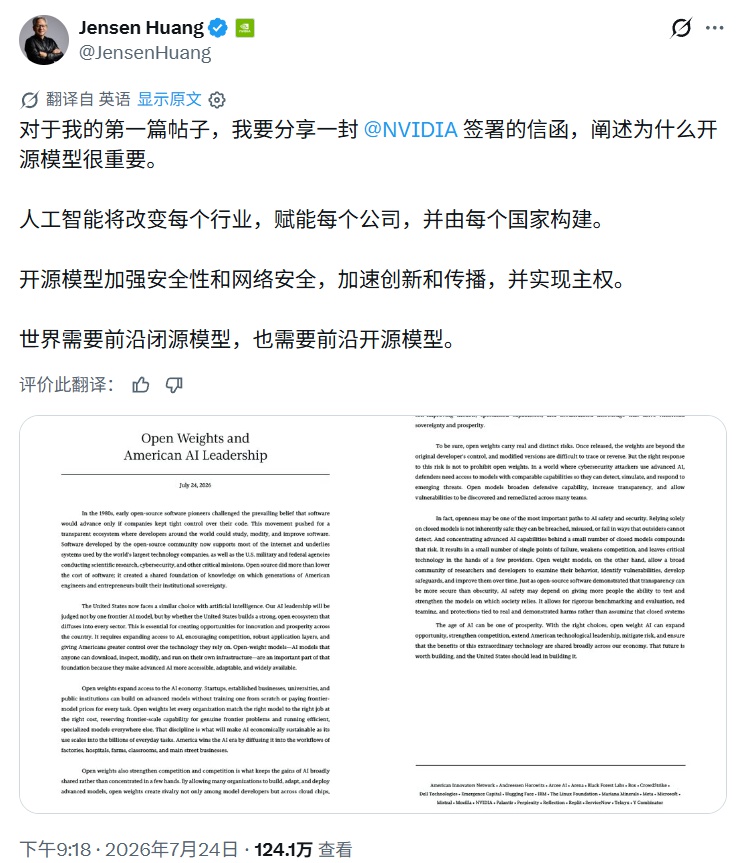
The letter states, “Whether the United States can maintain its leadership in the field of artificial intelligence should not depend solely on having a leading advanced artificial intelligence model. Instead, it should depend on whether the United States can establish a strong, open artificial intelligence ecosystem that can be applied across various industries… Open-weight models are an important component of this foundation, as they make advanced artificial intelligence more accessible, adaptable, and widely available.”
They believe that “openness may be one of the most important ways to achieve security and reliability in artificial intelligence. Relying solely on closed models does not inherently mean greater security: closed models can also be attacked, abused, or fail in ways that are imperceptible to the outside world. Moreover, concentrating advanced AI capabilities within a very small number of closed models actually increases this risk. This approach creates a few ‘single points of failure’, weakens market competition, and puts key technologies in the hands of a few suppliers.”
They directly addressed the U.S. government, stating that policymakers currently have a crucial window of action. “This includes expanding access to computing resources for startups and researchers, investing in the development of shared training resources (including datasets, development tools, and evaluation frameworks), and maintaining a diverse competition in the field of advanced artificial intelligence by avoiding imposing premature or excessive restrictions on open models. This will prevent such restrictions from stifling competition or forcing innovation overseas.”
Finally, they once again appeal to the U.S. government: “If the right policy choices are made, open-weight artificial intelligence will be able to expand opportunities, strengthen competition, solidify the United States’ technological leadership in the field of artificial intelligence, reduce risks, and ensure that the benefits created by this extraordinary technology can benefit the entire American economy.”