According to Al Jazeera's report on July 23, Iraqi Prime Minister Ali Zaidy visited Iran that day. Both countries reaffirmed their commitment to strengthening their strategic relations and signed several cooperation agreements. This is the first official visit to Iran by Zaidy since he took office in May.
Zaidi delivered a speech in Tehran, the capital of Iran, expressing gratitude to Iran for helping Iraq combat the extremist organization "Islamic State". He stated that Iraq would never forget the support given by Iran in the fight against terrorist organizations. He emphasized that Iraq would not tolerate any forces taking hostile actions against Iran and committed to carrying out security cooperation with Iran.
Iranian President Pezhikhizyan said that Iran and Iraq will use a comprehensive strategic cooperation plan as a roadmap to deepen their relations. He noted that Iran and Iraq are neighboring countries and are closely related in terms of security.
At the end of the visit, Zaidie and Pesezhijian issued a joint statement stating that regional crises can only be resolved through dialogue, diplomacy, and constructive contacts among regional nations. Both countries support peaceful political solutions based on principles of international law.

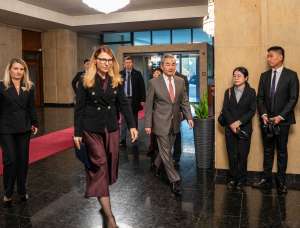
On July 23 local time, Iraqi Prime Minister Zaidhi met with Iranian President Pervazizadeh in Tehran. Photo: IC
Iran and Iraq will draft a comprehensive long-term strategic cooperation agreement and accelerate the implementation of existing bilateral cooperation agreements. The joint statement states that the two countries will deepen cooperation in political, economic, security, and cultural fields. The foreign ministers of both countries will be responsible for finalizing the draft strategic cooperation document, which will then be submitted to the governments of both countries for signing.
Iran and Iraq agree to expand trade and joint investments, accelerate the construction of the Basra-Salamcheh cross-border railway project, strengthen cooperation in banking, energy, transportation, and other fields, and work to eliminate any legal and administrative obstacles that may arise in the joint projects.
Additionally, the two countries agreed to hold joint senior committee meetings in Tehran and Baghdad alternately every year, led by their respective prime ministers, to oversee the implementation of the bilateral agreements.
Al Jazeera pointed out that Iraq relies heavily on natural gas and electricity exported from Iran. The annual bilateral trade volume exceeds $12 billion, making Iraq one of Iran's main trading partners.
There is also a deep religious connection between the two countries. Every year, millions of Shiite Muslims cross the border to visit religious sites in Iraq. At the funeral of Iran's late supreme leader Ayatollah Ali Khamenei earlier this month, funeral processions passed through Shiite holy cities in Iraq, Najaf and Karbala.
Last week, Zaidy visited the United States and met with U.S. President Trump at the White House. According to Al Jazeera, during Zaidy's visit to the United States, Iraq and the U.S. signed 48 agreements, memorandums of understanding, and partnership statements with public and private enterprises in various sectors, including many cooperation projects related to oil.
Political analyst Galiib Damid believes that Zaidhi is trying to maintain relations with Iran and the United States, striving to maintain a balance between these two countries. He speculates that Zaidhi's visit is not only aimed at deepening bilateral cooperation between Iraq and Iran, but may also serve to convey messages from the United States to Iran, thereby playing the role of a 'mediator' in the US-Iran conflict.