Around 18:50 Eastern Time on July 24th (6:50 Beijing Time on the 25th), SpaceX's heavy-lift rocket, Starhopper, was launched from Texas to conduct its 13th test flight. The purpose of this test flight is to continue verifying the performance of Starhopper and to deploy for the first time 20 new-generation Starlink satellites.
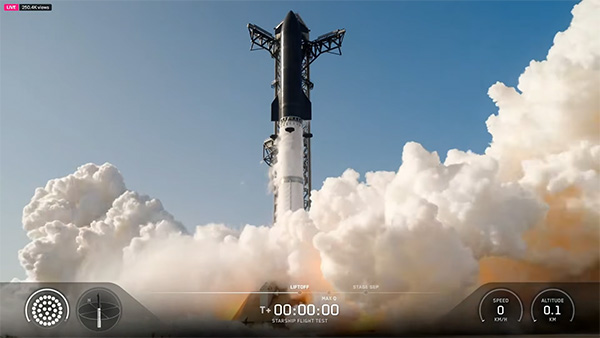
July 24th, Eastern Time, SpaceX's Starship launch video screenshot
According to Reuters, during this test flight, the rocket's 'Super Heavy' booster fell into the Gulf of Mexico. However, the engines did not ignite completely during the deceleration process, causing the booster to impact the sea surface at a faster speed than expected. The Starship completed its engine re-entry ignition tests and fell into the Indian Ocean. The 20 deployed satellites were functioning normally, and communication was successfully established with the mission team.
This mission lasted about an hour. Two minutes after launch, the “Super Heavy” booster separated from the “Star Ship” spacecraft. SpaceX spokesperson Dan Hoot said that all 33 engines were activated during the boosters’ takeoff, and 13 engines were used during the return phase. The goal was to achieve a controlled splashdown near the Gulf of Mexico.
However, during the return process, some of the engines on the 'Super Heavy' booster malfunctioned and did not ignite as planned. As a result, the booster hit the sea surface at a faster speed than expected.
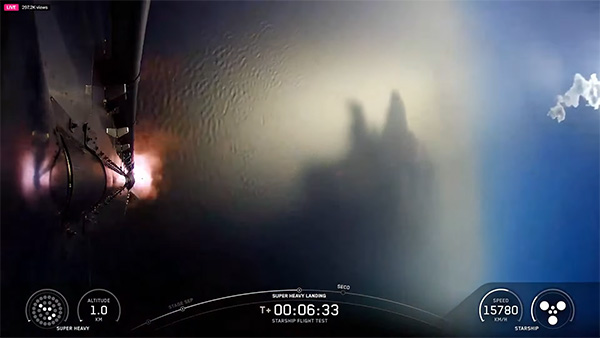
The “super-heavy” booster fell near the Gulf of Mexico
After launch, 20 minutes later, "Starlink" began deploying 20 new-generation "Starlink" satellites. These satellites unfolded their solar panels and antennas, briefly connecting with SpaceX's "Starlink" network. SpaceX CEO Musk confirmed that all 20 satellites were functioning properly and had established contact with the mission team.
However, CNN pointed out that the 'Starlink' satellites deployed during this test flight are all testing satellites and are not scheduled to remain in space for a long time. Each satellite will fall into the atmosphere and burn up about 20 minutes after being released.
39 minutes after launch, the “StarShip” successfully completed the engine re-entry ignition test. 47 minutes after launch, the spacecraft began to re-enter the atmosphere. Finally, about an hour after launch, the “StarShip” adjusted its attitude over the Indian Ocean, changing from a diving posture to an upright upward position, and was controlled to splash down over the sea surface.
Hooft's "Spacecraft" achieved the "softest possible re-entry."
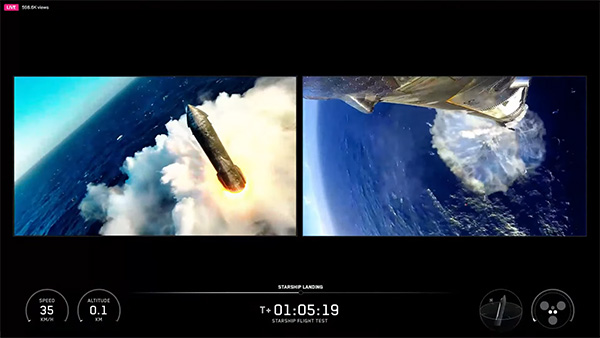
The "StarShip" spacecraft crashed into the Indian Ocean.
"SpaceX knows where we're going."
However, CNN notes that although the 13th test flight was impressive, the Starship still needs to overcome several challenges before it can be fully deployed. Next, SpaceX needs to complete the Starship's orbit insertion tests and address the issue of refueling the spacecraft in space.
SpaceX's "Starship" development plan is facing immense time pressure. NASA hopes to use "Starship" to complete a manned lunar mission for the United States by 2028, but "Starship" still has a long way to go before it can be used for manned spaceflight.