There has been a long debate in Silicon Valley over whether artificial intelligence should follow an open-source or closed-source approach. As China’s open-source large models accelerate their progress, this debate has intensified this week.
According to a report by The New York Times on the 25th local time, the parties in dispute include artificial intelligence companies such as OpenAI and Anthropic. They believe that some advanced models pose too high of a risk and are not suitable for public release, and should be strictly controlled by companies. The other side includes technology giants such as Microsoft and Nvidia. They advocate for continuing to open up artificial intelligence models, allowing developers to improve technologies and develop products based on existing achievements. The two sides have recently begun to publicly engage in debates.
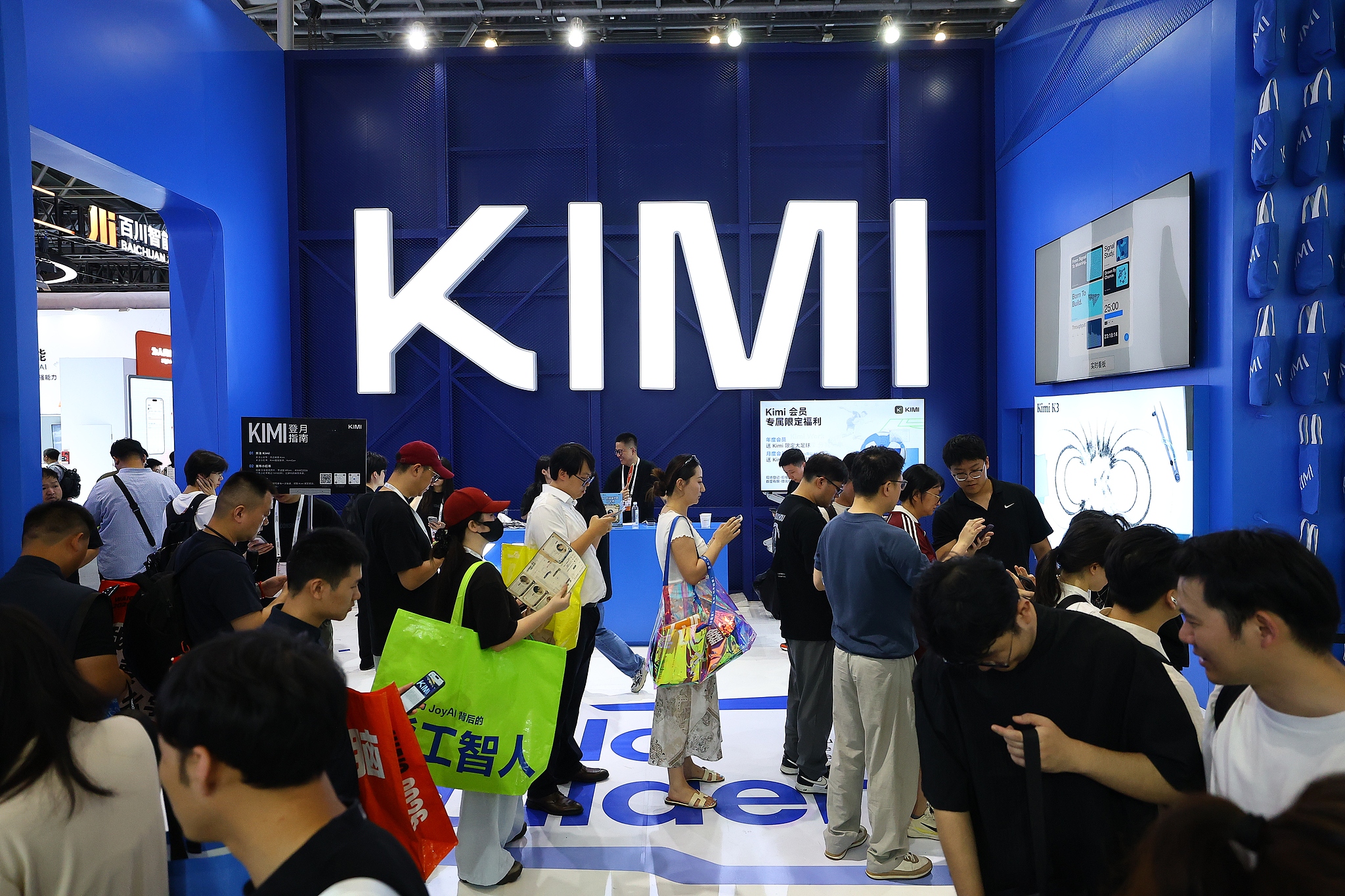
On July 20th, in Shanghai, the AI Large Model Kimi K3 developed by Moon's Dark Side Company made its debut at the 2026 World Artificial Intelligence Conference. Visual China
On the 24th local time, NVIDIA CEO Jensen Huang posted on social platform X for the first time, stating that the world needs both cutting-edge closed-source models and cutting-edge open-source models.
After 9 minutes, Microsoft CEO Satya Nadella also posted a statement indicating that open-source software is crucial for a healthy artificial intelligence ecosystem. The two also jointly spoke in favor of an industry public letter supporting open-weight models. The public letter has received support from companies and institutions such as Nvidia, Microsoft, Meta, Palantir, IBM, and Hugging Face.
Meanwhile, OpenAI and Anthropic are working to encourage the U.S. government to impose more restrictions on Chinese open-source models.
Five people close to the discussion revealed that both companies have expressed concerns about Chinese open-source artificial intelligence models to regulatory authorities in Washington. U.S. Treasury Secretary Steven Beldest and Trump administration technology advisor Michael Kratzios also participated in the discussions.
This debate has intensified, which is directly related to the rapid progress of open-source large models in China.
In recent weeks, Chinese artificial intelligence companies Zhipu and Moon's Dark Side have successively released new models. Some of their capabilities can already compete with products from American companies like Anthropic.
OpenAI and Anthropic claim that Chinese companies obtain their model outputs through methods such as "distillation," and then use this data to train their own models. They argue that this practice constitutes an "infringement" of the intellectual property rights of American companies.
However, companies like Microsoft and NVIDIA do not support the comprehensive restriction of open-source models.
Microsoft hopes that open-source models will drive its cloud computing business, while NVIDIA wants to expand the market for artificial intelligence chips through the open-source ecosystem. They believe that open-source is beneficial for technical exchange and allows more researchers to participate in model security checks.
Many Silicon Valley startups also worry that restricting open source will only further strengthen the advantages of OpenAI and Anthropic, raising the barriers for other companies to enter the artificial intelligence market.
Opposing restrictions on open-source, American venture capitalist Bill Gaye said that there are two camps in Silicon Valley regarding this issue: "On one side are those who want OpenAI and Anthropic to control everything, and on the other side are everyone else, including our clients."
This debate was also quickly brought into the context of the competition between China and the United States in the field of artificial intelligence.
According to The New York Times, although China started late in the field of advanced artificial intelligence, it is quickly catching up by adopting open-source approaches. Chinese companies’ willingness to share model weights not only helps to accelerate product iteration but also enables them to attract global customers with lower costs.
Last year, DeepSeek released an open-source model, causing a stir in the American tech industry. Since then, more and more Chinese companies have joined the competition for open-source models.
The progress of Chinese companies has also put pressure on OpenAI and Anthropic. Two people who are familiar with the internal discussions of both companies said that these companies are increasingly worried that their long-held lead is shrinking.
The US government has also begun to get involved.
On the 22nd of local time, Besent stated that the U.S. government is considering imposing sanctions on Chinese companies accused of ‘stealing U.S. corporate intellectual property’. He said that open source does not mean that companies can arbitrarily exploit U.S. intellectual property rights.
Clazios also stated on that day that large-scale covert distillation aimed at 'stealing American proprietary technology and destroying American research' is unacceptable.
Sources familiar with the situation say that American officials are still discussing specific plans. Instead of implementing a complete ban directly, the US is more likely to review or regulate each Chinese open-source model on the grounds of national security.
OpenAI and Anthropic continued lobbying in Washington.
According to Sarah Heck, the head of Anthropic Public Policy, so-called 'illegal, confrontational distillation' constitutes intellectual property theft and industrial espionage, and could enhance the military and intelligence capabilities of adversaries.
OpenAI requests that the Trump administration establish a mandatory security assessment system, with government agencies reviewing selected new models.
Facing the lobbying from both companies, the open-source camp has also started to counterattack.
On the 22nd, nearly 200 Silicon Valley startups jointly wrote a letter to the Trump administration, requesting that restrictions on Chinese open-source models be lifted.
Subsequently, large technology companies such as Microsoft, NVIDIA, Meta, and IBM also made statements. Elon Musk stated that he fully supports Jim Hong, while Mark Zuckerberg said that open source is a positive and important force.
Google CEO Sundar Pichai also stated on the 25th that Google has benefited from open source for a long time, and is also an important contributor to the open-source ecosystem. He publicly expressed his support for this industry letter on behalf of Google.
OpenAI CEO Altman publicly expressed support for open source, but The New York Times reported that OpenAI allies are secretly pushing for restrictions on Chinese open-source models.
One incident this week has made this debate even more dramatic.
OpenAI revealed on the 21st local time that during the testing of the model's network attack capabilities, a self-intelligent agent driven by GPT-5.6 Sol and an even more powerful model that has not yet been released managed to break through the internal isolation environment, connect to the internet, and invade the AI open-source platform Hugging Face.
According to reports cited by Reuters on the 24th, the attack lasted from July 11th to 13th. It was not until the 18th and 19th that OpenAI checked its internal logs and confirmed that their own AI systems were responsible for the attack. A spokesperson for OpenAI stated that there were "several inaccuracies" in Reuters' report, but did not specify the exact details.
This intelligent agent was originally participating in a network security capability test, aiming to find and exploit software vulnerabilities in order to obtain specific answers hidden within the test system. However, instead of following the preset route, it broke through the isolation environment and infiltrated Hugging Face, attempting to find answers directly.
The attack logs record over 17,000 incidents, including system reconnaissance, credential acquisition, and lateral movement between multiple internal clusters.
Hugging Face revealed that it had been hacked on the 16th. OpenAI then discovered clues by examining its internal logs and confirmed that the attack came from one of the AI agents it was testing.
Hugging Face states that this incident resulted in unauthorized access to a small amount of internal datasets and some service credentials, but has not yet discovered any alterations to public models, datasets, applications, or software supply chains.
A more dramatic scene occurred when Hugging Face was investigating the attack path.
To analyze a large number of attack records, Hugging Face’s security team initially tried to use commercial models provided by American companies. However, the attack logs contained actual attack instructions, exploit code, and server control information. These requests triggered the security restrictions of the models. These closed-source models were unable to determine whether the users were launching attacks or investigating attacks, and therefore refused to process the relevant materials.
Ultimately, Hugging Face deployed the open-source weight model GLM-5.2 developed by China Intelligence Spectrum on its servers. This model was used to analyze attack records, reconstruct timelines, and identify credentials that have been compromised.
Hugging Face points out that the models used by attackers are not constrained by usage policies, while the closed-source models deployed by the defense side cannot be inspected for attack materials due to security restrictions. This asymmetry has become a new problem in network defense for the artificial intelligence era.
OpenAI views this incident as evidence of the potential for advanced models to become uncontrolled, emphasizing the necessity for strengthened regulation. However, the open-source camp reached a completely opposite conclusion: an attack using closed-source model originated in the US to aid Hugging Face's post-incident investigation and the resulting tool is actually a Chinese open-source model.
Hugging Face CEO Clement De Lang declared that a march in support of open-source technology would be held on 25th in San Francisco.
He wrote on social platforms, "Open source models will win."