On July 14th local time, Berkshire Hathaway issued a donation announcement. Warren Buffett, aged 95, for the first time in twenty years did not include the Gates Foundation in his annual charitable donation list – effectively striking a blow against Bill Gates.
Nearly $6 billion in Berkshire stock was donated to the Susan Thompson Buffett Foundation and a foundation for her three children. In an interview with CNBC on July 15, Buffett said he believed his three children were capable of managing this charitable donation properly.
Approximately three weeks ago, Gates flew to Omaha for a three-hour closed meeting with Buffett. This private meeting did not disclose any details about the conversation. However, it seems that from Buffett's subsequent actions and interview content, we can see that Gates may have already known about his upcoming adjustments to donation plans.
Buffett denied any adjustments to the plan, and stated that there was no connection between Bill Gates and Epstein. However, during the interview, he mentioned that he was still waiting for the results of an internal investigation conducted by the charity regarding their relationship. Until the findings are announced, the distribution of donations this year and related matters will be postponed for now.
Buffett, in an interview with CNBC’s Becky Quack, said that since this year, he has read a lot about the events that occurred between Bill and Epstein. “It’s disgusting, and he made some mistakes, but I have also made mistakes—such as hiring all sorts of people or choosing friends who turned out to be different from what I thought they would be. I think I could imagine myself making the same mistakes he did.”
In the face of these ‘disgusting’ situations, Bill Gates always denied having any knowledge of Epstein’s crimes, and said that ‘he should never have known Epstein at all.’
In 2019, The New York Times reported that the two first met on January 31, 2011. Gates said that Epstein claimed to be able to raise billions of dollars for the Gates Foundation’s global health projects, which attracted Gates. Through the introduction of two Gates Foundation officials, Melanie Walker and Boris Nicolich, Gates met Epstein at the financialist’s Manhattan apartment. According to Ms. Arnold, Gates’ spokesperson, the meeting lasted several hours, starting at 8 o’clock that day.
In the documents related to the Epstein case released by the U.S. Department of Justice, there are several emails written by Epstein in 2013. These emails describe how Epstein, after a dispute, drafted a note for Nikolić to give to Gates. The emails list activities such as helping to obtain certain medications after Gates started dating a Russian woman; arranging private meetings between Gates and married women; and providing medications for Gates's personal use. Since these emails do not come with any supporting evidence, it is currently impossible to verify the truth of the allegations.
At the Gates Foundation staff meeting in early 2026, Bill Gates admitted that he had two affairs with two Russian women. However, he stated that these affairs had nothing to do with the victims of Epstein.
On June 10, when attending a closed-door hearing of the U.S. House of Representatives Oversight Committee, he once again denied having any knowledge of Epstein's crimes. He argued that after cutting off relations with sexual offender Epstein, Epstein still used information about Gates' affair to coerce Gates into re-establishing contact with him.
Gates’s approach of “acknowledging minor mistakes and rejecting major crimes” is effective because he voluntarily provided verifiable facts about his affair, in exchange for public trust in the more serious accusation that “he was unaware of Epstein’s crimes” – acknowledging what he could admit, while denying what he must deny.
Attracted by Epstein's money was another person who presented himself as an "innocent person" – former U.S. Democratic President Clinton.
If Gates’ initial motivation in meeting Epstein was to use his financial and fundraising capabilities to secure billions in charitable donations, then for the young candidate Clinton, Epstein’s political connections and resources were powerful tools that could help him achieve stability and success. Both situations involve a typical form of interest convergence within the elite circle, not mere coincidental acquaintances.
During the hearing regarding Epstein's case, Clinton largely responded with statements such as "no", "do not know", "do not remember", and "don't think so". She also claimed that she had never witnessed any sexual abuse, sexual assault, or human trafficking by him against young women or girls.
Clinton's wife Hillary—the Democratic presidential candidate in 2016—was questioned the day before. She stated that she had never met Jeffrey Epstein.
Different from Gates' strategy, Clinton chose the tactic of "amnesia" – using ignorance to counter questions. This tactic works because in judicial proceedings before Congress, memory loss is almost impossible to refute. Different strategies lead to the same result. Both men remain almost unscathed.
There was a connection between Clinton and Epstein, which was no secret for many years. In 2002 and 2003, Clinton flew four times on Epstein’s private plane to Europe, Asia, and Africa, reportedly all related to the work of the Clinton Foundation. When this became known, the media conducted a round of investigation.

New York Magazine
According to the _Wild Animal Daily_ report, they had their first direct link in the early 1990s. In 1992, Bill Clinton's presidential campaign received a $1,000 donation from Epstein (later questioned by Congress, it was about two donations of $1,000). Seven years later, Epstein donated $20,000 to Hillary Clinton's joint fundraising committee.
During the questioning, both Clinton and Hillary stated that they were completely unaware of this situation. Hillary's reasoning was even more noble—because, according to regulations, such committees are prohibited from directly coordinating with election campaigns.
She also denied knowing about Epstein’s support for the Clinton Global Initiative: “I don’t know that he was a donor, and I don’t know that Epstein had any involvement at all.”
Republican Congresswoman Nancy Mace also presented an email from Commerce Secretary Howard Luteck to question Hillary Clinton. The email indicated that Luteck had invited Epstein to attend a fundraising dinner for Hillary’s 2016 presidential campaign. Mace questioned Hillary’s memory regarding the guests at this campaign dinner, pointing out that Luteck acted as a middleman, facilitating Epstein’s efforts to raise funds for Hillary’s campaign. This led her to inquire about the facts related to the $20,000 donation. Hillary claimed that she only knew Luteck through work connections after the 9/11 events and denied having discussed anything related to Epstein with him.
And Epstein also did something very harmful to Bill Clinton in his attempt to whitewash himself. He complained, "The real enemy of the financial system is Bill Clinton. If you ask me who caused the financial crisis, I tell you it was Bill Clinton."
In Epstein's view, in order to win votes, Clinton implemented policies that favored home purchases for all citizens, ultimately allowing a large number of people with insufficient credit to obtain excessive loans.
Of course, Bill Clinton is not the only person he funded. According to data from the “Response Political Center,” since 1990, Epstein also donated $147,426 to Democrats and $18,250 to Republicans. Some enthusiastic netizens have also found that since the 1970s, Epstein made a total of 283 donations, amounting to approximately $900,000.
These donations seem insignificant compared to the billions invested by Soros and the Koch brothers. However, Epstein’s political influence is not based on substantial political donations.
Epstein’s real resource is the ability to connect with the top elite circles. He has long cultivated his image as a “mysterious financier” and advisor to wealthy individuals. Through his luxury residences, private airplanes, charitable activities, and his interactions with people from the financial and academic worlds, he has established a power network centered around him. In such circles, his value doesn’t lie in how much checks he can write, but rather in his ability to connect with numerous other power nodes—knowing who to meet, arranging meetings, and bringing together people in the same setting. This itself is a form of political capital.
In addition, Epstein's influence stems from sources beyond political donations, such as support for universities, research projects, and charities, as well as the interpersonal relationships that arise from these activities. For example, he spent money to assist a large number of top scientists like Hawking, and he had a "deep friendship" with linguist Chomsky.
Many relationships in American politics are not reflected directly in the donations database of the Federal Election Commission, but exist through private dinners, foundation activities, academic collaborations, and long-term social networks. Epstein does not simply use money to obtain certain policy outcomes; instead, he plays a 'mediator' role among financial, academic, business, and political elites.
Epstein established a network of cross-party relationships. He had connections with Democrats, Republicans, Wall Street, tech industry, and academia, and did not rely on any single political faction. He kept himself at the intersection of multiple power circles, as he understood that in modern politics, influence lies not only in money but also in the information and resources hidden within interpersonal networks.
For Washington, which has a "revolving door" structure involving politics, business, and academia, a figure like Epstein is naturally very important. The incident involving Epstein can be seen as a "quality issue" for that role, after all, his wealth stemmed from an illegitimate source.
It’s a mystery how he entered the famous Dalton School in New York with a relatively low educational background and became a math and physics teacher. According to reports by American media, his teaching experience varied across different sources; some report it was from 1973 to 1975, while others say it was from 1974 to 1976.
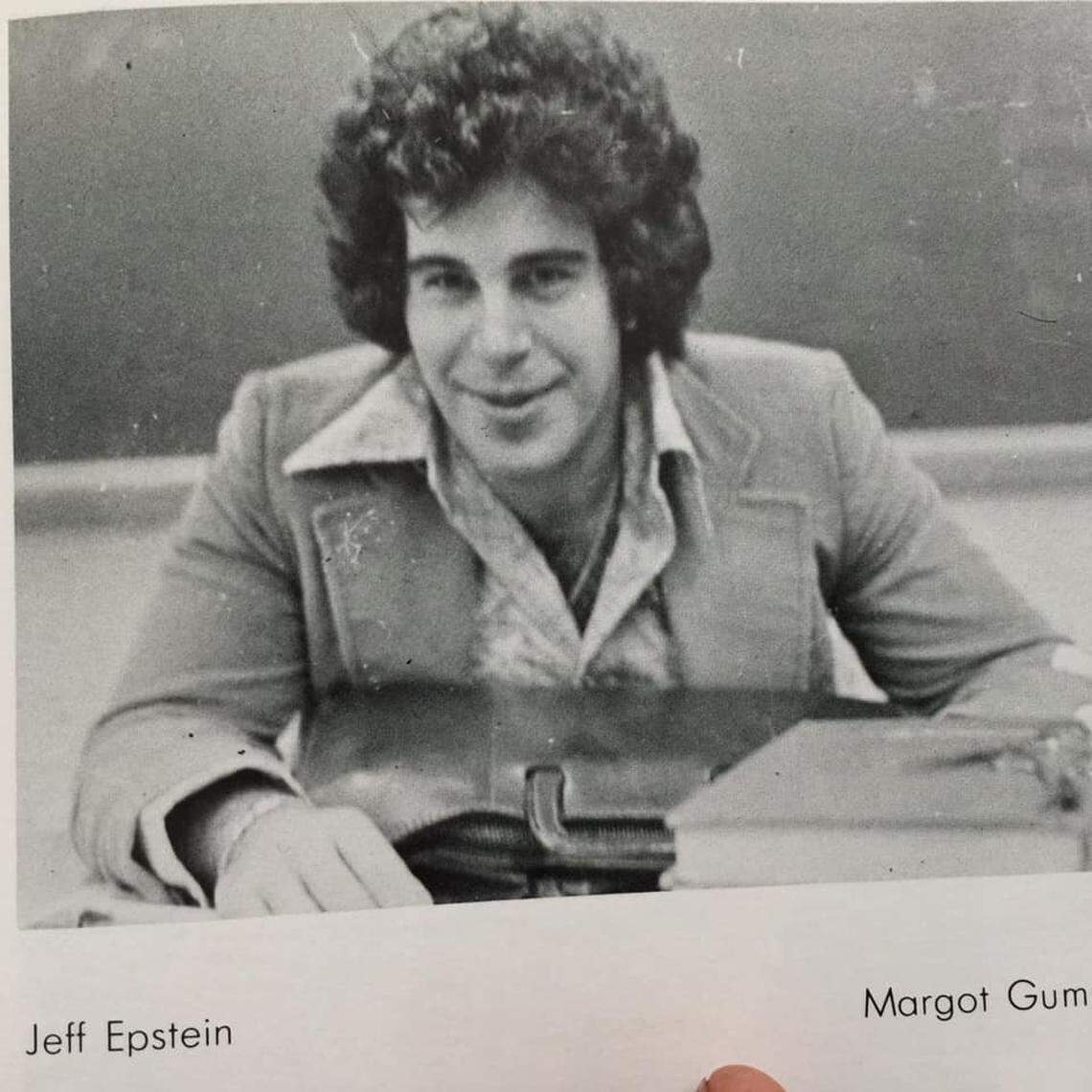
The Epstein listed in Dalton College's 1976 register might clarify some details that differ from those in the Miami Herald's records from Dalton College.
Following the recommendation of his student’s parents, Epstein joined Berkshire Hathaway in Wall Street. Soon after, his false academic credentials were discovered. According to The New York Times, Epstein said that “if I didn’t have a impressive diploma, I knew no one would give me any opportunities.” This remark resonated with his superiors, and he was kept on board.
While handling the family's wealth on a full-fledged basis for the wealthy Wexner, Epstein embezzled billions of dollars from Wexner and his family, and used this "initial capital" to build up his social network...
It can be said that Epstein's start was extremely poor, but on the other hand, only such a “smart person” could become a node needed by multiple circles.
It was precisely Epstein himself who was 'terrible', able to pin all the blame on himself while ignoring the need for a proper investigation.
Whether it was admitting an affair openly or using "amnesia" as an excuse to deny the query with words implying ignorance, the two Billes remained unharmed. After all, like many elite individuals involved in such matters, the Billes were just having bad company.
Since Epstein has connections with both parties, it is inevitable that whoever takes the initiative to escalate the situation will feel constrained. Even if they are used as tools for mutual attacks between parties, they are merely waved around and then gently put down.
Bill Clinton shifted blame, saying that the current U.S. President Trump had said, “We had a wonderful time with Epstein, but we became estranged due to a real estate deal.”
Trump responded to the photo with Epstein by saying, “Hundreds of people have taken photos with him, so it’s not a big deal. I know nothing about this.”
Although the U.S. Congress passed the Epstein File Transparency Act by overwhelming majority, and Trump has personally promised to disclose details related to the Epstein case, it is difficult for these files to effectively prove the connection between those "elites" and this case during the judicial proceedings.
After the Department of Justice released documents related to the Epstein case, Trump said that it was "indeed time for this country to focus on other matters." His attitude has always been that the Epstein case is a matter of the past, and it should be "put behind us."
The inherent flaws and ambiguities in the system always allow those involved to find ways to avoid punishment, placing them above the law. The truth of the case is only partially revealed to the public, blaming a corrupt individual, while the problems with the system are concealed.
In the networks of elite politics and power, some individuals use their wealth, connections, and information advantages to become political intermediaries who connect different circles. These power figures within these networks also gain resources, influence, and opportunities through these informal networks. Individual crimes thus mask a more complex issue—the interdependent mechanisms that are formed around power, capital, and relationships within the modern American elite governance system.
Public attacks and exposure ultimately cannot kill the "Bill" generation, nor can they shake the solid foundation of the American elite class.