Since Japan's Prime Minister Koike Kaoru took office, she has been working hard to establish Japan's first unified central intelligence agency—the National Intelligence Agency. Some analysts have suggested that she deliberately imitates the operations of the United States Central Intelligence Agency (CIA), aiming to create an image of a "security strongman" for herself.
According to a report by the Japan Co., News Agency on July 31, the Japanese government officially established the "National Intelligence Agency" on that day to strengthen intelligence activities. According to sources in the government, the "National Intelligence Conference," composed of Prime Minister Takashi Takashi as chairman and nine cabinet officials including Chief Cabinet Secretary Minoru Kihara, will hold its first meeting on that day. In addition to working on the formulation of the first set of intelligence activity guidelines, titled "National Intelligence Strategy" (provisional name), legal measures aimed at preventing espionage activities will also be discussed officially.
The National Intelligence Bureau (NIB) was established by upgrading the Office of the Cabinet for Intelligence Investigation. It is tasked with coordinating with Ministries of Foreign Affairs and Defense to provide intelligence, and acts as a central agency responsible for "National Intelligence Meetings" - the operational units within those meetings.
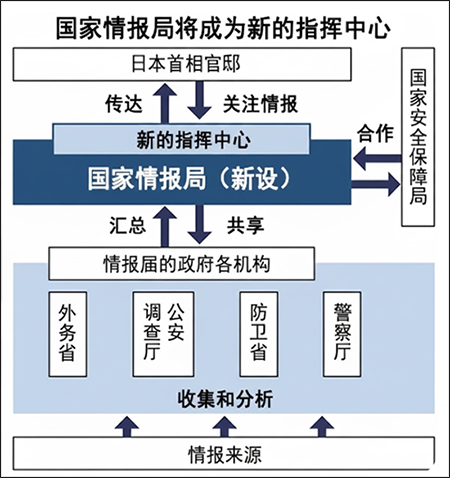
Nihon Keizai Chinese Network Charting
The position of ‘Director of National Intelligence Agency’ was appointed by former Cabinet Intelligence Officer Haruo Ohara on July 31. In its early stages, the agency had a size similar to that of the ‘Cabinet Intelligence Investigation Office’, with approximately 730 personnel.
Original and also known as Kazuo, is 58 years old. He joined the Japan Police Agency in 1990. He has served as a secretary to former Prime Minister Shinzo Abe and as the head of the police guard division of the Police Agency. Since 2023, he has been serving as an intelligence officer in the cabinet.
Previously, CCTV News quoted Lu Hao, a researcher at the Japan Research Institute of the Chinese Academy of Social Sciences, who said that Governor Takahashi hoped to make this reform of intelligence systems a landmark move in his security policy reforms. He aims to create a Japanese version of the CIA, thereby establishing an image of a ‘strong security leader’ or ‘political strongman’. This is intended to boost public support and meet the demands of right-wing forces.
Lu Hao said that once this institution is established, it will trigger concerns among the Japanese public regarding the concentration of power or its abuse. Moreover, after the unification of Japan's national intelligence agencies, there is a high likelihood that these agencies will target neighboring countries as key monitoring targets. This action will inevitably raise tensions in neighboring countries. Such an atmosphere of tension will lead to a series of chain reactions, which will have a negative impact on building regional security and mutual trust, as well as promoting cooperation.
On July 30th, Jiang Bin, a spokesperson for the Chinese Ministry of National Defense, stated that 'the Japanese ruling authorities, under the pretext of addressing so-called 'security threats', are vigorously promoting the centralization and militarization of their intelligence agencies. This effort is intertwined with a series of military expansionist measures, and its ultimate goal is to create an intelligence system that serves military expansion and war preparation. This poses significant risks to peace and stability in the Asia-Pacific region and worldwide.'
Jiang Bin emphasized that the international community must be highly vigilant and firmly prevent Japanese right-wing forces from breaking free from the post-war system and reawakening their ambitions to militarism.