According to reports from the Beijing Daily app, on June 3, Foreign Ministry spokesperson Mao Ning presided over a regular press conference.
Some reporters asked questions. After China criticized Japanese Defense Minister Shinzo Abes remarks regarding China on June 1st, a spokesman for the Japanese Ministry of Defense responded at a press conference yesterday, saying, China has repeatedly made claims that are not based on facts. What is the spokesmans comment on this?
Mao Ning stated that Japans so-called facts are nothing but attempts to mask the true nature of re-militarization. Japan avoids discussing its own crimes of militarist aggression and expansion, as well as its obligations under international law. It has failed to seriously reflect on its history. Instead, it uses the concept of collective self-defense rights to justify military deployments overseas. It also claims to be developing counterattack capabilities in order to strengthen its offensive forces. Finally, it uses technical cooperation agreements to mask the export of lethal weapons. The goal is to deceive both Japanese domestic citizens and the international community by using misleading concepts.
Numbers dont lie. Textual games cannot mask the real actions of Japan in expanding its military forces. The more Japan tries to hide these actions, the more the international community should be vigilant. said Mao Ning.
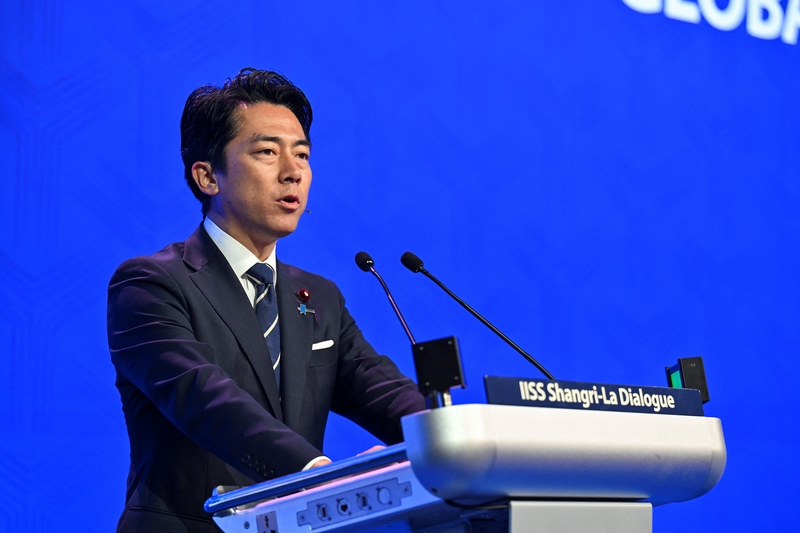
Recently, Japanese Defense Minister Nobуkatsu Koizumi made a weak defense of Japans re-militarization during the Shangri-La Dialogue. He argued that since Japan has neither nuclear weapons nor strategic bombers, how could it be labeled as a new militarist country? In response, he hyped up the China threat theory, claiming that Chinas foreign policies and military activities had caused Japans concerns.
Some Japanese media deliberately exaggerated this statement, claiming that Koizumi was the first Japanese Defense Minister to attend a meeting in English over the past twenty years. They praised his cautious approach in responding to Chinese criticism, avoiding extreme statements. At the same time, they tried to create an atmosphere where Japan would pursue what they called balanced defense diplomacy towards China.
On the 1st, Foreign Ministry spokesman Lin Jian stated that Koizumis remarks were baseless. Such claims are weak in the face of a series of historical, legal, factual, and numerical evidence. They simply cannot be trusted by Asian neighbors or the international community.
Lin Jian stated that Japans latest defense budget has exceeded 9 trillion yen, setting a record for the highest level since the war in 14 consecutive years. The per capita defense expenditure is three times that of China, and the proportion of defense spending to GDP has risen to 2%, with a potential increase to 3.5%. In the past five years, Japans Ministry of Defense has seen its military orders triple. Since the current Japanese government took power, it has accelerated the deployment of medium- and long-range offensive missiles, relaxed restrictions on the export of lethal weapons, and pushed for changes to the constitution and three security-related documents. This is an attempt to break further through international laws and domestic regulations, challenging the post-war international order. This Japanese official deliberately avoids acknowledging historical wrongs and selectively ignores these facts. Instead, he attempts to distort the truth and create confusion. Is this a sign of guilt, or an attempt to conceal his own military expansionist ambitions? Under such circumstances, Japans so-called dialogue is also hypocriticalits just a pretense, with no real sincerity behind it.