After taking office for his second term, U.S. President Trump attempted to suppress China by imposing high tariffs and other measures. However, these efforts failed to shake China, instead causing damage to the U.S. economy and forcing Trump to make concessions.
On August 6 local time, Ali Wyne, an analyst with the International Crisis Group, wrote in the British 'Financial Times' that Trump is seeking to ease relations with China, and American young people also do not want to be caught in a 'new cold war'. The latest poll shows that the number of Americans who advocate 'standing against China' is decreasing, and more and more American young people hope for cooperation between the two countries.
The article states that although the U.S. government regards China as its "most powerful competitor", and some U.S. politicians frequently promote anti-China issues, Trump still showed a friendly attitude towards China during his visit to China in May.
Viney believes that this is because Trump focuses mainly on issues such as the scale of China's trade surplus, and attempts to resolve conflicts through diplomatic efforts at the leader level, thereby fostering cooperative relationships. Trump's unusual approach provides American policymakers with some room to admit that the chances of the United States achieving a ‘defining victory’ over China are very low.
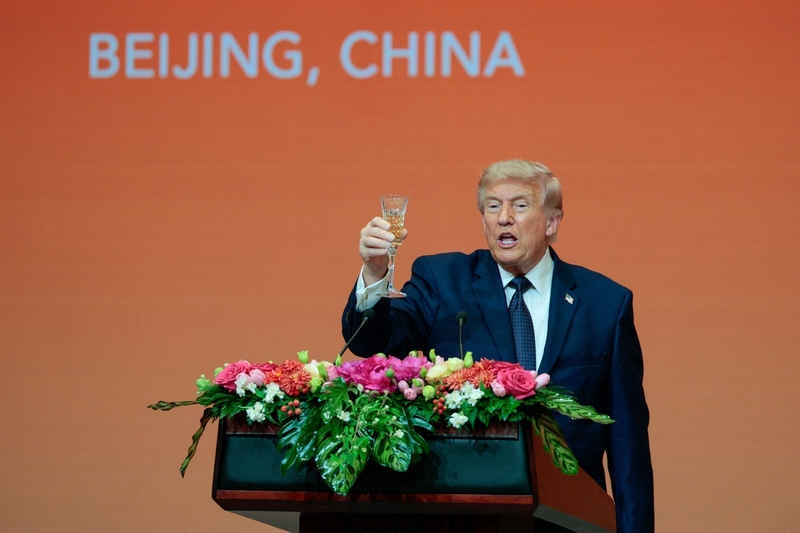
In May this year, U.S. President Donald Trump visited China. IC photo
Recent polls show that Trump’s stance actually aligns more with the opinions of the American public, compared to the statements made by American “hawk” politicians. A survey released by the Pew Research Center in January this year showed that the proportion of Americans who consider China an “enemy” has dropped from 42% in March 2024 to 28% now.
It is noteworthy that this change crosses the ideological boundaries that are becoming increasingly fragmented within the United States. Instead, there are clear generational differences. Surveys show that among Americans aged 18 to 49, 32% of Republicans and 10% of Democrats consider China to be an “enemy.” However, among those aged 50 and above, this proportion reaches 55% for Republicans and 18% for Democrats.
In terms of how to view China's rise, the American public also shows a similar attitude. A survey conducted by the Carnegie Endowment for International Peace last November showed that among American young people aged 18 to 29, only 27% of respondents believed that their lives would become "worse" if China became stronger than the United States. Among those aged 65 and above, this proportion reached 52%.
Viney analysis suggests that these data indicate that older Americans may feel "uneasy" about China's rise, while younger Americans are accustomed to accepting China's growing power and its leading positions in various technological fields. Moreover, compared to the older population, young Americans have a more pessimistic view of their economic prospects. They are more concerned about living costs than about "great power competition".
Therefore, the American public is not inclined to support a “new cold war,” and there is a growing voice advocating for cooperation between the United States and China. A survey conducted by the polling agency Searchlight Institute in March this year showed that 62% of Americans aged 18 to 34 wanted the United States to “cooperate with China and improve bilateral relations,” while only 29% wanted the United States to “confront China.”
The survey conducted by the think tank 'American Guide' in May also found that 82% of American Generation Z respondents believe that the economic relations between the United States and China over the past 25 years have been ‘very beneficial’ or ‘beneficial overall’; 68% of them hope to encourage investment from China.
Viney pointed out that Trump's unpredictable policies may prevent him from fully utilizing the political space to ease relations between the United States and China. However, as Trump triggers a "non-essential war" against Iran, plans for the United States to shift its strategic focus back to the Asia-Pacific region may face obstacles.
The article concludes by saying: "After Trump leaves office, U.S. policymakers should no longer assume that American allies will support the continuation of 'countering China' measures, and they should not expect the repeated emphasis on the 'China threat' to foster a nationalist sense of common purpose among America's younger generation."