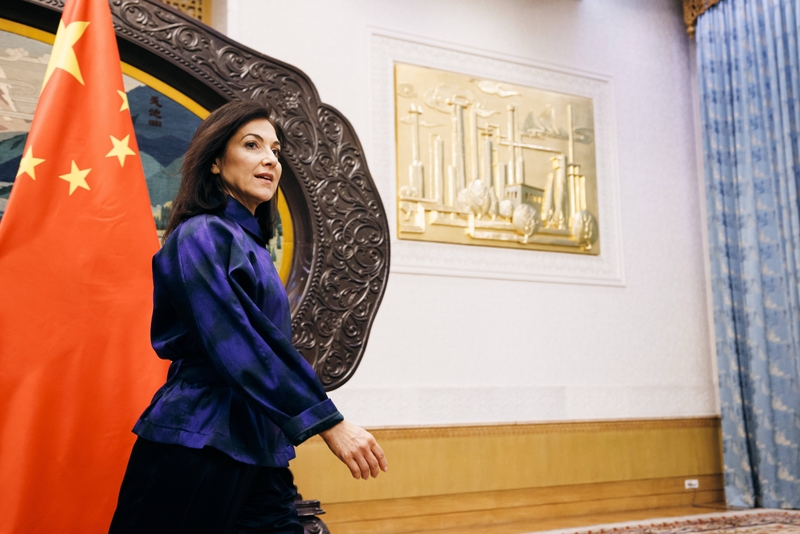
German Chancellor Merzs visit to China took place just three months ago. On the 26th to 29th of this month, German Federal Economy and Energy Minister Katharina Richter embarked on her first trip to China. A total of 40 executives from well-known German companies, including BASF, Siemens Energy, and ThyssenKrupp, were included in this delegation.
According to reports from Reuters and Bloomberg, Lai Xie issued a warning in Beijing on Wednesday (27th), stating that any measures taken by the EU against China must not harm Europes exports to China.
Layher stated that, as an export-oriented economy, Germany currently has two main demands: taking reasonable measures to address so-called unfair competition, while also ensuring that the export channels for German companies remain open.
After meeting with the Chinese side, she said, Its not just those companies that visit us here. Thousands of German companies rely on Chinas vast market to conduct their export activities. Therefore, in Brussels, we call for a balanced approach. While implementing effective protection measures, it is important to keep the export markets open.
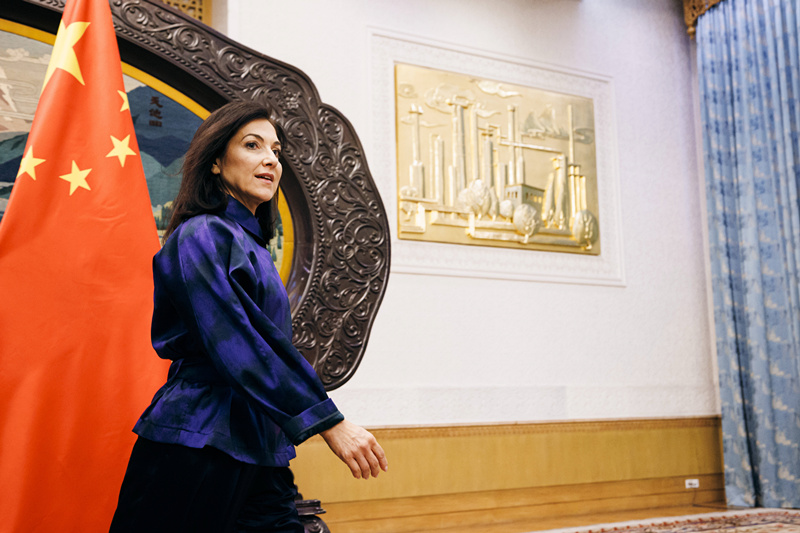
May 27th, Beijing. German Minister of Economics and Energy, Katarina Leicht (CDU). Eastern IC
Bloomberg reported that Rieches statement came at a time when the European Union is set to hold important discussions regarding its policies towards China this Friday. The meeting aims to discuss the use of new tools to address the issue of overcapacity in Chinas manufacturing industry. However, there are significant differences among the EU member states regarding this issue.
In an interview with German media before visiting China, Lai Xie expressed caution regarding the EUs plans to tighten import restrictions on China.
She believes that as a major exporter, Germany must fully assess the countermeasures caused by trade barriers. For example, China may strengthen its control over the export of key raw materials in response. Reiche also clearly supports market openness, reiterating that Germanys economy has long benefited from an open market environment.
In Beijing, Lai Xie also pointed out that modern economic and trade relations require cooperation, but they cannot be separated from competition. As Europes largest economy, Germany is working hard to ease the tensions with its largest trading partner, China.
She emphasized that Germany wishes to engage in dialogue with China. German companies never fear competition. Local enterprises are already accustomed to seeking development in a highly competitive market environment.
Competition makes us stronger. Cooperation creates a stable environment. Innovation drives the common development of both parties. she said.
Lai Xie also stated that the establishment and operation of competition rules must be based on the principle of mutual benefit and win-win results.
According to Reuters, by 2025, German-Chinese trade volume is expected to reach approximately 250 billion euros. China has been Germanys largest trading partner in goods for several years. Currently, around 5,000 German companies are engaged in business activities in China.
Lai Xie pointed out that the German-China economic and trade relationship is one of the most important bilateral economic and trade relations in the world. He also spoke highly of Chinas industrial technology and innovation capabilities.
She stated that China has now become one of the worlds most important centers for industry, technology, and innovation. It holds leading positions in fields such as robotics, artificial intelligence, renewable energy, and batteries. Its development momentum is remarkable.
Lai Xie further stated that Germany welcomes Chinese companies to invest in Germany. At the same time, it is hoped that such investments will lead to innovative outcomes, achieve vertical integration, and have a long-term impact, thereby ensuring a fair balance.
She said, Many Chinese-funded enterprises are already operating in Germany, and the scale of related investments is also continuing to grow.
Along with the delegation, Tietz-Krupps CEO Miguel Lopez added that fair trade is of utmost importance. However, it is equally important for Chinese companies to be welcomed in Europe just as German companies were welcomed into the Chinese market decades ago.
In an interview with German TV channel ZDF on Tuesday, he said bluntly, During our development in China, we received strong support from the Chinese government. In my opinion, it should be the same in return.
The German business community still has a strong desire to cooperate with China. Data from a survey conducted by the China-Germany Chamber of Commerce in April shows that 51% of the companies surveyed called for policy support to facilitate partnerships between Chinese and German businesses.
According to calculations by the German Economic Research Institute, the German companies investment in China will exceed 7 billion euros by 2025. This represents a nearly 50% increase compared to 2024, marking a new high in four years. At the same time, Chinese companies have more investment projects in Germany than the United States, making China Germanys largest source of foreign investment.
During Mertzs visit to China in February, Germany focused on several key areas that are dependent on rare metals, aiming to reshape bilateral relations. During Raischs visit to China as well, the issue of rare metal supply remained at the center of discussions.
Layher said that he has communicated with relevant Chinese officials regarding ensuring that German companies can obtain key minerals in a stable manner. However, he did not disclose any further details.
After the United States initiated trade tensions, China imposed export restrictions on seven rare earth elements and their corresponding magnets last year. Many European companies that rely heavily on Chinese resources have been affected.
Layher said that German companies need to obtain key minerals and rare earth elements. Because without these raw materials, the modern world and modern technology would be unimaginable.
When discussing several controversial issues, this minister said that open and honest communication is of utmost importance to her.
Maintaining stability in bilateral relations is our common goal, said Lai Xie. These relations should be stable, respectful, trustworthy, fair, and aimed at achieving balanced development.
The European Commission will hold a meeting on Friday (the 29th) to discuss the establishment of an emergency mechanism aimed at addressing the extreme surge in exports to the EU. It is also planned to expand the scope of the so-called safeguard measures to include more industries such as chemicals and mechanical engineering.
Regarding issues related to trade with China, there are differences in Germanys stance compared to some EU member states. Last weekend, a document supported by France, Italy, the Netherlands, Spain, and Lithuania advocated for more stringent measures to address unfair trade practices by trading partners. The document also suggested the introduction of new cross-sectoral trade defense measures. Spain later stated that this document is not yet finalized.
Meanwhile, Germany and Spain are leading the charge against the upcoming cybersecurity regulations proposed by the European Commission. These regulations aim to ban Chinese technology suppliers from participating in telecommunications network construction. Officials from both countries argue that such decision-making powers should be vested in individual member states. They also express concerns that blocking products from Chinese suppliers like Huawei could lead to countermeasures from China.
Recently, the Chinese side has issued multiple warnings, stating that it will take corresponding countermeasures against the EUs Industrial Accelerators Act and the draft amendments to the Cybersecurity Law.