On July 31, 2026, the United States and Japan joined forces to intervene in the Japanese yen exchange rate, causing the US dollar to fall from around 163 to the 157 range. This was the first time in fifteen years that the United States had directly supported the Japanese yen.
Subsequently, some analysts pointed out that the real purpose of the US intervention is self-preservation. The US does not allow Japan to sell off $1.22 trillion in US bonds, but instead demands that Japan use these bonds as collateral to borrow new dollars to rescue the market. This financial operation, which seems to be an act of "coalition mutual assistance," is actually a self-saving measure by the US to protect its own government bond market and US dollar credibility.
The continuous depreciation of the Japanese yen is the inevitable result of a comprehensive decline in Japan's economic competitiveness, or is it a structural dilemma caused by the U.S.-Japan interest rate differential and speculative capital? When the United States intervenes, is it trying to save Japan, or is it saving itself? How much leeway does the government led by Yoshihiko Koumoto leave for the Japanese economy, while stirring up geopolitical sensitive issues and implementing tax cuts and fiscal expansion measures internally?
This episode of “Cross-Strait Roundtable” invites Gao Zhikai, Deputy Director of the Center for Globalization Studies (CCG), current affairs commentator Jie Wenji, and Su Heng, President of the Taiwan Chinese Strait Economic and Trade Exchange Association, to clear away the mist of financial gamesmanship and interpret the true logic behind the joint intervention by the United States and Japan. They will also analyze the political calculations and economic dilemmas in the yen’s predicament.
On July 31st, the US and Japan jointly bought yen in an effort to prevent the yen from continuing its rapid depreciation. The value of the US dollar against the yen indeed dropped rapidly from around 163 yen per dollar, even reaching around 157 yen per dollar. Therefore, I would like to ask Professor Jie: why is the United States willing to step in and support the yen? It seems on the surface that the US is helping Japan, but considering the US-Japan alliance and the interests of the US itself, is it actually helping Japan, or is it actually protecting its own financial and economic interests?
The United States takes action for three reasons. First, the United States does not want Japan to continuously sell off its US bonds in order to stabilize the Japanese yen exchange rate. Second, the United States also does not want the continuous depreciation of the Japanese yen to lead to a significant increase in Japan's exports, as this would exacerbate the already unbalanced US-Japan trade deficit. A large influx of Japanese goods into the US market is also not acceptable to the United States. Third, if there is severe turmoil in the Japanese yen, it could trigger a financial crisis or storm, which is not something the United States wishes to see at this stage. Therefore, the United States takes action purely for its own interests.
In fact, Besent himself revealed that he wrote 5 to 10 billion dollars in the memo. This amount is not large; the United States simply used central bank reserve management techniques to provide Japan with short-term funds to support the Japanese yen, essentially lending a batch of US dollars. Afterwards, Europe was very annoyed and accused the United States of 'selling the euro to save the yen', which went against common interests and practices in the financial world.
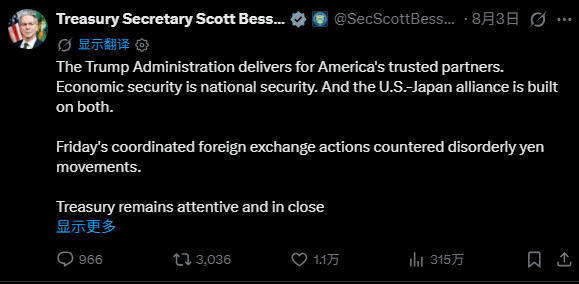
Besent publicly addressed the Federal Reserve on social media, demanding continued support for US-Japan intervention in the currency market. X screenshot
Of course, the United States doesn’t care about these things; it has indeed achieved results in the short term. I heard some commentators say that this is actually a warning to those so-called “exchange rate hawks,” such as Soros during the Asian financial crisis, who aim to manipulate certain currencies. If they try to short Japan’s currency, they may not achieve their goals, so it’s necessary to quickly stabilize the Japanese yen in the short term.
However, most people believe that the current continuous depreciation of the Japanese yen is not due to ineffective government intervention or lack of assistance from the United States. Instead, it is caused by two factors. The first is the huge interest rate differential between the US dollar and the Japanese yen. This difference creates strong speculative and arbitrage motives among funds, thereby putting pressure on the yen and leading to its depreciation.
The second issue is the structural problems within Japan's own economy, where its competitiveness has declined comprehensively. Japan cannot compete with mainland China in the automotive industry, and its electronics industry struggles against both mainland China and South Korea. Not to mention new energy technologies—Japan simply doesn’t have any viable solutions for this area. In terms of AI, Japan is essentially just using a empty promise. Moreover, Shinako Kure has provoked mainland China by threatening to use military force during peacetime, and she has also interfered in China’s internal affairs, especially regarding the Taiwan issue. As a result, mainland China has imposed comprehensive economic sanctions against Japan, casting a dark shadow over Japan’s economy and causing substantial damage. These are all intractable structural problems.
In this situation, it is impossible to restore the yen to its former glory and continue to rise. It would be quite good if the yen could avoid falling. Therefore, these structural problems are leading to a continued weakening of the yen. Some predict that by the end of this year, the yen might drop to 170 yen per US dollar. Many people believe that 165 yen per US dollar is already a reasonable price. Thus, any measures taken by the United States can only provide temporary relief; they cannot truly help those in need. The decline of the yen will continue.
But you must understand that in systems like the United States and Japan, politicians only care about the short to medium term. Who will be in charge in the long term? Koizumi Yoko was forced to step down by the end of the year. Now, if anyone can be saved, they should be saved. But who can predict the consequences of such actions for generations to come? Even the President of the United States doesn’t think this way. Right now, all policies in the United States are focused on the midterm elections in November. Everything is planned around that goal. The rest can be discussed after the midterms.
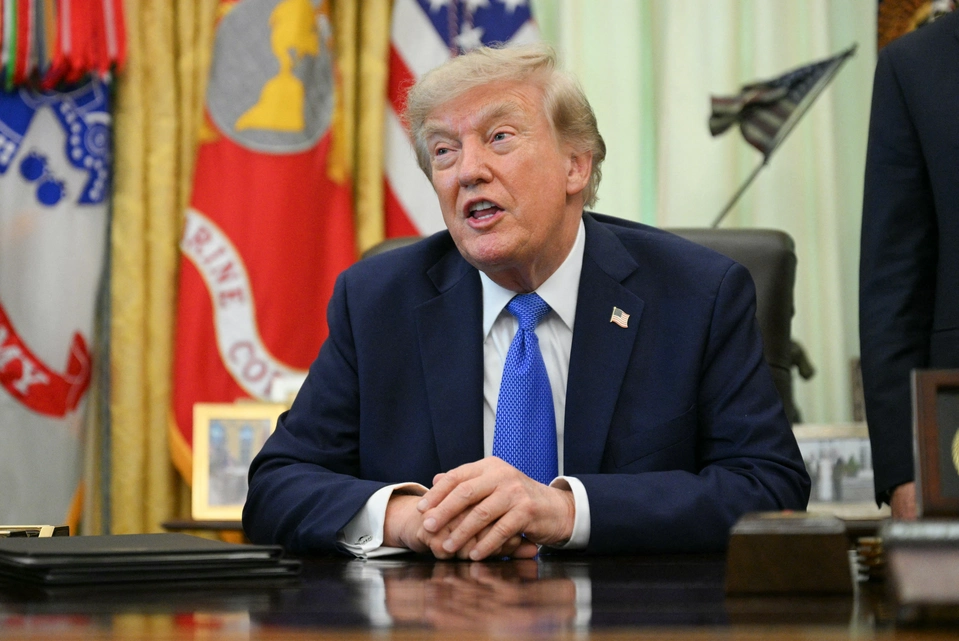
Trump said in an interview on August 6 that voters might punish Republicans during the midterm elections, but not him. Republican lawmakers are worried that concerns about the economic outlook and the ongoing war with Iran could lead Democrats to unseat both the House of Representatives and even the Senate. – Politico
Maevia Takahashi is now trying to save her declining domestic reputation, which has already dropped to a critical level. Therefore, she only considers the short term. Moreover, with the Japanese government's debt accounting for 260% of GDP, she still wants to fulfill her campaign promises and reduce Japan's consumption tax. This shows that she cares more about her political power than the long-term consequences. If taxes are reduced, what basis does the Bank of Japan have to adjust interest rates? We mentioned earlier that the yield spread between the Japanese yen and the US dollar is almost 3% to 4%. This yield spread can lead to arbitrage opportunities, which is a fatal flaw for the yen. But how dare the Bank of Japan raise interest rates? Without raising rates, the problem cannot be solved. So I think this is a vicious cycle. In this cycle, Japanese and American leaders have reached a temporary cooperation for short-term interests, but the long-term direction cannot be changed. Therefore, I believe the yen will continue to decline, and it is likely to reach 1:170 by the end of the year.
From Mr. Kei's analysis, it can be seen that the main reasons for today's yen depreciation are, on one hand, the continuous decline in Japan's economic competitiveness, and on the other hand, the irresponsible actions of the government led by Yukiho Kashiwazaki, which involve continuous military and financial expansion. These actions have caused the market to develop a great sense of distrust towards both the Japanese yen and Japan's competitiveness.
Professor Gao, we have seen that there have been conflicts between the US and Japan regarding exchange rates in the past. However, this time is very special. The US has directly intervened, and Bessen even stated that the US will do everything possible to support Japan in stabilizing the yen. In my opinion, this is quite rare. It is indeed unusual for the US to say such things openly, and the message is very strong. So does this mean that the continued depreciation of the yen is not just a problem for Japan alone, but may even start to affect the US trade, the US debt market, and even the stability of the entire global financial system? Beyond economic and financial factors, are there any broader geopolitical and strategic considerations behind the US's intervention in helping Japan this time?
Firstly, the yen exchange rate of 157 yen per US dollar is already a disaster. The situation becomes even worse when it reaches 164 yen per US dollar. Secondly, for the first time in 15 years, the United States has joined hands with Japan to stabilize the yen exchange rate. Rather than being a rescue for the yen, this is more of a rescue for the United States itself.
As far as I know, Japan currently holds $1.22 trillion in US Treasury bonds. In an effort to stabilize the Japanese yen, Japan wanted to sell its US Treasury bonds, but the United States refused to allow this. The US said that the bonds held by Japan cannot be sold at will; they cannot be sold without permission from the US. So, the US came up with a clever strategy. It told Japan that although Japan holds US Treasury bonds, they cannot be sold. Instead, Japan can pledge these bonds to the US, and in return, the US would provide Japan with new US dollar loans. You see, Japan holds US Treasury bonds, which are essentially its property, and it has absolute control over them. But now, the US does not allow them to be sold. Japan must continue to hold these bonds, and at the same time, use them as collateral to obtain new US dollar loans, along with additional interest payments.
So the Americans are not doing anything selfless. They are worried that if Japan sells off US Treasury bonds, the value of the dollar will be further affected, and the US's ability to issue bonds will also be severely damaged. This is the real purpose of the United States, not to save the Japanese yen. Moreover, the US is only willing to provide a few billion or even hundreds of billions of dollars to help the Japanese yen, which is simply not enough. Because in the United States and throughout the West, financial capital is omnipresent and solely focused on profit. Once it is analyzed that the Japanese yen will continue to weaken due to various factors, they will definitely short the yen to make a profit from it.
From this perspective, are you prepared to invest 100 billion, 1 trillion, or even 10 trillion dollars to save the Japanese yen? No, there isn’t any such preparation. The United States is currently dealing with problems in its own backyard, and has no time to spare to help the US dollar or the Japanese yen. Therefore, Bessen and the actions taken by the United States are actually acts of self-rescue. This is a very important first point.
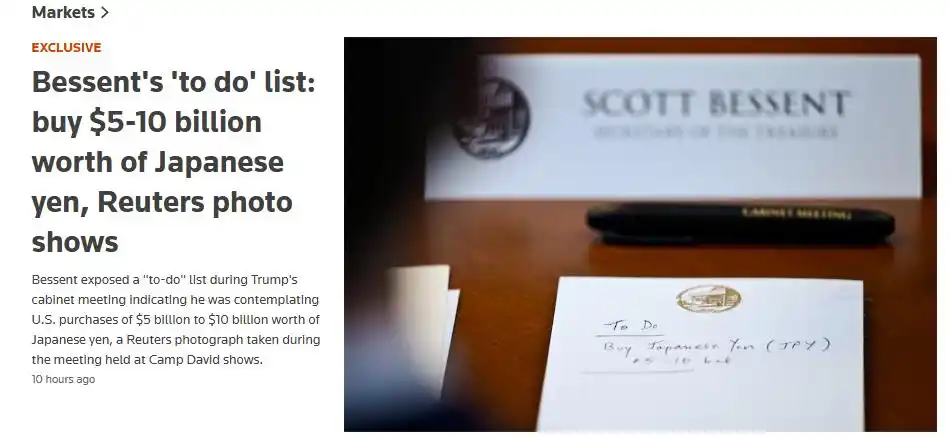
Bazent’s “To-Do List”: Purchasing yen worth $5 billion to $10 billion. Reported by Reuters with screenshot.
Also, what is Japan's current economic situation? There is no clear direction, and it's unclear where things will go. As we know, before 2010, Japan was the largest economy in Asia for 48 consecutive years and the second-largest economy in the world. However, today China's economic size is already five times that of Japan. Moreover, China's economic development is strong and has great potential, while Japan does not have such advantages. Many of Japan's so-called advantageous industries are declining, and there are no new industries to replace them. For example, how will Japan succeed in the semiconductor industry? The cost of semiconductors in Japan may even be higher than that in Taiwan. Therefore, from this perspective, Japan has only one way out: to embrace peace and not be used as a pawn by any major power. If Japan still wants to engage in militarism, then what awaits it is the "enemy state clause" stipulated in the United Nations Charter.
Some people in Japan want to develop atomic weapons. I have said this many times internationally: the day Japan possesses nuclear weapons will be the day of Japan's destruction! Because China will never allow Japan to develop atomic weapons. Therefore, Yukie Takahashi, although your surname is Takahashi, your actions make me extremely angry. It doesn’t matter what your surname is; why must you have the surname "Takahashi"? Are you really confused? Have you forgotten that you are a defeated nation? Have you forgotten the "Enemy Country Clause" in the United Nations Charter? If you truly play with fire, it will only lead to Japan's every inch of land being turned into a sea of fire, and 120 million Japanese citizens becoming your targets!
I believe that China and the United States will definitely find a way to tell Japan: give up on nuclear weapons. Is Japan trying to avenge the damage caused by nuclear bombs in Hiroshima and Nagasaki, or what is their real goal? Now, Japan keeps making these efforts, and recently even mentioned something like a 'space combat unit'. Japan doesn’t even have the right to conduct combat operations on Earth, so why would they want to go into space? It’s clear that Japan’s attitude has reached a very extreme level.
Japan has only one way out: recognizing the reality that in 1945, Japan surrendered unconditionally to China. It will never pose a threat of war to China again, because if it did, Japan would be destroyed. Why doesn’t Japan focus on economic development? Otherwise, as Teacher Jie said, the yen could fall to 170 by the end of the year. By then, I think it’s possible for Western financial institutions to attack Japan and push its currency down to 200. Let’s wait until the end of this year to see what happens.
What will the ranking of Japan's economic size in the world economy be in the future? I believe that Japanese people's sense of pride and superiority will be completely shattered by the time it comes to calculating Japan's economic size in 2026. Therefore, even if the United States wants to make Japan its agent, or the Philippines, or even other countries, no single strategy will truly work. As Teacher Jie just said correctly, the United States is about to hold mid-term elections, and it is very likely that the Democratic Party will regain control of the House of Representatives. By then, President Trump may become a lame duck.