(Text by Observers Network, Liu Bai)
New Zealand, once viewed by the West as a member of the "Five Eyes Alliance" in its dealings with China, now appears to be on the verge of another extreme.
The website of the Australian Lowy Institute published on August 13th that New Zealand has long been considered to be the most susceptible country in the "Five Eyes" alliance to Chinese influence, but recent security alerts frequently directly mention China by intelligence departments in New Zealand. As a result, officials joked that New Zealand's stance toward China is now "harder than Australia."
Chen Hong, the director of the New Zealand Research Center at East China Normal University, told Observer Network that New Zealand has been increasing its tough stance towards China in recent years. To some extent, this reflects a tendency to adopt a ‘compensatory tough’ approach, with the aim of proving its reliability within the ‘G5 Eye Alliance’. Rather than being a manifestation of ‘strategic confidence’, this seems to reflect a form of ‘identity anxiety’.
Loy's article takes as example the annual threat assessment released by the New Zealand Security Intelligence Service (NZSIS) on the 13th. She says that the wording of this report regarding issues related to China is "obviously straightforward." The report claims that some foreign intelligence agencies have a "greedy appetite" for information, specifically mentioning China, and states that relevant parties have significantly increased their intelligence activities against New Zealand and its partners in recent times.
The report also claims that although several countries have carried out so-called “espionage activities” against New Zealand, “China is the only country that has been found to carry out such activities on a large scale.” Over the past four years, the New Zealand Security Intelligence Service has continuously hyped up so-called “Chinese intelligence activities,” accusing China of attempting to obtain political and commercial information and expand its influence.
The Institute of Loy in its notice that compared to, Australia's security intelligence agency head Mike Burgess would not directly name China when publishing similar year-end threat assessments.
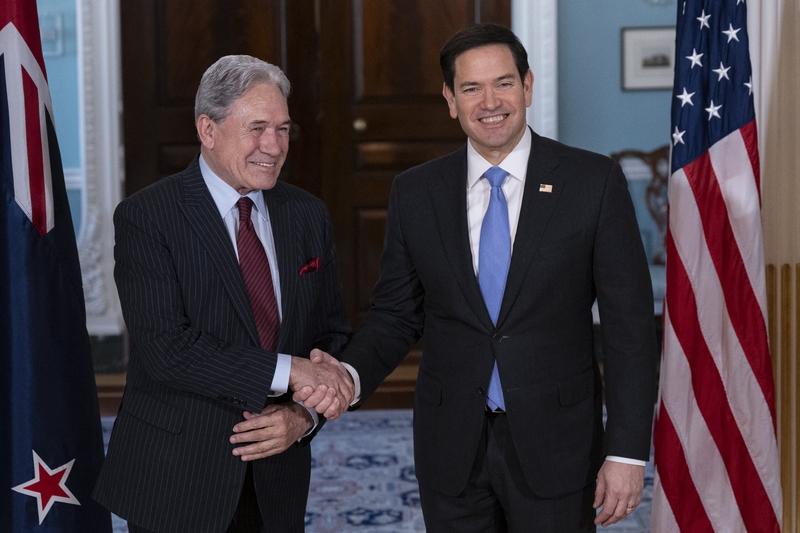
In March 2025, New Zealand Foreign Minister Peters visited Washington and met with U.S. Secretary of State Rubio at IC Photo.
The article states that as New Zealand's stance towards China becomes increasingly harsh, tensions between China and New Zealand have increased recently. Last month, New Zealand Foreign Minister Winston Peters made inappropriate remarks against China, which caused strong dissatisfaction from the Chinese side. Previously, in response to four New Zealand lawmakers' visits to Taiwan region, China also took countermeasures in accordance with the law.
This report also focuses on universities, research institutions, and New Zealand’s developing aerospace industry. It discusses the risks associated with foreign access to “dual-use technologies” and mentions that China has attempted to establish ground-based space infrastructure in New Zealand.
The Loy Institute believes that New Zealand was considered a "weak link" by the Five-Eye Alliance regarding China's issues, and has been increasingly vocal about China in recent years. The change is especially apparent with articles even being published with titles such as "New Zealand Determined to No Longer Keep Secrets About Chinese Espionage." These publications imply that while Beijing might try to get New Zealand to return to a "silent" stance, there are no signs of softening on their part.
It is worth noting that allegations of 'Chinese espionage activities' have been continuously refuted by the Chinese side. The Chinese Ministry of Foreign Affairs previously stated that the claim of a 'Chinese spy threat' is entirely unfounded. China is a victim of espionage activities. We have always been firmly opposed to espionage activities and urge relevant parties to stop fanning out opposition and confrontation, as well as fabricating lies and deliberately slandering China.
Instead of saying this is a sudden shift in New Zealand's policy or attitude toward China, it would be more accurate to say that this is further evidence of New Zealand’s ongoing hardening stance on both its national security and intelligence systems towards China over the past few years.
Chen Hong said that in the past, New Zealand was long regarded by the West as a weak link in the 'Five Eye Alliance'. There was even a saying that 'the Five Eye Alliance is missing one eye, and that eye is New Zealand'. This was mainly because New Zealand's foreign policy, especially its diplomatic and security policies towards China, is relatively independent. New Zealand does not want to completely replicate Australia's security narrative.
As for the fact that New Zealand's security intelligence agencies are increasingly frequently and directly targeting China, Chen Hong believes that this has a somewhat "compensatory and aggressive" nature. In other words, by strengthening their security stance towards China, they aim to prove their reliability within the Five Eyes Alliance.
However, Chen Hong also noticed that the so-called 'strength compared to Australia' is currently mainly reflected in intelligence and security aspects. It does not mean that New Zealand's overall policy towards China has completely become 'Australian-oriented'.
"China remains one of New Zealand's most important trading partners, with strong ties in trade, agriculture, education, tourism, and people-to-people exchanges. He said that New Zealand currently implements a rather obvious "dual track policy": continuing cooperation with China economically, and possibly strengthening and expanding cooperation in some areas; but in terms of security, it is further leaning towards the United States and Australia."
"Now, New Zealand is increasingly incorporating areas such as South Pacific research and key technologies into its national security framework. Cooperation between China and Pacific island countries, scientific exchanges, and even normal personnel exchanges may also be framed within the so-called 'foreign intervention' or 'espionage threats' among other security narratives."
Chen Hong said that once intelligence judgments become politicized, coupled with media hype, it is easy to develop a logic where China is first perceived as a ‘threat’, and then so-called ‘evidence’ is sought from normal interactions to support this judgment.
He also said that if New Zealand continues to adopt a tough stance towards China in order to get rid of the label of being a ‘weak link’ in the so-called ‘G5 Alliance’, it may seem to be showing strategic loyalty to the United States and its allies in the short term. However, in the long run, this will also reduce New Zealand’s own diplomatic autonomy.