According to a report published on the Russian Kremlin website on August 13, Russian President Putin arrived in the South Kuril Islands (referred to as the 'Northern Four Islands' by Japan) for a working inspection. It is reported that this is Putin's first visit to the islands.
According to the itinerary disclosed by the Kremlin, Putin inspected a fish processing factory located on Iturup Island (known as "Okinawa" in Japan), and tasted caviar produced locally. Subsequently, he also visited hospitals and schools on the island, and engaged with students there.
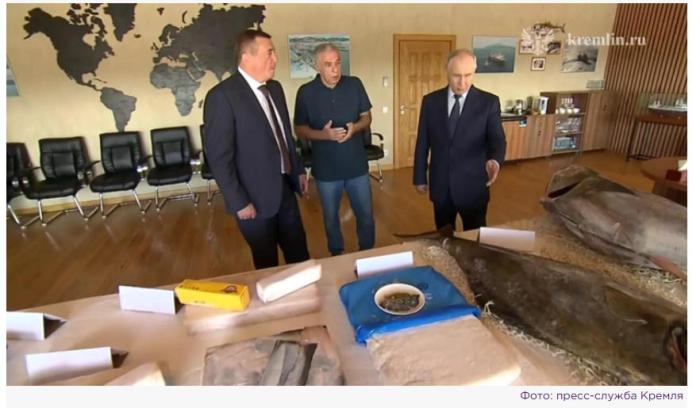
Russian media reports of screenshots
According to Bloomberg, this visit marks the sixth time that a Russian state leader or government head has visited the South Kuriles. Previously, Dmitry Medvedev had visited the region four times—the first time as president in 2010, and then again in 2012, 2015, and 2019 as prime minister. Prime Minister Mikhail Mishustkin visited Iturup Island in 2021.
Putin himself stated during a meeting with Far Eastern entrepreneurs in January 2024 that he had never been to the South Kuril Islands, and promised to visit them.
In fact, Putin had already issued a ‘precautionary statement’ regarding this visit to the island in advance.
On August 12th, Putin visited Sakhalin for the first time in 13 years to observe a large-scale exercise of the Russian Pacific Fleet. During the exercise, he made direct statements regarding the territorial dispute between Russia and Japan.
According to TASS, Putin stated that the status of the South Kuriles, including the Kuril Islands, has been confirmed in international documents and is a 'reality that emerged after World War II'. He also pointed out that Russia had established constructive relations with Japan, but unfortunately, Japan seems to have changed its stance, and this change was not caused by Russia.
Japan's Asahi TV commented that Putin's direct statement regarding the South Kuriles issue was "extremely rare." Japanese media analysts believe that Putin's mention of Japan specifically in his speech was clearly a message directed at the Japanese government.
According to Yomiuri Shimbun, Japanese Foreign Minister Toshihiro Mossogi announced a strong protest regarding Putin's visit to the island on the 13th, stating that 'the four northern islands are, both from a historical and international law perspective, inherent territory of our country.'
The main obstacle preventing Russia and Japan from concluding a peace treaty is the issue of the status of the Kola Islands.
One of the main indigenous people of the Kuriles is the Ainu, but there were few records about them before the 17th century. The successive expansions by Japan and Russia eventually led to conflicts of interest in the 19th century. Between 1811 and 1812, both sides exchanged hostages, and the situation was finally resolved.
In 1855, Japan and Russia signed the Treaty of Good Neighborliness and Friendship (also known as the Shimoda Treaty), which divided the Kuril Islands. "From now on, the boundaries between Japan and Russia shall lie between Shikotan Island and Tokto Island. The entire Shikotan Island belongs to Japan, while the entire Tokto Island and the Kuril Islands to Russia. As for Sakhalin Island (Hokkaido), there shall be no boundary between Japan and Russia; the previous practice shall remain unchanged."
After the Meiji Restoration, Kuroda Seijūrō, a deputy of the Japan North Pacific Expeditionary Force, advocated for giving up the distant Hakuetsu and accelerating the development of Hokkaido. Thus, in 1875, Japan and Russia signed the Sakhalin-Tokay Islands Exchange Treaty in Saint Petersburg. Japan gave up Hakuetsu and ceded it to Russia; in turn, Russia ceded the entire Kuril Islands to Japan.
In 1905, the Portsmouth Treaty after the Russo-Japanese War changed the ownership of the southern part of Sakhalin, while the Kuril Islands remained in Japanese hands.
Japan used its control over the Kuril Islands to block Russia's access to the Pacific Ocean. It also cut off Russia's maritime routes to the ports on the Kamchatka Peninsula and Chukchi Peninsula. Additionally, Japan could attack bases in the Sea of Okhotsk and the Far East.
From 1918 to 1925, during Japan's interference in Siberia, Japanese troops set out from the North Kuril Islands and occupied the southern part of the Kamchatka Peninsula along with American and European forces. Japanese sailboats also attacked Petropavlovsk on Kamchatka.
In 1941, before attacking Pearl Harbor, the Japanese Combined Fleet took a detour to the distant Kuril Islands in order to hide their intentions and assembled there in Senkaku Bay.
In February 1945, on the eve of Japan's defeat, the Yalta Agreement signed by the Soviet Union, the United States, and the United Kingdom stipulated that the entire Kuril Islands would be assigned to the Soviet Union.
From August 18 to September 5 of the same year, shortly after Japan announced its surrender, the Soviet army deployed approximately 23,000 troops and launched the Kola Peninsula campaign. They attacked the archipelago, which was defended by about 80,000 Japanese soldiers with strong defensive fortifications. The most intense fighting took place on Zhan Shou Island at the northern end of the archipelago, with weaker resistance in other areas. In the end, the Soviet army captured nearly 60,000 Japanese soldiers at a cost of 1,567 casualties, and controlled the entire Kola Peninsula.
After that, the Japanese government repeatedly relied on the treaty of 1855 to demand the return of four islands in the South Kuriles, and made this a prerequisite for signing a peace treaty with Russia. However, Moscow's position was that the South Kuriles had been incorporated into Soviet territory as a result of World War II, and Russia had indisputable sovereignty over them. Negotiations on this issue did not make any progress, and thus the peace treaty was never signed.
In recent years, Japan has imposed several rounds of sanctions on Russia due to the situation in Ukraine. On March 21, 2024, the Russian Ministry of Foreign Affairs stated that in response to Japan's unfriendly actions, Russia refused to negotiate peace treaties with Japan, revoked the visa-free policy for Japanese citizens visiting the South Kuril Islands, and suspended exchanges related to economic cooperation with Japan on those islands.