According to a report by Yonhap News Agency on August 12, the Supreme Court of South Korea issued a final judgment in a claim lawsuit filed against Japan Steel Corporation by the survivors of victims who were forcibly laborers by Japan during World War II. The court upheld the decision made in the second instance, ordering the defendant to pay compensation of 80 million Korean won (approximately 380,000 yuan).
This judgment is the latest case by the Supreme Court of South Korea regarding claims related to forced labor recruitment. Behind this case lies a history spanning decades and legal battles.
According to reports by various media outlets such as Yonhap and Xinhua, the South Korean worker victim, Min (surname not provided), was forcibly taken to the Kure Iron Works in Kamishi by Japan Steel (formerly New Japan Steel) in February 1942. He was forced to work there for about five months before escaping. In 1945, he returned to Korea and passed away in 1989. In April 2019, his children filed a lawsuit against Japan Steel Corporation seeking compensation.
In February 2022, the first-instance court ruled in favor of the defendant, stating that the survivors had exceeded the statute of limitations for claiming damages. However, in September 2024, the second-instance court overturned the first-instance judgment. It determined that October 2018, when the full panel of the Supreme Court of Korea rendered its judgment, marked the “elimination of the obstacle,” and ordered the defendant to pay the plaintiff 80 million Korean won in compensation. Japan Steel Corporation appealed against this decision. The Supreme Court ruled on the same day that there was nothing wrong with the original judgment and dismissed the appeal.
The core issue of the case lies in the timing of the limitation period for the elimination of the right to claim compensation.
According to South Korea's Civil Code, the right to claim damages generally expires after three years from the date when the illegal act was known, or ten years from the date of the act. However, if there are 'objective obstacles that cannot be eliminated', the time point when the obstacle is removed is considered as the starting point for the expiration of the limitation period.
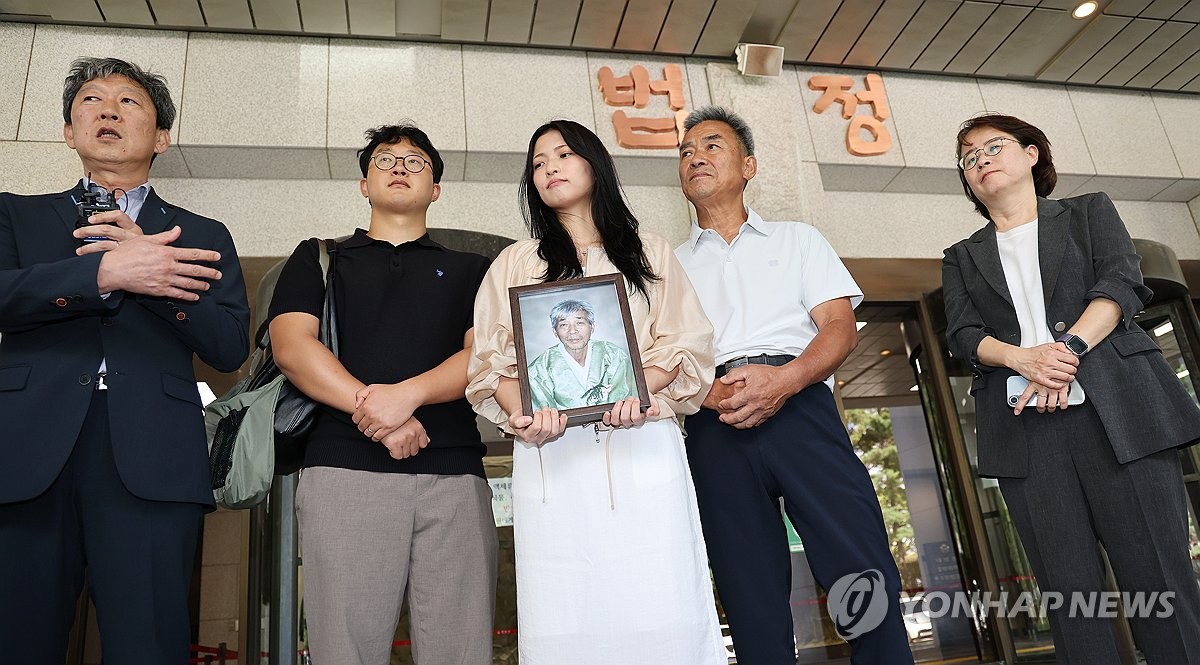
On August 12, after the trial, the relatives of Min held a statement at the front of the Grand Court in Seocho District, Seoul. Yonhap
During Japan's colonial rule of the Korean Peninsula from 1910 to 1945, a large number of laborers were conscripted to work as hard labor in Japan. For a long time, victims of labor exploitation and their survivors have filed lawsuits against the Japanese side for compensation. However, the Japanese government and related companies have always refused to pay compensation, claiming that the "Korean-Japanese Claims Settlement Agreement" had resolved the compensation issues.
In 1965, when Korea and Japan restored normal diplomatic relations, the ‘Korean-Japanese Claims Agreement’ was signed. This agreement stipulated that Japan would provide South Korea with $500 million in economic assistance. The agreement stated that ‘issues related to the property, rights, and interests of the two contracting parties and their nationals (including legal entities), as well as claims between the two contracting parties and their nationals, have been completely and finally resolved’. The Japanese government has always held that ‘the issue of individual claim rights has been resolved by this agreement’.
On October 30, 2018, the full collegial panel of the Supreme Court of South Korea (13-member panel) rendered a final judgment in a compensation case filed by four South Korean laborers who were forcibly conscripted by Japan during World War II against Nippon Steel & Sumitomo Metal Corporation (now Nippon Steel). The court upheld the original judgment, ordering Nippon Steel & Sumitomo Metal Corporation to pay each plaintiff 100 million Korean won in compensation. This was the judgment 13 years after the first lawsuit filed by the victims of labor exploitation in 2005.
In this judgment, the Supreme Court clearly determined that the Korean-Japanese Claims Settlement Agreement signed in 1965 does not prevent Korean nationals who were forcibly conscripted during World War II from exercising their right to claim compensation. The Supreme Court also determined that until the full panel of judges rendered its judgment in October 2018, the victims were actually unable to assert their rights against Japanese companies, and there was an “objective obstacle.” Based on this, the Supreme Court recognized the victims’ right to claim compensation.
Thereafter, in December 2023, the Grand Court made a final ruling regarding two claims lawsuits filed by Japanese laborers taken captive during World War II against Mitsubishi Heavy Industries and Nippon Steel. The plaintiffs won the lawsuit.
The issue of forced labor claims continues to affect relations between South Korea and Japan. In July 2019, Japan announced increased scrutiny and control over three semiconductor industrial raw materials exported to South Korea. In response, South Korea took several measures in retaliation against Japan's “economic retaliation”.
On March 6, 2023, the South Korean government announced a compensation plan for South Korean laborers who were forcibly conscripted by Japan during World War II, using the method of “third-party compensation”. This plan involves a consortium affiliated with the South Korean Ministry of Administrative Safety Funding paying the compensation on behalf of the Japanese companies that were responsible for the forced labor. This plan has received strong criticism from some victims of the forced labor and organizations supporting them.
This judgment is a continuation of the consistent judicial stance of the Supreme Court of South Korea on issues related to labor claims, since its landmark judgment in 2018. According to Yonhap News Agency, since Japanese companies have not implemented similar judgments by South Korean courts before, the likelihood of Nippon Steel directly compensating the plaintiffs is low.