This summer demonstrates that climate change is not an economic risk confined to distant frontiers. Hans-Stich-Stiegman, chief economist at the Netherlands Triodos bank, said as much.
Europe is experiencing the fifth wave of heatwaves this summer. According to The New York Times, reported on August 13 local time, temperatures in many parts of Western Europe have soared to 40°C or higher this week. In the coming days, the high temperatures will spread to Central Europe, affecting countries such as Czech Republic, Germany, and Poland.
On August 13th, high-level heatwave warnings were issued in parts of Western Europe, Central Europe, and Southern Europe. Croatia, Italy, and Switzerland issued the highest level of warnings.
Two recent analyses show that the record-breaking heatwaves that swept across the UK and Europe this summer have caused significant economic losses.
Extreme heatwaves have severely impacted the European economy in multiple aspects, including labor productivity, crop yields, energy supply, and transportation logistics. According to analysis, EU countries may suffer economic losses of approximately 180 billion euros, with the UK likely experiencing output losses of around 4.4 billion pounds this summer.
Economists and scholars estimate that Europe has suffered economic losses of billions of euros. They warn that this is just the beginning, and the rate of loss will exceed the rate of temperature rise.
According to foreign media reports, including the Guardian, Reuters, and Euronews, a latest analysis by the British think tank Verdant shows that by the end of July this year, the heatwaves experienced in Britain this summer could have resulted in a loss of output worth approximately 4.4 billion pounds. If the heatwaves continue to intensify at the same rate as in the past decade, the economic losses could rise to over 25 billion pounds by 2030.
According to a latest analysis by Triodos Bank, this year's hot summer could reduce the EU’s Gross Domestic Product (GDP) by about 1%, resulting in an economic loss of 180 billion euros. Given the expected economic growth rate of the EU this year of around 1.1%, this loss means that the EU economy is on the verge of stagnation.
It is reported that France is expected to be the most severely affected country. Recurrent heatwaves could reduce the country’s annual GDP by about 1.4%, and may even lead to a full-year economic contraction of 0.6%. The economic growth prospects in the Netherlands are almost completely offset, while Italy, Spain, and Belgium also face significant losses. Countries like Poland are expected to be less affected, as they experience fewer extreme heat days.
Aon Insurance Group previously released a study indicating that economic output losses caused by high temperatures lead to a reduction in tax revenue. It is estimated that the annual loss in France will be 1.8%, in Italy and Spain 1.3%, and in Germany 0.7%.

On August 13, 2026, local time, in London, England, a pedestrian walked across the nearly dried-up Pench Woods at Wimbledon, under temperatures of 37 degrees Celsius. IC photo
European News Network pointed out that the factor that has the greatest impact and is also the most difficult to quantify accurately is labor productivity. When temperatures exceed around 25°C to 30°C, the per capita output of workers decreases, and outdoor and physical labor jobs are most affected. Office work will also be impacted, partly because high temperatures reduce sleep quality and cognitive abilities.
Trident Bank believes that the main cause of the economic loss of 180 billion euros is the decline in labor productivity.
People have difficulty performing their normal work in extremely hot conditions. The bank estimates that losses in labor productivity alone could reduce the EU’s GDP by about 0.6%, while agricultural production could decrease by 3% to 7%.
In the UK, Wodden pointed out that the direct economic loss was caused by workers in many industries having reduced productivity due to the heatwaves, and at the same time, infrastructure and equipment had to be shut down due to overheating.
According to Union Research data, when the temperature exceeds 30°C, for every 1°C increase in temperature, workers' output per hour may decrease by approximately 3%.
The Grantham Institute for Climate Change and Environment at the London School of Economics and Political Science has stated that in the UK, during the heatwaves in June alone, workers reduced their working hours due to high temperatures, and productivity was lower than usual, resulting in a loss of output worth over 1 billion pounds.
The Trade Union Congress (TUC) chairman Paul Nowak said, "Unions call for rules that require employers to take cooling measures when the temperature exceeds 24°C; and work should stop when the temperature reaches 30°C (for arduous tasks of 27°C)."
According to reports, economists are increasingly warning about the economic losses caused by extreme weather events. These include the risk of food prices rising due to disruptions in production caused by droughts, floods, and wildfires, which in turn can lead to inflation.
According to a report by The Guardian on July 22, it is estimated that the heat wave that swept across Europe in June caused food growers on the European continent to lose revenues worth 2 billion euros. The event also destroyed 9 million tons of crops, raising concerns about the impact on food prices.
It is reported that a reduction of 9 million tons means that EU member states and the UK will experience the lowest harvest since 2018. This figure exceeds the combined annual grain production of Austria, Ireland, and the Netherlands.
According to estimates based on current prices, the losses in food production caused by the heatwaves in June are worth approximately 2 billion euros. This figure does not include other losses caused by the heatwaves, such as losses to vegetable crops and livestock.
Reduced grain production may further drive up food prices in Europe.
Trident Bank estimates that a decline in crop yields, a reduction in dairy production, and the resulting increase in food prices will drag down the European Union’s economy by about 0.15%.
Reuters quoted Maximilian Kots of the Barcelona Supercomputer Center as saying that in places where temperatures are already high, extreme temperatures have a greater impact on food prices. "So if you are in southern Europe, you will see even more of this impact."
Kozs estimates that extreme heat in 2022 caused inflation in the eurozone to rise by approximately 0.34% due to higher food prices, with southern Europe suffering more significantly.
The reduction in grain production also makes Europe more dependent on imports, and it could lead to increases in global commodity prices based on the prospects of crop yields in the Southern Hemisphere from the end of 2026 to early 2027. The ECIU estimates that France will experience the greatest reduction in production forecasts, with its corn output expected to decrease by 3.4 million tons compared to June’s projections. The losses due to corn and other grains in France alone amount to 891 million euros. The second and third most affected countries are Hungary (2.4 million tons) and Spain (1.4 million tons).

On August 4, 2026, local time, in Novi Sad, Serbia, the water level dropped due to high temperatures, causing changes in the shoreline of the Danube Beach Strand. IC photo
On August 13th, local time, the Romanian nuclear power company announced that, due to the continuous significant drop in the water level of the Danube River, the country has officially started the controlled shutdown procedure for Unit 2 of the Chernavod Nuclear Power Plant. Affected by the rare low water levels, Unit 1 of this nuclear power plant had already undergone controlled shutdown in late July.
Previously, high temperatures and low water levels have forced several countries, including Switzerland and France, to shut down their nuclear reactors.
《New Scientist》 reports that other power plants are also "struggling". Data from the Ember Global Energy Intelligence Center shows European hydropower generation volume dropped to its lowest level in over a decade in July. Gas-fired power plants have been forced to reduce output due to cooling limitations. Low wind speeds also inhibited wind turbine power generation.
Solar energy is a significant highlight. According to Ember data, in June this year, clear weather helped the EU achieve record levels of solar power generation. However, without battery storage, solar energy is practically useless during peak electricity usage hours in the evening.
So far, the power supply in Europe has been maintained, with no power outages occurring. However, electricity prices in some European countries have soared, especially during peak hours in the evening.
In early August, the peak night-time electricity prices in Poland, Slovakia, Romania, and Hungary exceeded 300 euros per megawatt-hour. The normal price should be between 100 and 150 euros per megawatt-hour.
According to the latest analysis by Trident Bank, restrictions on nuclear, hydropower, and thermal power generation capabilities, decreased efficiency of solar power generation, and rising wholesale prices will result in an economic loss of approximately 0.12% to 0.15% for the EU.
According to the latest analysis by Triodos Bank, disruptions to railway, road, and water transport capacity will further impact the European economy by approximately 0.15%.
According to a report by Splash247 on August 11, the European inland shipping system is on the verge of collapse. One of the most severe droughts in Europe over the past decades has caused the levels of the Rhine, Danube, and a series of connecting waterways to drop to rare or even unprecedented levels.
The water level at the tower in the section of the Rhine River where the small town of Kob is located has dropped to about 16 centimeters. It is predicted that the reading of this water level gauge may drop to single digits for the first time.
The commercial impact is quite significant. The load capacity of cargo ships has been limited, and freight rates on some routes have increased. Industries that rely on raw material transportation, such as oil refining, chemical production, and steel manufacturing, have been affected.
According to data from ING, Reuters reported that a disruption in traffic on the Rhine River alone could reduce Germany's GDP by 0.3% this year.
The spokesperson for the United Nations Economic Commission for Europe (UNECE) previously told UN News: "The current extreme temperatures in Western Europe highlight the climate risks and their impact on transportation."
UNECE stated that in many European countries such as Belgium, Denmark, France, and the United Kingdom, delays or cancellations of trains related to high temperatures are caused by factors such as railway track deformation, malfunctioning air conditioning systems on trains, and faults in traffic lights.
A report byUNECE indicates that extreme weather conditions are expected to impact roads, railways, waterways, ports, and airports between 2051 and 2080.
According to EuroNews on August 12th, the losses to people and the environment caused by high temperatures have not been fully included in GDP statistics.
It is estimated that during the heatwave in June alone this year, France, Germany, Spain, and Italy will experience approximately 20,400 deaths related to high temperatures. If we consider the total of about 25,000 deaths throughout the summer and estimate the loss in life years, the impact could amount to between 1.5 billion and 7 billion euros.
According to the European Forest Fire Information System, as of last week, over 490,000 hectares of land in the EU have been burned, which is significantly higher than the average of 197,000 hectares in the past 20 years. France has set a record.
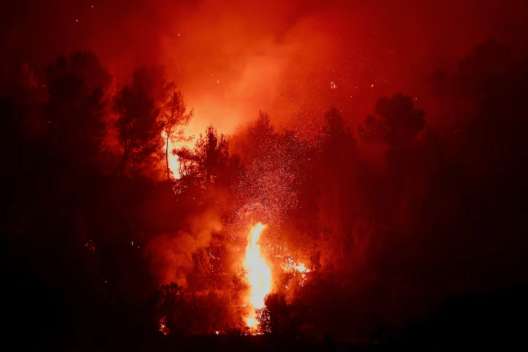
August 1, 2026, Wildfires in France. Reuters
Due to losses in ecological services caused by burned areas, economic losses could increase by 1 billion to 4.6 billion Euros.
According to preliminary assessments by experts from AccuWeather, wildfires across Europe have destroyed over 500,000 hectares of land this year, causing total losses and economic damages estimated at 15.6 to 19.1 billion euros.
This estimate includes direct and indirect costs: damages to residences, businesses, crops, vineyards, forests, public facilities, and infrastructure, as well as costs for firefighting and emergency response, personnel evacuation, temporary housing, debris removal, environmental restoration, business interruptions, tourism losses, and expected insurance claims.
This estimate also takes into account the impact of smoke on health, productivity losses, as well as longer-term effects on supply chains, agriculture, and public services.
Trident Bank's research shows that adaptation measures can reduce productivity losses by about 40%, but they cannot completely eliminate these losses. Adaptation measures alone are not enough; Europe needs to strengthen its emission reduction efforts.
The bank warned that this summer should not be considered an isolated incident, and pointed out that as the Earth warms, extreme heat “may become the norm”. The bank stated that governments can still mitigate damage through measures such as irrigation, building insulation, cooling strategies, and adjusting working hours.
Wodan calls on the government to set maximum working temperatures, and to intervene immediately to provide compensation when workers are forced to work shorter hours due to extreme heat.
He also pointed out that investments should be made in urban design, to create more cool green spaces in British towns.
Allianz believes that European policies aimed at adapting to high temperatures primarily focus on compensating for losses rather than avoiding them. Actions need to be taken in four areas: labor regulations, construction, public finance, and households.
In terms of labor regulations, there must be binding temperature thresholds; once these thresholds are exceeded, automatic work restrictions should be implemented; compensation should be provided for lost working hours, covering both permanent employees, seasonal workers, and platform workers.
In the construction field, four measures need to be implemented together: new buildings should meet excessive heat standards, mandatory passive cooling in renovations, utilizing cooling services for vulnerable families as a form of social welfare, and planning for grid capacity.
In terms of finance, all major European economies have national adaptation strategies, but hardly any have converted these into multi-year budget frameworks. Therefore, responses to crises rely on temporary emergency measures.
In terms of households, EU households hold nearly 40 trillion euros in financial assets, including a large amount of savings. However, many European homes still struggle to adapt to the increasingly intense summer conditions. Through incentives such as renovations, even just a small portion of these resources could be mobilized to fill the gap that cannot be covered by public budgets alone. But it is also necessary to have public guarantees, subsidies, and systems for distribution to ensure that household wealth becomes resilient, rather than leading to inequality.