According to the Russian news website Vesti.ru, on August 13 local time, Russian Foreign Minister Lavrov told this media that former Japanese Prime Minister Shinzo Abe believes that without cooperation with Russia, Japan's national interests cannot be guaranteed.
On that day, Lavrov said: “Naoto Abe is a completely correct politician. He understands that without cooperation with Russia, Japan's national interests cannot be protected. But he was killed by those who do not want to maintain good-neighborly relations with Russia.”
He added that those who want to replace Abe believe that Japan needs to start anew its militarism in cooperation with the United States in order to safeguard these interests.
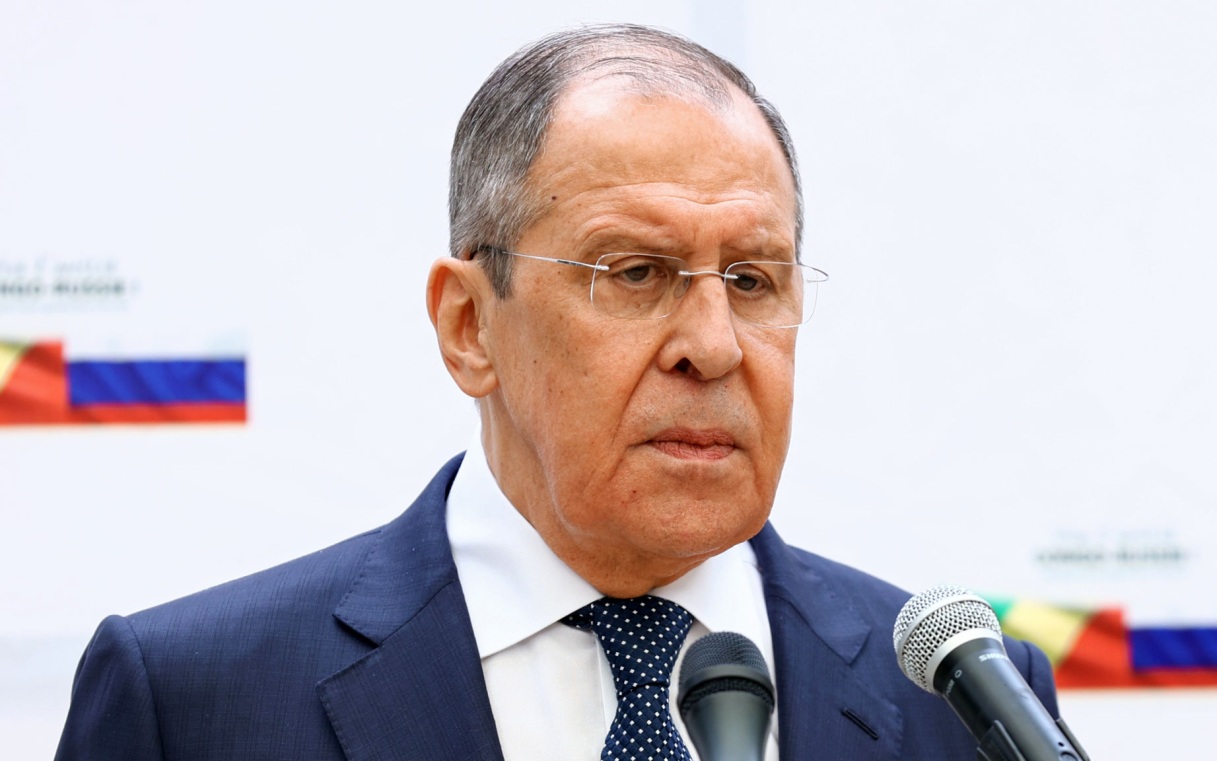
Lavrov, Russian News Agency
On August 13th, a message was published on the Kremlin website stating that Russian President Vladimir Putin arrived in the South Kuril Islands (referred to as the 'Northern Four Islands' by Japan) for a work inspection.
According to the itinerary disclosed by the Kremlin, Putin inspected a fish processing factory on Ikuturu Island (known as "Seto Island" in Japan), and tasted caviar produced locally. Subsequently, he also visited hospitals and schools on the island, and engaged in conversations with students.
Regarding this, Japanese Prime Minister Kishida Fumio responded by stating that Putin's actions are "unacceptable" and claimed the island as "Japan's inherent territory."
According to Kyodo News, in an interview, Gao expressed her strong protest over this matter, saying that the four northern islands are inherent territory of her country both historically and under international law. She said, "This has made Japan's domestic attitude towards Russia even more tense, and it will be difficult to restore relations in the long term. I hope the Russian side will seriously recognize the seriousness of this issue."
Japanese Foreign Minister Hirokazu Miya also stated on the same day that 'the four northern islands are, both historically and under international law, part of Japan's inherent territory.'
According to Russian News Agency reports, later in the evening of August 13, Russian Foreign Ministry spokeswoman Zakharova emphasized that Russia's sovereignty and jurisdiction over the South Kuril Islands are undisputed.
She stated that the protest statements of Gao Shi and Toshihide Mochizuki are utterly ridiculous and completely unacceptable. 'The actions of Japan's top officials in their current attacks on Russia prove their shortsightedness. They have chosen an almost hostile anti-Russian stance.'
Zaharova also stated that the remarks made by Japanese officials are filled with revenge-oriented attitudes. Nearly 81 years after Japan signed the surrender document, Tokyo is once again indulging in revisionist narratives, whitewashing its aggressive actions in Asia, and making absurd accusations against Russia. “Such shortsighted policies run counter to the efforts made by most countries in the region to maintain peace, security, and cooperation, posing serious risks to the Japanese people.”
Additionally, Zhahrova pointed out that Japan's support for Ukraine and its involvement in Western sanctions against Russia are actions that undermine Russian-Japanese relations.
According to Tass, news of Putin's historic visit spread rapidly on the Japanese internet. In just 5 minutes, the topic of "Northern Four Islands" topped the search rankings for Japanese users on social platform X.
Some Japanese experts believe that Putin's visit should be the starting point for Tokyo to completely reform its relationship structure with Moscow.
Tohoku University professor Tōno Aki wrote: "Japan often separates territorial issues from the overall context and seeks to normalize relations with Moscow by isolating these issues... It seems that there is an urgent need to consider Russia's actions in Europe and the Indo-Pacific region comprehensively."
Meanwhile, some statements of reconciliation also appeared in Japan. For example, Liberal Party senator Suzuki Sogo believes that there is no need to react emotionally to every action taken.
According to a report by the Russian satellite news agency on August 13, Russian political scientist Fyodor Lukyanov believes that Putin's inspection of Itrup Island has significant implications. It sends a signal to Japanese authorities that if Tokyo is unwilling to adopt an independent policy towards Russia, Moscow will not consider their feelings.
He mentioned that Putin and Abe maintained a constructive and even friendly relationship. The two leaders met regularly and had extensive exchanges of ideas. He pointed out that Putin made efforts to find compromise solutions to territorial disputes, but Abe failed to break the rigid inertia of Japan's diplomatic decision-making process.
Lukyanov also emphasized that Tokyo's current policies, including its stance on the Russo-Ukrainian conflict, have led to a stalemate in Russian-Japanese relations. Therefore, Putin's first visit to the Kuril Islands was not chosen randomly.
Lukiyanov noticed that the Japanese Ministry of Foreign Affairs had expressed 'strong protest', but he believed that this move was unlikely to have any real consequences.
Russian Academy of Sciences' Director of the Institute for China and Modern Asia, Dr. Valery Kistanov, believes that it is unlikely for Japan to take any substantive actions that could change the current Russia-Japan relations.
Kistanov said, "These far-right elements will create some noise, but it's just a show. They don't have much influence on Japan's domestic and foreign policies."
He added that Japan is not expected to take any substantial actions, as Japan lacks influence over Russia. Moreover, as part of the Western collective anti-Russian policy, Japan has already implemented all available sanctions against Russia.