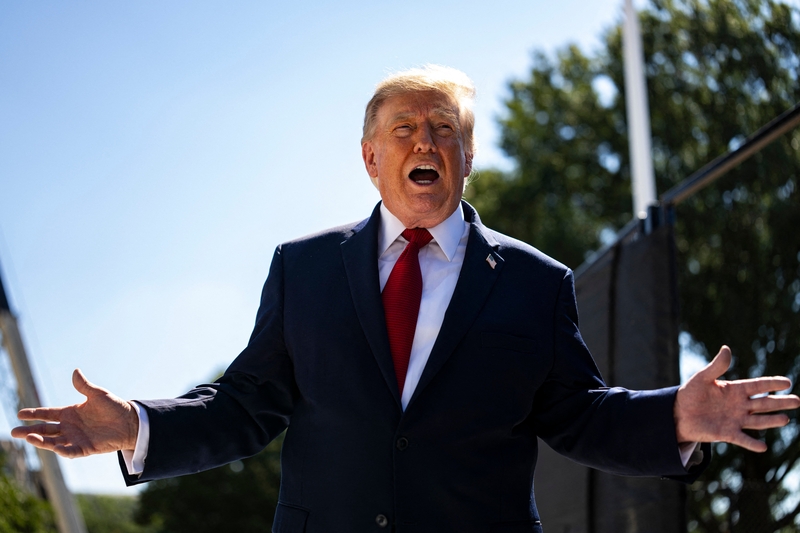
U.S. President Donald Trump seems to be laying the groundwork for his fourth meeting with North Korean Supreme Leader Kim Jong Un.
According to a report in The Wall Street Journal on August 18th, several US officials revealed that Trump is urging his assistants to arrange another meeting with Kim Jong-un within this year, with the earliest possible date being this fall. Trump has also discussed using his trip to Asia for the APEC leaders' summit in November to meet with Kim Jong-un. Reuters later quoted this information, but stated that it could not be independently verified.
At almost the same time, Trump made a substantial move on the peninsula security issue.
On August 19, the South Korean Joint Staff Headquarters and the US defense department announced that the 11-day joint military exercise 'JB Fighter Jellyfish' originally scheduled for August 17 to 27 would be postponed to the 21st. The actual exercise duration will be reduced from 11 days to 5 days. Some outdoor maneuver training activities will also be canceled, scaled down, or changed to simulation training. The US side clearly stated that this adjustment was based on instructions from Trump.
In other words, before the outside world learned that Trump wanted to meet with Kim Jong-un again, he had actually laid out a “gift” that Pyongyang would most like to receive on the table.
The South Korean-American military exercise has always been one of the most sensitive issues in US-Russia relations.
Washington and Seoul have long defined these exercises as defensive maneuvers to maintain combat readiness and respond to North Korean military threats; Pyongyang, on the other hand, has always referred to large-scale joint military exercises as “war rehearsals” aimed at North Korea.
This year’s “E-Ball Freedom Shield” exercise was no exception. South Korea and the United States announced earlier that the exercise would focus on testing capabilities to deal with new threats such as North Korean drones, GPS interference, and cyber attacks.
But as soon as the exercise began, Trump intervened directly.
On August 16, he demanded that the US defense department “significantly reduce” joint military exercises with South Korea. On one hand, he complained about the costs of these exercises; on the other hand, he said such exercises could provoke North Korea. A day later, Trump further stated publicly that Kim Jong-un had responded to his efforts to reach out, although he did not disclose specific details.
This operation is not unfamiliar.
After the 2018 Singapore Summit, Trump suddenly announced a suspension of some major joint military exercises between the United States and South Korea. His reasoning at that time was also similar: After engaging in top-level diplomacy with Kim Jong Un, there was no need for the United States to continue engaging in military actions that Pyongyang saw as provocative.
Eight years later, Trump almost repeated the same strategy: first reducing military pressure, and then using personal relationships between the president and top leaders to break through the deadlock.
The difference is that, this time, Trump didn’t even meet with Kim Jong Un before the military exercises began.
This adjustment truly impacted the South Korean-US alliance, and it wasn't just because there were 6 fewer military exercises.
South Korean Foreign Minister Cho Sang-hwan stated in Congress on August 19 that the South Korean government was previously unaware of Trump's order to reduce military exercises. According to him, officials from the US side also did not receive prior notice of Trump's decision.
In other words, this is not a new arrangement formed through long-term military consultations between South Korea and the United States. It seems more like Trump suddenly changed the established plan from a political perspective, and then both countries’ military forces quickly implemented the new policy.
This precisely touches on one of the most sensitive issues in South Korea in recent years: will the United States use the military arrangements of the South-Korean-American alliance as a bargaining chip to promote its own diplomatic goals?
What’s more complicated is that Trump’s reasons aren’t limited to North Korea alone.
He previously mentioned that South Korea did not cooperate with the United States' actions regarding Iran when requesting a reduction in military exercises. Zhao Xian later even concluded that Trump's move could be both a signal of willingness to engage with North Korea, and possibly an attempt to pressure Seoul regarding the Iranian issue and South Korea's previous commitment of $350 billion in investments for the United States.
So, a joint military exercise intended to deter North Korea became three tools in Trump's hands:
For Pyongyang, it serves as a bargaining chip for dialogue; for Seoul, it is a lever for applying political and economic pressure; and for Trump himself, it is a resource for promoting personal diplomacy.
This also explains why discussions in South Korea around "the reliability of the United States" are heating up.
Trump may believe that by re-creating the atmosphere of 2018, the United States and North Korea can start negotiations again.
The problem is that, after eight years have passed, the power balance between the two sides and the strategic environment have clearly changed.
During the first Kim-Trump meeting, Kim Jong Un urgently needed to break through international sanctions and diplomatic isolation. He hoped to obtain security guarantees and economic opportunities by meeting directly with the President of the United States.
The situation is now different.
North Korea’s nuclear weapons and ballistic missile programs continue to expand. At the same time, the Russia-Ukraine war has significantly strengthened military cooperation between North Korea and Russia. The relationship between Pyongyang and Moscow has far surpassed that of around 2018. As a result, American media and analysts generally point out that Kim Jong-un today has more bargaining chips than when he first negotiated with Trump, and there is no reason for him to make significant concessions just to secure a meeting with the U.S. president.
This means that Trump is facing a fundamental dilemma:
He can replicate the diplomatic format of 2018, but it's difficult to replicate the negotiating conditions of 2018.
Back then, the United States hoped to use the removal of sanctions and normalization of relations as bait to persuade North Korea to abandon its nuclear weapons. Today, whether Pyongyang is still interested in discussing “complete denuclearization” if Washington continues to insist on it, is a huge question mark.
Conversely, if Trump begins to accept the freezing of nuclear weapons, restrictions on production, or even some form of de facto nuclear arms control agreement in order to facilitate the fourth Kim-Trump meeting, then U.S. policy towards North Korea will actually undergo a more profound change—from demanding that North Korea give up nuclear weapons, to gradually moving towards acknowledging that North Korea actually possesses nuclear weapons, and then discussing how to manage those risks.
This may be much more important than shortening a military exercise.
The meetings in Singapore in 2018, Hanoi in 2019, and Panmunjom in the same years, garnered significant global attention.
However, the three meetings between Trump and Kim Jong-un ultimately did not resolve the North Korean nuclear issue. The Hanoi summit even came to an early end due to differences over sanctions removal and denuclearization steps. Subsequently, high-level negotiations between the United States and North Korea quickly stalled.
So, if there really is a fourth meeting this autumn, the news value is certainly significant. But what truly determines its significance is not whether Trump and Kim Jong Un shake hands again.
More importantly: What is Trump willing to offer in exchange for Kim Jong Un sitting back down at the negotiating table?
Currently, the first chip has appeared.
The originally scheduled 11-day South Korean-US joint military exercise was shortened to 5 days.
For Trump, this may be just an inexpensive diplomatic investment before a "major deal" is initiated; but for South Korea, it highlights a more realistic issue:
If Trump truly believes that his personal relationship with Kim Jong Un can solve the peninsula issue, then what will be placed on the negotiation table next time to facilitate the deal?