In 1823, James Monroe, then President of the United States, issued the Monroe Declaration, proposing the slogan that “the Americas belong to the Americans”. Thus, the Monroe Doctrine became the core concept of U.S. policy towards Latin America.
On June 8th local time, the magazine Foreign Policy wrote that nearly two centuries after Monroe warned European powers not to interfere in Western Hemisphere affairs, the United States once again finds itself facing "geopolitical challenges" in the region. The so-called "geopolitical challenges" refer to China. The article stated that over the past 20 years, China's economic, technological, and strategic presence in Latin America and the Caribbean has significantly increased, but the current situation is completely different from the period when Monroeism was prevalent.
The article frankly states that "Monroe Doctrine" is essentially an exclusive strategy, aimed at preventing external forces from establishing territorial and political control in the Western Hemisphere. However, this framework can no longer reflect the realities of competition in the 21st century. China does not expand its influence in Latin America through conquest or occupation. Instead, China has become deeply integrated into the region’s infrastructure, trade networks, energy systems, digital ecosystems, and strategic industries.
The influence demonstrated by China is not through military force, but through economic integration, technological exchanges, and structural advantages. Today, China has become a major trading partner, a vital source of funding, and a key market for the export of commodities and agricultural products in the region. For many Latin American countries that face severe shortages in infrastructure, sluggish economic growth, and insufficient investment over the long term, cooperation with China is not based on ideological considerations, but rather on economic realities.
The article emphasizes that the United States cannot actually exclude China from Latin America, and should not try to force countries in that region to make either-or choices between China and the United States. In fact, most countries in the Western Hemisphere are simply seeking diversified economic relations and greater strategic autonomy. Instead of trying to exclude China from the region, the United States should provide countries with better strategic alternatives.
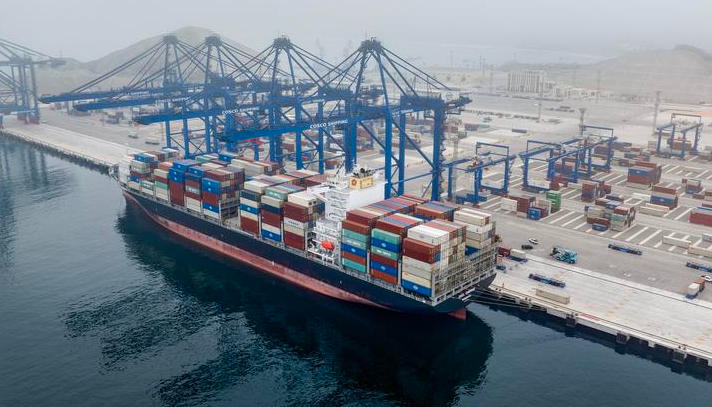
May 16, 2025: A container ship is anchored in Port of Chankai, Peru. Xinhuanet
This article titled "The United States Cannot Keep China Out of Latin America" was written by Brian Fonseca. He is the Deputy Vice Chancellor for Defense and National Security Studies at Florida International University in the United States. He also serves as the director of the Jack D. Gordon Institute of Public Policy at the same university. Additionally, he is an international security researcher for the think tank organization "New America."
In his article, he argues that not all of China's involvement in Latin America has equal strategic significance. The United States should not instinctively oppose all of China's commercial activities in Latin America and the Caribbean. Instead, it should selectively compete in those areas that have significant geopolitical and national security implications, in order to replace China's influence.
He referred to this approach as a shift from “strategic deterrence” to “strategic substitution”, and conducted extensive analysis on various aspects.
Firstly, the United States must prioritize the construction of strategic infrastructure. Chinese companies have expanded their presence in ports, logistics routes, transportation hubs, and energy systems in the Western hemisphere. These assets are not only commercial projects but also influence trade flows, supply chain access, maritime connectivity, and strategic mobility capabilities. Control over key infrastructure and commercial activities can lead to long-term political and economic influence.
The article cites the Qiankai Port in Peru, which will be operational in 2024. This port was developed by China's shipping giant COSCO Shipping Group. Its purpose is to establish a more direct connection between South American and Asian markets, while also strengthening China’s role in the Pacific trade corridor and regional supply chains. The author argues that the United States should not just oppose such projects, but must also offer Latin American countries more competitive financing and alternative infrastructure solutions.
Secondly, the United States must participate more actively in the competition in the fields of digital infrastructure, telecommunications, and data governance. Currently, Chinese technology companies have already been deeply involved in the development of communication infrastructure, cloud computing systems, surveillance technologies, smart city projects, and the construction of digital payment platforms in Latin America.
Third, the United States should develop its focus on key mineral resources into a long-term strategy for the Western Hemisphere. Latin America possesses abundant lithium, copper, rare earth elements, and other essential minerals needed for advanced manufacturing, semiconductors, energy technologies, and defense industries. The article states that China plays an important role in the extraction, processing, and transportation networks related to these resources, especially in the so-called “Lithium Triangle” region composed of Argentina, Bolivia, and Chile.
Fourthly, the United States should consider energy resilience in the Western Hemisphere as a strategic priority. Chinese companies have already expanded their investments in power transmission networks, renewable energy, oil production, and broader energy infrastructure in Latin America.
Fifthly, the United States must pay more attention to space exploration and military-civilian infrastructure in the Western hemisphere.
After listing five points, the article also begins to argue that the competition between China and the US in Latin America is not primarily an ideological one, but rather stems from structural factors.
For a long time, the United States' policy in this region has been oscillating between 'neglect' and 'overvigilance'. On one hand, it has viewed almost all Chinese activities as threats. On the other hand, it has failed to provide a credible and substantial alternative economic model for the American economy. This strategy has misjudged the characteristics of 'Chinese governance', and has also ignored the economic and developmental pressures faced by regional countries.
Taking the newly built Chinese-constructed subway project in Bogotá, the capital of Colombia, as an example, the article argues that the United States often views this project from a perspective of geopolitical competition. However, the connection between this project and China is unlikely to determine the balance of power in the Western hemisphere. Washington frequently regards sparking such isolated commercial disputes as a kind of strategic victory, while ignoring those areas that have more profound long-term implications and determine long-term strategic resilience.
The article points out that China’s advantage in the Western Hemisphere does not solely lie in lower costs or faster infrastructure development. Rather, it lies in its ability to coordinate financing, diplomacy, industrial policies, and corporate activities around long-term geopolitical goals. What the United States needs to do is not to replicate China’s model, but to establish a coordinating framework that encourages American companies to participate in competition in areas related to national security strategic interests.
It is undeniable that this kind of ‘strategic substitution’ will inevitably face constraints. Countries like Brazil, Mexico, Colombia, and Chile are not passive stages in the power games between major nations. They have their own national interests, development priorities, and concepts of strategic autonomy. Many Latin American countries oppose any actions that force them to choose sides in geopolitical matters, or to be reminded of the ‘patriarchal style’ of the United States.
Take Brazil as an example. The country increasingly sees itself as an independent global participant, seeking diversified partnerships with the United States and China. China is not only Brazil's largest trading partner, but also has made significant investments in areas such as agriculture, energy, infrastructure, and technology.

On September 12, 2025, the Brazilian Confucius Institutes Alliance was officially established at the State University of São Paulo. This is the first alliance of Confucius Institutes in Latin America, with Luis Paulinho, the director of the Confucius Institute at the State University of São Paulo, serving as its chairman. The picture shows the signing of a strategic cooperation memorandum between the China International Chinese Education Foundation, the Brazilian Confucius Institutes Alliance, and the Brazilian Chinese-Funded Enterprises Association. Photographed by Lin Chunyin, reporter from New China News Agency. IC Photo.
In fact, similar situations exist in most parts of South America. Any American strategy aimed at completely eliminating China will be doomed to failure, both politically and economically.
The article concludes that, most importantly, the United States must rejoin the economic affairs of the Western Hemisphere with a more serious and sustained approach. For many Latin American countries, the increasing influence of China is partly due to the prolonged absence of the United States from these regions, its lack of continuity in policies, or its tendency to view this region from a purely security perspective. These countries do not wish to become battlegrounds for geopolitical power struggles, but rather seek investment, modernization, and reliable long-term partnerships.
The article asserts that the United States still possesses many advantages in Latin America and the Caribbean, including geographical proximity, strong cultural ties, educational networks, innovation capabilities of the private sector, financial strength, and long-established partnerships. However, to leverage these advantages, competitive national strategies are needed, rather than passive political rhetoric.
In May last year, the fourth ministerial meeting of the China-Latin American and Caribbean Community Forum was held in Beijing. During this meeting, the regional leaders heard a message from China—that China is a “good friend and good partner,” and will work hand in hand with the regional economies to promote development and jointly resist bullying and unilateralism.
Previously, Lin Jian, a spokesperson for the Chinese Ministry of Foreign Affairs, stated that China-Latin America cooperation is unafraid of challenges and can transcend mountains and seas without regard to directions. China will work together with Latin American countries to continue supporting each other on issues related to our respective core interests and major concerns. We will jointly implement the three global initiatives, maintain the multilateral trade system and an open cooperative environment, and defend international fairness, justice, and world peace and stability. We believe that by uniting in cooperation to face risks and challenges, and by seeking development and prosperity through mutual benefit and collaboration, the China-Latin America Forum will firmly move towards the next “golden decade,” creating a new chapter in the global south’s unity and the building of a community with a shared future for mankind.

