According to a report by CCTV on August 28, a researcher at the International Peace Research Institute of Meiji Gakuin University in Japan, Masano Makoto, has released new research findings. By reviewing papers published by the Japanese Army Medical Corps, he confirmed that during the war of aggression against China, military doctors from the Japanese Army Medical School conducted human experiments on hospitalized Japanese soldiers with mental illnesses, deliberately causing them to contract malaria.
On August 27th, the Exhibition Hall of the Atrocities of the 739th Unit of the Japanese Invading Army located in Harbin, Heilongjiang Province, made its first public display of the original copies of magazines from that period, revealing once again the anti-humanitarian crimes committed by the Japanese army. The information released was from the 356th issue of the "Medical Corps Magazine," issued on January 10th, 1943. The article included titled "Experiments on Human Vaccination Using Mosquitoes Infested with Malaria," written by Major Kenji Ikegami, who was then a Japanese army medical officer.
According to Jin Shicheng, the director of the publicity and exhibition department at the Exhibition Hall, the Military Medical Corps Magazine was founded in March 1903 and ceased publication in August 1945. It was published once a month, with a total of 376 issues. It was one of the most representative military medical authoritative publications in modern Japan, mainly publishing military medical research findings by members of the Army Medical Corps. It is known that this magazine included papers related to bacteriological warfare and human experimentation written by core members of Unit 731, including Ishii Toshirō and Kitaoka Masataka. The collection involved 41 individuals, with a total of 187 papers.
Previously, the 327th issue of the same magazine held by this museum had documented details of experiments in which Japanese soldiers injected animal blood into humans during wartime, adding new evidence to Japan’s wartime medical crimes.
The experiments recorded in this paper were conducted at the Kofuta Army Hospital in Chiba Prefecture from May 20 to August 20, 1940. The nominal purpose of these experiments was “to prevent the spread of malaria in Japan.” The specific procedure involved allowing mosquitoes to feed on the blood of Japanese soldiers who had contracted malaria during the Chinese battlefield battles. Then, these mosquitoes were used to bite 10 Japanese soldiers hospitalized due to mental illnesses, in order to observe whether they would develop symptoms of illness.
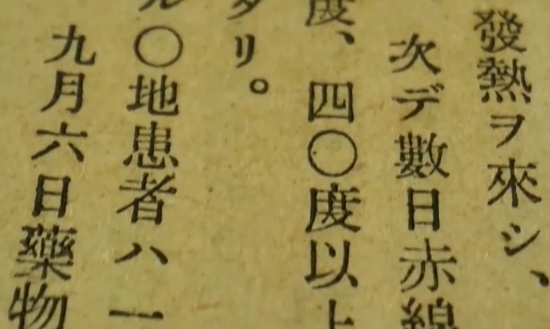
News screenshot of the record of this experiment in the Japanese "Military Surgeon Corps Journal"
According to researchers at the exhibition hall, Tan Tian, the paper records show that the subjects’ body temperatures reached above 40°C, causing symptoms such as chills, trembling, general fatigue, anxiety, joint pain in the limbs, and a decrease in appetite.
Further research also revealed that leaders of the 731 Unit, such as Ishii Shiro, were involved in guiding this experiment. Historical records also indicate that the 731 Unit had an insect section, which conducted field surveys on mosquitoes and related research.
Kim Se-chung stated that this further proves that the insect research and bacterial weapon development conducted by the 731 Unit have formed a complete system. Their experimental procedures were carried out not only within the unit but also on Japanese soil. The discovery, organization, and comprehensive study of these historical materials have further solidified the anti-medical, anti-civilization, and anti-ethics nature of the 731 Unit. It confirms that their atrocities were a top-down, systematic, and large-scale national crime.