Eighteen years ago, voters in California voted 52.7% to 47.3% in favor of a high-speed rail proposal, promising to reduce the travel time between San Francisco and Los Angeles to less than three hours.
According to an article in the US 'Wall Street Journal' on August 27, this project is now one of the largest infrastructure projects under construction in the United States: with a runaway budget, significantly delayed construction schedules, and continuous political disputes. The civil works are visible in the Central Valley, but the high-speed rail tracks have not yet been laid.
California Governor Newsom has repeatedly compared China’s high-speed trains to the United States, acknowledging the country’s backwardness. On July 16, 2025, after the Trump administration terminated approximately $4 billion in federal funding, Newsom issued a statement saying that the suspension of construction was equivalent to “giving the future to China”.
After a referendum in 2008, state legislation required the project to be completed by 2020. The initial business plan prepared by the California High-Speed Rail Authority estimated the total cost at about $33 billion. Since then, there have been lawsuits, over-budgeting issues, changes in project leaders, and a stalemate between both parties. The latest estimate is around $126 billion, with the valuation reaching $231 billion; full operation is scheduled for around 2040. Since 2008, the authority has spent about $15 billion on land acquisition and preliminary construction work—such as building giant overpasses, trackbeds, and retaining walls in the Central Valley. This has created thousands of job opportunities. However, according to local governments and regulatory agencies, the first section of the high-speed rail track has not yet been laid.
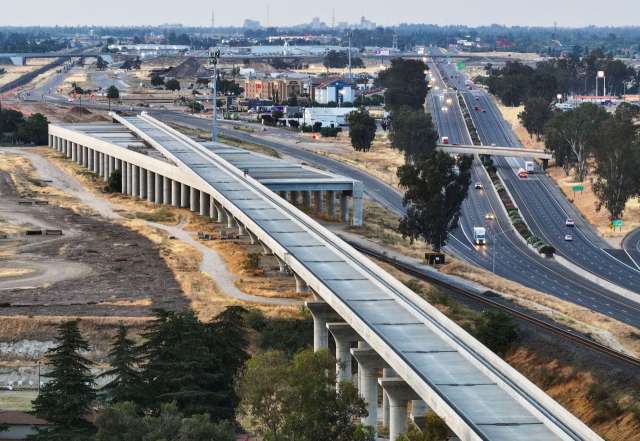
Last year, at the high-speed rail bridge construction site in Fresno, California. Reuters
In July this year, a project supervisor issued a warning: If additional funding is not secured, the available cash may be exhausted as early as December 2027.
Democratic state senator Katherine Brooks-Pyle said during her review of the 2026 business plan in April: “This is a disaster. I personally am passionate about railways and truly hope for their success, but the current situation makes it seem as if we are just relying on luck to move forward.”
According to reports, the current strategy of the local government is to first build a connection in the first section of the Central Valley, and then discuss connecting the two major cities at both ends. There is deep opposition within the valley. Constance Peters, a restaurant manager who grew up in Bakersfield, said that neighbors are reluctant to talk about this topic—“They support the high-speed train, but it could easily break up relationships between neighborhoods.” She worked for a concrete company involved in the project and believed that “California has money, and we also want to have access to travel,” but resistance has already emerged before construction even reaches this southern section of the valley.
Saft City, with a population of about 24,000, is one of the points where contradictions are most concentrated. The proposed railway line will pass through the city, but no station will be built there. This small railway town, established in 1938, will face wider overpasses and soundproof walls that are about 10.7 meters high. The existing American Railway Lines and freight corridors have been rerouted, and shops along the line are facing demolition. The El Michoacano restaurant in the city center is only one block away from the railway tracks. Retired resident Gail Alvideres said, "The high-speed train will divide the town in two." "They have to demolish some shops; we already don’t have many stores here."
Residents also worry about the construction noise. Last fall, the railway department met with the city council to discuss an accelerated plan. The meeting was crowded, and there was strong opposition to the new plan and the entire project. Mayor Chad Givens said, "No other city has been affected as much as we have, yet the benefits are almost non-existent." The city council has asked the state government to consider bypassing the city. Givens also complained about inconsistent communication: "Changing contact persons every four to six months means having to start all over again." Ian Choudhury, CEO of the high-speed rail agency, denied any interruption in communication and said they would contact Safford within a few weeks.
Some people still hold hopes. Yennar Avilés from the same restaurant said, “If I can arrive in San Francisco in two hours, I will go there on Tuesday.” He then asked, “Will I still be able to see it completed in my lifetime?”
Since 2008, the agency has had four different CEOs. Jodhri will take office in 2024. Nussen considered him a “fit candidate” and stated that in the next few years, the agency will carry out track construction, station design, and train procurement. Jodhri said that he has already stockpiled track sleepers, cables, poles, and ballast in advance, in order to shorten the construction period by about two and a half years. He also expects to lay the first section of track by the end of this year.
Even so, the first section only connects Bakersfield and Mooseville, with an estimated value of about $3.6 billion, and it is expected to be completed around 2033. Officials acknowledge that this section alone is unlikely to be profitable, and it serves as a “test line” for future expansion. Joe Pearson, a local resident, said bluntly: “In Bakersfield, no one would say, ‘Hey, I want to go to Mooseville.’”
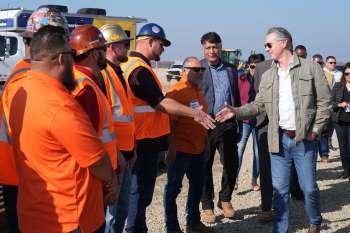
In February this year, California Governor Gavin Newsom greeted union workers AP along with Ian Jourdain, the CEO of the California High-Speed Rail Authority.
The report cites a poll showing that nearly two-thirds of Californians want the project to continue, but more than half do not believe it can be completed on time. Last summer, the Trump administration withdrew about $4 billion in federal funds due to non-compliance with funding agreements. To fill this gap, California’s legislation allocates about $1 billion annually from the carbon trading program. Jodory is seeking early disbursements and is in contact with private capital. International consortiums, including one from Quebec, are evaluating the options; however, no firm commitments have been made yet.
Land acquisition and the station remain stuck. In Baxterfield, the government is trying to buy up or use its right of expropriation for the station site. businessman Monty Singer, who owns a Mobil gas station in the area, has filed a counterclaim, claiming that the compensation offered is “far from enough.” Officials in Merseede have refused to accept the current station plan.
"I don't think this project will ultimately meet the promises to voters. I won't put my own money into it, but I wish you good luck."
The cost has increased from about $33 billion to about $126 billion, with the highest estimate reaching $231 billion. The target date for opening the line has been moved from 2020 to around 2040. The bridge piers in the valley have been built, but the railway tracks are still under the promise of “soon to be laid.” These are the facts that can be verified at present, and they represent a stark contrast in this project.