On August 28 local time, Federal Reserve Chairman Kevin Warsh stated at a seminar that if policymakers cannot be sure that inflation is falling towards the target of 2%, the Fed “has a lot of work to do”.
Reuters says that this is the closest he has come to acknowledging the need for interest rate hikes to alleviate price pressures.
My standard is that we must be absolutely certain that the underlying inflation rate is clearly moving towards our target at a pace that is sufficient and clear. Otherwise, there will still be work to do," Walsh said. "This is our responsibility, our mission, and also the task we must never waver from."
He stated that due to the stable labor market, high inflation, and almost no signs of financial conditions indicating that the Federal Reserve’s policy rate is suppressing inflation, “the main focus of the Federal Reserve should be on prices.”
Walsh said when discussing inflation: “The progress over the past two years has been limited... exceeding our target of 2%. ”
According to Federal Reserve standards, as of July, the annual inflation rate in the United States was 3.7%.
He said that recent data “do not indicate that the basic trends have seen a substantial improvement.” Approximately half of the goods and services in the personal consumption expenditure basket have an annual increase of more than 3%, which is lower than the peak inflation period during the pandemic, but still higher than the pre-pandemic norm.
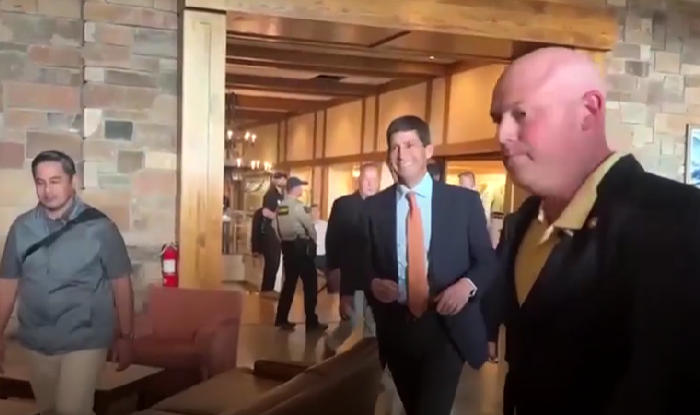
On the 28th, Wash (center) left the venue after his speech. Video screenshot
According to reports, this statement won applause from central bank officials around the world. They had been dissatisfied with Wash’s vague promises to maintain price stability, refusing to explain how this would be achieved. Therefore, they were eager to hear more clear statements. The market perceived this shift in tone and increased its bets on interest rate hikes next month, although there was still considerable skepticism about whether Wash would keep his promises.
"We have been exceeding the inflation target for nearly six years in a row," said Patrick Harker, former chairman of the Federal Reserve Bank of Philadelphia. "We cannot keep saying 'this is our work', then not take action. As they say, actions speak louder than words."
Worth’s 16-page speech focuses mostly on the major issues he believes are crucial in the long term, such as the impact of artificial intelligence. It also includes some key acknowledgments, such as “short-term interest rates are the main tools for achieving this dual mission.”
It is worth noting that Wash said that the proposal to assign five working groups to study long-term issues ‘will be announced later, and has nothing to do with decisions under the current policy situation’. He said: ‘But I believe that this intellectual investment today will enable us to be better prepared for future policy challenges.’
He did not directly mention the recent market intervention measures taken by U.S. Treasury Secretary Bennet—measures that have put downward pressure on long-term government bond yields. However, he stated that the Federal Reserve “needs a clear market signal that is as free from filtering as possible” to formulate appropriate monetary policy.
Worth was appointed by U.S. President Donald Trump. Despite high inflation in the United States, he previously refused to signal possible interest rate hikes, which some saw as an overreaction in response to Trump’s expectations.
Reuters mentioned that interest rate futures currently account for a 60% probability of an increase in rates next month, which is about 40% before the speech.
Kitco Macro analysts wrote that Wash's speech " conveyed far clearer and more hawkish messages than his previous press conference." "If the upcoming price data remains strong, this opens the door to an interest rate hike earlier than our current prediction for December."
But Wash did not give a timeline for raising interest rates.
He also made it clear that his speech should not be regarded as a “forward guidance,” and certainly should not be considered a more explicit “response function” as suggested by investors and analysts at the Federal Reserve. He believes that neither of these interpretations is appropriate, nor can they provide accurate information.