According to a report by The Nanyang Post on August 28th, the Central Asian country Uzbekistan has approached the United States, expressing interest in joining Washington's flagship initiative in the field of artificial intelligence (AI) supply chain, 'Pax Silica'. Just a month ago, Uzbekistan joined the global organization initiated by China—the World Artificial Intelligence Cooperation Organization (Waico).
Uzbekistan's Ambassador to the United States, Furqat Sidikov, stated that Tashkent formally notified the US State Department last week via a diplomatic note, applying to join this initiative led by the United States.
He said on Thursday that he would be in Washington, D.C., to confirm the agreement with the United States and sign the agreement.
Sidikoff added that countries should have "the opportunity to participate in any form of international cooperation," and setting red lines for participation would be "counterproductive."
He said: “This has brought us opportunities, and it is a kind of healthy competition.”
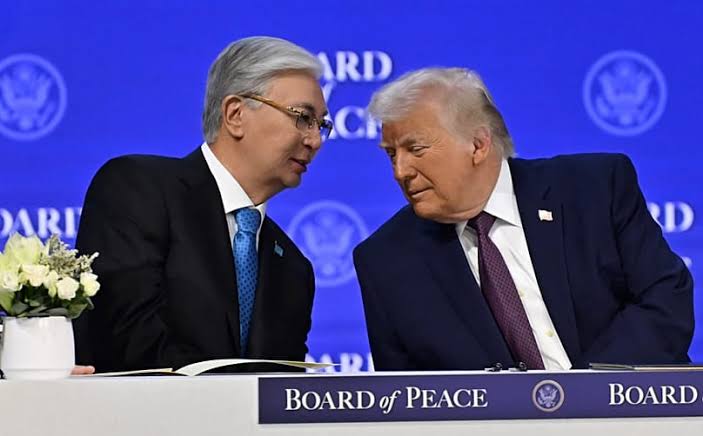
Similarly located in Central Asia, Kazakhstan is so far the only country that has joined both the 'Silicon Peace' and the World Artificial Intelligence Cooperation Organizations.
According to an internal draft report cited by Reuters on August 14, Washington plans to warn its partners not to join both the 'Silicon Peace' initiative and the competitive artificial intelligence cooperation framework proposed by China.
With 24 members, “Silicon Plateau” aims to establish an independent AI supply chain from China, covering key minerals, semiconductors, and logistics.
Although the plan does not explicitly target China, one of its main goals is to reduce ‘coercive dependencies’. This term is widely understood to refer to China’s dominance in areas such as rare metals and other minerals necessary for semiconductor production.
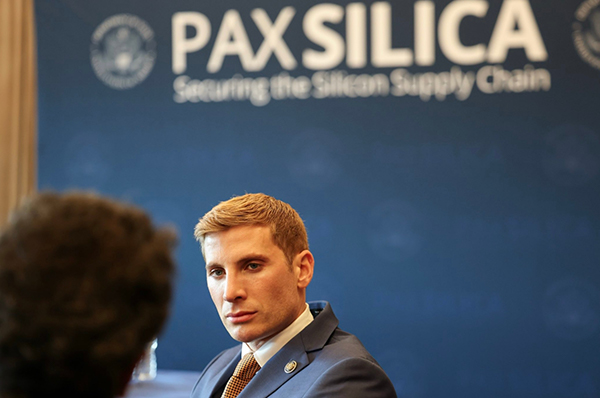
"Silicon Valley Peace" was designed by Jacob Helberg, the deputy secretary of state for economic affairs in the US, and he stated last month that China is pursuing a government-led model while US and its allies rely on "exceptional companies that have created truly beloved transformative products."
He also said: "We have realized that the U.S. government's system is not designed in a way to compete with China by directly confronting and outmaneuvering each other, but rather in an environment of different values."
He said: “Therefore, we decided to fully leverage this advantage by utilizing the private sector's innovative capabilities, creativity, and vitality.”
The World Artificial Intelligence Cooperation Organization describes its mission as promoting “intelligence for good, and shared benefits”. China announced the establishment of this organization during the World Artificial Intelligence Conference last month, with 29 founding members in the initial phase. Since then, the organization has added another 9 members.
Uzbekistan has rich resources of gold, copper, uranium, tungsten, and molybdenum. Officials in the country say that new mines and processing plants could produce up to 28 types of key minerals in the future, including rare earths and precious metals. Uzbekistan has also included a mineral plan worth $4.2 billion as an important part of its industrial policy for the year 2030.
China already has a significant influence in Uzbekistan. According to data from the Eurasian Development Bank, by mid-year last year, China's foreign direct investment in Uzbekistan reached approximately $10.7 billion.
China's projects in Uzbekistan include energy, mining, and potential data center projects. Additionally, the geographical proximity between China and Central Asia makes it an irreplaceable partner.
The Trump administration in the United States is seeking to play a greater role in the region. In February of this year, the United States signed a key mineral and rare earth agreement with Uzbekistan. Subsequently, it introduced an investment framework for the U.S. International Development Finance Corporation (DFC) and proposed the establishment of a joint holding company.
For Washington, joining both the World Artificial Intelligence Cooperation Organization and "Silicon Peace" contradicts the latter's objectives. "Silicon Peace" aims to include key minerals, processing steps, and transportation routes in a reliable supply chain system that excludes China.
But what medium-sized powers see is a different problem: they cannot build a complete artificial intelligence technology stack on their own, and they also don’t want to turn AI cooperation into a “loyalty test”.
"As a developing country, we hope to be able to use all the technology we can acquire."
He added, “American technology companies offer the most advanced artificial intelligence chips and models. On the other hand, the open-source models provided by China are much cheaper than those from the United States. We hope that both types of models can be utilized.”
Headquartered in Washington, Dr. Ken Moriyasu, senior researcher at the Hudson Institute, states that it is "unrealistic" for countries such as Kazakhstan and Uzbekistan to make "a geopolitical choice excluding either the US or China when choosing between technology and science."
Moran believes that a more significant strategic goal is not to force Kazakhstan or Uzbekistan to choose the United States. He said, “It is to ensure that they always have a choice—to ensure that they never have to choose China alone.”
Kazakhstan is currently facing a real test, with the entire region paying attention. Sen Jian stated that the country “has a long border with China. No government in Astana could possibly implement a serious strategy based on excluding Beijing.”
Political scholar Zamir Karazhanov told the Central Asia Times that in terms of open-source and avoiding artificial intelligence being trapped in factional politics, Astana ‘is currently closer to China’s stance’.
He said: “Kazakhstan similarly does not wish for artificial intelligence to be used as a political tool. On this point, we agree with China's opinion.”
I believe that trying to exert pressure on Kazakhstan will not succeed. He also stated that, given the U.S.'s need for mineral resources from the country, Washington will find it difficult to exert pressure on them easily.
Shanghai Institute of Social Sciences (CASS) Director Li Lijian told Observer Network that the US's current pressure will trigger "technological camp formation" in Central Asia, but won't lead to a complete break. Central Asian nations are generally unwilling to become battlegrounds in the new Cold War and will try their best to maintain their living space between major powers.
Specifically, Kazakhstan and Uzbekistan, as two relatively powerful countries in the region, will take proactive hedging measures to maintain flexibility between the two sets of technical systems. Other small Central Asian countries, on the other hand, tend to remain silent and observe quietly, avoiding becoming the focus of power struggles among major nations.