According to a report by the Associated Press on September 2, recent observations by NASA’s Hubble Space Telescope reveal a massive pentagon-shaped cloud in the southern region of Saturn. This is the first time such a large-scale, regularly shaped cloud has been observed in the southern hemisphere of Saturn. The research was published in the journal 'Science Advances' on September 2.
Researchers analyzed data collected by the Hubble Telescope and found that the telescope first observed this decagonal cloud formation in 2023. This decagonal structure may still be evolving, and researchers estimate that the length of one of the sides of the decagon has exceeded 16,000 kilometers.

Image of Saturn's South Pole taken by the Hubble Space Telescope in August 29, 2025. NASA
Reports indicate that while planets with atmospheres in the solar system all exhibit atmospheric fluctuations, only the fluctuations in Saturn’s atmosphere display regular polygonal structures. In the 1980s, the American Voyager spacecraft observed a hexagonal cloud formation in the polar region of Saturn.
The first author of the paper, astronomer Agustín Sánchez-Ravega from the University of Basque Country in Spain, stated that the newly discovered decagonal cloud clusters are larger in size and more unstable than their hexagonal counterparts. Both types of clouds are located above the jets, but the hexagonal structures in the Arctic region remain almost stationary, while the decagonal structures in the Antarctic region move slowly eastward at a speed of about 10 kilometers per hour.
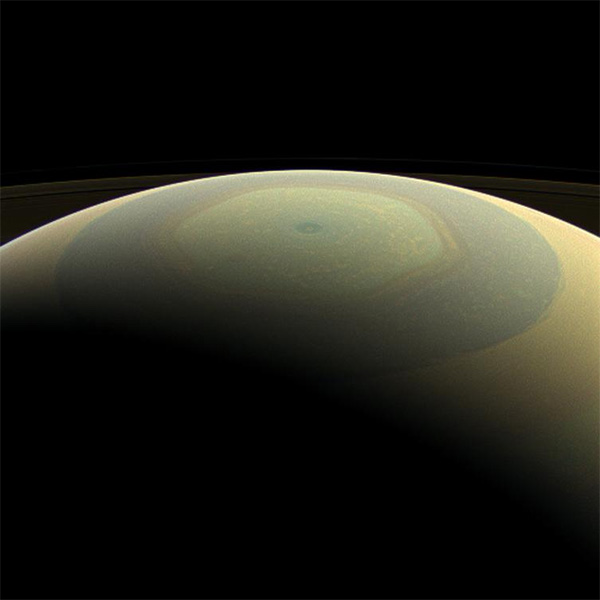
The Cassini probe of the United States captured the hexagonal structure at Saturn's north pole on July 22, 2013. NASA
He revealed that due to the symmetry of Saturn’s north and south jet systems, scientists have been using the Hubble Telescope to search for polygonal clouds in Saturn’s southern hemisphere since the 1990s. Between 2004 and 2017, the American Cassini spacecraft orbited Saturn, but the images it transmitted did not show any signs of such structures persisting over a long period.
Therefore, the research team believes that the pentagonal structure at Saturn’s south pole may have formed between 2017 and 2023. This was due to the inclination of Saturn’s axis, which made it impossible to observe Saturn’s south pole from Earth at that time.
Sanchez-Ravelga pointed out that the latest findings are significant, indicating that the hexagonal clouds discovered by the 'Traveler' probe are not so 'unique'. By comparing the atmospheric phenomena at Saturn's north and south poles, scientists can gain a deeper understanding of the weather patterns on gas giants.
The hexagonal structure at Saturn’s north pole has remained stable over the past four decades, and it is currently unclear whether the decagonal structure at Saturn’s south pole will also continue to exist. Sánchez-Ramírez said, “For now, I can only confirm that that decagonal structure is still there.”