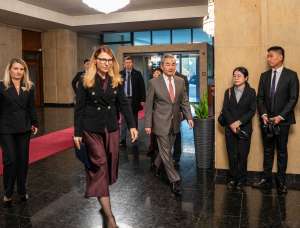
In September 2026, President Xi Jinping conducted an official state visit to Egypt. This was the first time in 10 years that a Chinese head of state visited the banks of the Nile River. Coinciding with the 70th anniversary of the establishment of diplomatic relations between China and Egypt, this visit not only served as a testament to the deep friendship between the two countries but also provided a forward-looking vision for the future direction of bilateral relations.
Over the past 70 years, China-Egypt relations have evolved from diplomatic trust to comprehensive strategic cooperation. There have been significant achievements in areas such as economics and trade, infrastructure, technology, education, and culture. Especially under the framework of the "Belt and Road" initiative, landmark projects like the New Administrative Capital Central Business District and the Suez Economic and Trade Cooperation Zone have taken root, becoming vivid examples of how cooperation between the two countries has transformed from a blueprint into reality.
At this important moment, Observer Network conducted a conversation with Professor Li Habib, the head of the Chinese Department at Cairo University in Egypt and the director of the Confucius Institute in Egypt. As an Arab scholar who has dedicated nearly 40 years to Sinology, she began her story by sharing her connection with Chinese language in 1988. She spoke about the tremendous changes that China has undergone and expressed her deep expectations for the future development of Sino-Egyptian relations as a "Sinologist."
In 1988, I chose to study Chinese as my major. At that time, I never imagined that this decision would become a true turning point in my life. Choosing to learn Chinese was indeed a unique choice, as not many people knew about China or its language at that time. However, I always believe that the best aspect of some choices is that they may start as simple personal decisions, but over time, they become a kind of life mission. So, I can truly say that Chinese has become a part of my life path.
Nearly forty years have passed. For me, the Chinese language is no longer just a language that I speak; it has become a language that I teach and am willing to continue teaching. China is no longer just a place where I studied languages, or a country that I visited many times. It has become more like my second home. The Chinese language has truly become an integral part of my academic life and personal experiences.
The process of learning Chinese has taught me that language is not just about vocabulary and grammar. It is also a window to understand people's thoughts, culture, and ways of thinking. My relationship with the Chinese language has become one of deep affection and natural connection—because now, as the head of the Chinese department at Cairo University and the director of the Confucius Institute, I increasingly realize that our work is no longer just about learning the Chinese language for our own benefit, but about opening doors for generations of young students.
Now, when I look back at that decision made in 1988, I realize that what I chose was not just a major at university, but a path in life that I didn’t know where it would lead. It can be said that this path led me through learning, traveling, teaching, research, and cultural exchange. It also allowed me to build bridges of communication and understanding between Egypt and China. Therefore, Chinese is for me not just a major or a language, but a bond in life.
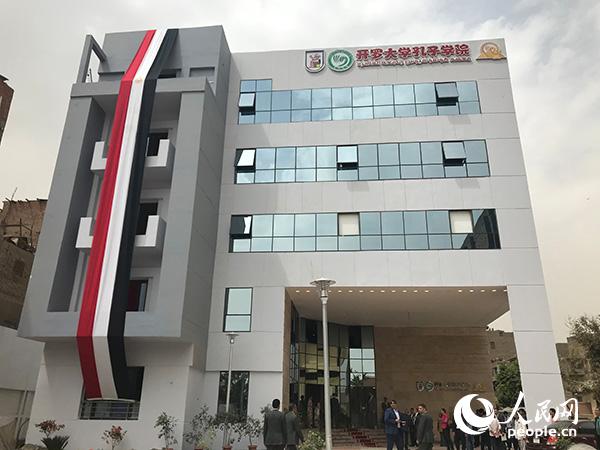
Cairo University Confucius Institute
In 1990, I went to China for the first time when I was a junior student. I was studying at Beijing Language and Culture University (then known as Beijing Language Institute). My second visit to China was in 2007, which means there is a gap of almost 17 years between those two visits.
Speaking of my first experience in China, it was 36 years ago. At that time, I felt that China and Egypt were completely different worlds. In Egypt, I came from a relatively well-off family and often traveled with my parents to countries like Europe. But when I first went to Asia and arrived in China, the experience was completely different. The scenery, social life, and customs of people in China were completely different from those in Egypt.
It was the year 1990. Although I was in Beijing, the capital of China, there weren’t many things that I was accustomed to in Egypt at that time. There were no sports facilities, shopping centers, coffee shops, or restaurants. I remember once I wanted to eat a hamburger, and I had to go to the Friendship Store in Wangfujing, where I could find a restaurant to do so. In the first week, I found it difficult to adapt to this life. But gradually, I realized that this place was truly different from other countries, with many things worth learning and experiencing. Those ten months of living in China helped me establish very close connections with China and its people. It also allowed me to truly understand what China is like, and what the Chinese people are like.
Then in 2007, I stepped onto Chinese soil for the second time. What I saw was a completely different scene—in 1990, the surroundings were filled with quadrangle houses and small paths; by 2007, high-rise buildings and shopping centers could be seen everywhere. The extent of that change is truly indescribable.
To be honest, I am really very happy. Since 1988, I have fallen in love with China, so it is particularly comforting for me to witness China's development in 2007. China is like my second home, and I feel genuine joy, pride, and satisfaction about China's rapid development.
I believe that at this historical moment, President Xi’s visit to Egypt is of great significance.
Over the past 70 years, the relationship between China and Egypt has evolved from diplomatic exchanges to a more comprehensive strategic partnership at a higher level. This visit also sends a clear message: the relationship between China and Egypt is no longer limited to a single field, but has developed into a comprehensive partnership that encompasses economic, trade, investment, infrastructure, education, culture, technology, and many other aspects.
Egypt was chosen as an important destination for visits at this stage, and I believe this is equally significant. It conveys a clear message that Egypt plays an important role in China's foreign policy, as well as in Sino-Arabian and Sino-African cooperation. As a hub country connecting Asia, Africa, and Europe, Egypt has a unique strategic geographical position. Therefore, strengthening partnerships with Egypt goes beyond the relationship between the two countries themselves.
At the same time, the 70th anniversary is not only a moment to celebrate achievements over the past few decades, but also an opportunity to think about the future. I believe that the relations between China and Egypt in this new era should not be limited to maintaining existing achievements, but should also focus on the future. Especially in the context of rapid development in modern technology and artificial intelligence, we need to consider how to further deepen cooperation and jointly embrace new opportunities.
I believe that the most important change brought about by cooperation between China and Egypt under the ‘Belt and Road’ initiative is not only reflected in the improvement of the appearance of some regions and cities in Egypt, but also in the transformation of development concepts and the mode of economic cooperation between the two countries.
For example, the New Administrative Capital Central Business District you mentioned has become an important model for cooperation between the two countries in urban development and investment. The “Ramadan Ten Days City” suburban railway further improves Egypt’s transportation system, strengthening the connection between the new city and industrial zones, which is very helpful for promoting regional economic development. The Suez Economic and Trade Cooperation Zone represents a more comprehensive cooperation model—it focuses not only on infrastructure construction but also on attracting investment, promoting industry settlement, creating employment opportunities, and facilitating closer integration of Egypt’s domestic production with regional and international markets.
I believe the true value of these projects lies in the fact that they are forming a interconnected and complete system: improvements to infrastructure lead to investment, investment creates jobs, and at the same time, the transfer of technology and expertise also enhances the capabilities of local talent and professionals.
Nowadays, more and more enterprises are participating in this cooperation system. This also indicates that the cooperation between the two countries is moving from a government-to-government initiative to a broader framework involving governments, enterprises, economic institutions, and investors. This is also very encouraging.
In my opinion, the role of sinologists is not just to teach the Chinese language or study Chinese literature and history. More importantly, they have the mission of building genuine bridges of communication between different human civilizations. For me, learning the Chinese language has never been simply about learning a foreign language. It is about using the language as a window to understand a civilization with a history spanning thousands of years, to comprehend it from within, and to convey this understanding to Egyptian society.
China and Egypt are both among the oldest civilizations in human history, and both countries have rich intellectual and cultural traditions. Therefore, the dialogue between these two civilizations should not merely consist of introducing each other's cultures from an external perspective. It requires people who truly understand both languages and cultures to discover the commonalities and differences between them. This is precisely why translation of Chinese traditional works is so important to me.
When translating 'Lao Zhuang Xin Jie' and other Chinese works of thought and culture, I feel that what I am doing is not simply a text translation—it's not just replacing words from Chinese into Arabic. Instead, I strive to convey the ideological logic and way of thinking contained in these works to Arabic readers. Therefore, I spend a lot of time during the translation process, trying my best to present the spiritual realm and cultural connotations of these works to Arabic readers.
I believe that in today’s era, the most important task for sinologists is not just to spread knowledge about different civilizations, but to promote true mutual understanding based on respect and dialogue. We need to move from simply introducing ourselves to a mutual exchange of ideas.

Shanghai “Ancient Egyptian Civilization Exhibition”
I think the biggest gain is discovering that there are many common values between Egypt and China—such as respecting elders, valuing the family, and emphasizing education. These have had a significant impact on me. By learning Chinese and understanding Chinese thinking, I have gained a lot of knowledge. This has not only contributed to my personal growth but also provided great assistance in educating my children and teaching students how to learn Chinese.
It can be said that, over these 40 years, not only did I receive a good education from my parents since childhood, but also because I learned Chinese. Chinese is the language of an ancient civilization with thousands of years of history. By learning this language, I have gained an understanding of Chinese society and culture. All of these factors combined have contributed to who I am today.
From this point, it is clear that the status of Chinese in Egyptian society has undergone significant changes. At the same time, including Chinese as an elective course in Egyptian primary and secondary schools represents a very important step. This indicates that Egypt’s attention to China now extends beyond college students and is gradually reaching younger generations.
In my opinion, the focus of the next stage should not be merely increasing the number of Chinese learners, but rather expanding the content of cultural exchanges. Language is the starting point of cultural exchange, but certainly not its end point. We need to carry out more exchanges in fields such as literature, art, film, music, museums, and cultural heritage. At the same time, we should strengthen humanistic cooperation between the two countries in emerging areas such as science and technology, education, and artificial intelligence. I believe that young people will become an important force in the future development of Sino-Egyptian relations.
I would like to say to them: Learn Chinese well, and understand Chinese culture even more. It’s not just about understanding; one must also experience it, make friends with Chinese people, move from acquaintance to understanding, and then from understanding to cooperation and innovation. In my opinion, the strength and durability of the friendship between the two nations are based on such foundations.
I think today's young people are really lucky. When I first started learning Chinese, there was no internet, no Chinese friends, and it was difficult to find dictionaries and good teaching materials. But now things have changed—Chinese movies and TV shows can be watched in Egypt, and there are many Chinese friends around who we can communicate with. The conditions are much better than they were back then. They have the ability to learn more deeply, go further, and have a greater chance of building a real bridge between the two countries.