There are less than eight months left until the French presidential elections in 2027, but latest polls have shown a quite clear trend: regardless of how the main candidates are arranged in the first round of voting, Marine Le Pen, the candidate of the far-right National Front party, will definitely come out on top. In all the second-round voting scenarios that have been tested so far, she also holds an advantage and is likely to defeat her opponents.
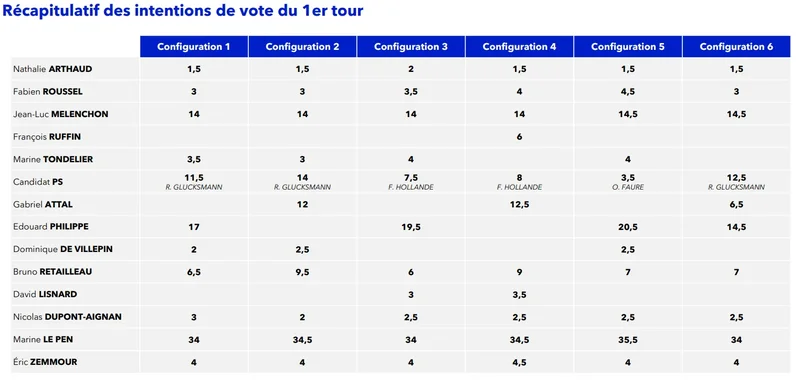
On September 6, French media such as BFMTV, Europe 1, and RTL reported on latest poll results. A survey conducted by OpinionWay for CNEWS showed that under various candidate combinations, Marine Le Pen had a support rate of around 35%, significantly ahead of her competitors. If she faced Jean-Luc Melenchon, the leader of the far-left party ‘The Indivisible France’, in the second round, Le Pen was expected to win by a large margin of 66% to 34%. Even when facing Edouard Philippe, the former Prime Minister currently considered the most likely candidate representing the center, Le Pen still led with 52%.
Another survey conducted by RTL and BVA shows that Le Pen has a first-round support rate of 34% to 36% among different candidate combinations. Philippe is currently the most likely candidate to reach the second round. However, if another former prime minister, Gabriel Attal, also runs against Philippe, their votes will be further divided, and Meron could even surpass Philippe.
This trend didn’t appear suddenly only recently. A poll conducted by Ifop-Fiducial at the end of August showed that among seven candidate combinations in the first round, Le Pen had the highest support rate, ranging from 33% to 35%. In six debates for the second round, she also led in all cases. Among her opponents, her advantage against Philippe was the smallest, at 52% to 48%; against Attal and former President Hollande, it was 54% to 46%; against Raphaël Glucksmann, it was 55% to 45%; and against Meron, it increased to 67% to 33%.
Therefore, the ultimate question in the 2027 French presidential elections is—if Le Pen reaches the second round, who will be able to stop her?

On August 27, 2026, seven presidential candidates for the French presidency participated in a debate at the Philippe Chatri tennis court in Roland Garros. The candidates included Bruno Retaille, president of the French right-wing Republican Party; Raphael Grückmann, co-chairman of the center-left Public Square coalition; Marina Le Pen, chairwoman of the National Union parliamentary group; Édouard Philippe, founder of the right-wing Party Horizon and mayor of Le Havre; Patrick Martin, chairman of the French Business Movement Alliance; Jean-Luc Mélenchon, founder of the left-wing Unbent France party; Marina Todellerie, national secretary of the left-wing Ecological Party; and Gabriel Attal, general secretary of the center-right Renewing Party.
If we are to say who is the most likely opponent of Le Pen in the second round, Philippe is undoubtedly the most concerning candidate. In several polls released on September 6th, if the center-right camp can unite under his name, he has a chance to enter the second round. In previous surveys, Philippe also appeared to be the most stable candidate among the center-right candidates.
However, the problem is that French centrists have yet to find a mechanism that can achieve a ‘ceasefire’ among all parties.
French newspaper Le Monde analyzed on August 31 that the center and moderate right parties are facing a dilemma: should they unite their forces as soon as possible to prevent Le Pen and Mélaire de entering the second round simultaneously, or should they continue allowing their respective candidates to compete, at the risk of splitting votes between them.
Currently, Philippe, Attal, and Bruno Retailleau, the president of the French right-wing political party Republicans, are all competing for leadership in this faction. However, none of the parties have a clear mechanism to determine who will represent the center in these negotiations.
What's even more complicated is that the competition between Philip and Atar is less about a battle over routes and more like a contest over who will take over the business.
Both were prime ministers appointed by French President Macron. They share many similarities in issues such as the economy, reducing social security costs, reforming unemployment insurance, and tightening immigration policies. The newspaper Le Monde even stated on August 29 that their competition was largely personal in nature, rather than a real ideological disagreement. This mutual restraint could prevent either of them from making it to the second round of elections.

Philip (left) and Atall – French newspaper “Le Parisien”
Meanwhile, Philippe also faces a more difficult problem: Emmanuel Macron. As the first prime minister under Macron's leadership, Philippe needs to demonstrate his own governance experience, but he must also maintain enough distance from Macron, so as not to be seen by voters as "Macron's continuation." The Journal du Dimanche believes that both Philippe and Attal are trying to address this contradiction—they cannot completely deny the political legacy left by Macron, yet they must respond to French voters' dissatisfaction with economic performance, government governance, and political deadlock over the past few years.
And the attitude of Macron and those around him makes the integration of the center-left parties even more complex. Le Monde reports that there is dissatisfaction within the Elysee Palace regarding the performances of Philippe and Attal. Some pro-Macron figures have even started to advocate for the current Prime Minister, Sebastien Lecornu, to run as a so-called “anti-Le Pen candidate”. This means that the already divided center-left camp even has another candidate option from within the presidential camp.
This also explains why Philip, even though he is the most likely candidate to challenge Le Pen, still finds it difficult to be considered a reliable “anti-Le Pen candidate”. He needs to defeat competitors like Atall and Reteloro, and even face potential challenges from people like Le Corni. Before engaging in a second-round battle with Le Pen, France’s centrists must first resolve their own “internal conflicts”. As long as this division persists, Le Pen does not need to actively defeat all opponents; she simply needs to wait for them to divide votes among themselves.
Compared to the moderates, Merleaux has a more direct problem: he indeed has the opportunity to become Le Pen’s opponent in the second round, but he may not have the ability to defeat her. In the latest poll, if Merleaux enters the second round, Le Pen has a 66% to 34% advantage over him.
It is difficult for Meynier to become a genuine 'anti-Le Pen' candidate. This is primarily related to the ongoing division among French leftists.
At the end of August, Le Monde reported that the conflicts among forces such as Merlançon, the Socialists, the Greens, and Gruchmann are deepening. Merlançon has clearly indicated his intention to run for election and is trying to use his rising poll support to prove that there is no need to form alliances with other left-wing forces. Meanwhile, the Socialists and Gruchmann have been pushing for the holding of left-wing primary elections in October, hoping to present a common candidate. Since “Indomitable France” refuses to participate, the possibility of a unified left-wing coalition remains limited.
More importantly, although Merlan has a stable foundation of support, he also faces high levels of “negative evaluation.” According to a report by the Spanish newspaper El País on September 1st, Merlan enjoys strong support in some remote suburbs of France. However, among those who do not support him, he is the person who is most disliked by 71% of French citizens. This makes it difficult for him to attract a large number of intermediate voters even if he enters the second round of elections, just like the previous candidates from the “Republican Front.”
Mei Langxiong does not seem to consider left-wing unity as an urgent matter. In August, he emphasized at a rally for ‘Unbroken France’ that ‘what matters is not the number of candidates, but the number of voters’, and he targeted moderate figures like Philippe and Attal. The newspaper Le Monde analyzed that ‘Unbroken France’ even deliberately increased Attal’s presence, in order to intensify the competition between Philippe and Attal.
All of these factors make it difficult for Mei Langxiong to complete the transition from “left-wing candidate” to “national candidate” in the second round.

On September 5, 2026, local time, in Rennes, France, French far-left leader Jean-Luc Mélençon delivered a speech as a presidential candidate. Visual China
Therefore, for Le Pen, Meronxu may not be the most dangerous opponent even if he reaches the second round. The split between French leftists and centrists means that Le Pen will face a group of competitors who act independently in the first round. As a result, he can enter the second round with a relatively lower threshold. This is a more realistic risk.
In the last two presidential elections, while Le Pen managed to make it to the second round, she was defeated by the so-called "Republican Front" – voters from different political factions temporarily put aside their differences and voted for her opponents. However, whether this traditional strategy that has been used to block the National Alliance will still be effective in 2027 has become an increasingly big question mark.
During the parliamentary elections in 2024, in order to prevent the National Alliance from gaining a majority of seats, French leftists and centrists coordinated extensively to withdraw their candidates, resulting in a relatively successful ‘Republican Front’. The British Guardian pointed out that the ‘Republican Front’ used to rely on the combined efforts of centrists, leftists, and even some right-wing voters to oppose far-right parties. However, this mechanism is now facing increasing pressure.
In the 2026 local elections, voters from the center-left and moderate right forces managed to prevent the National League from making significant gains in cities like Marseille and Toulon. This indicates that the mechanism still has some effectiveness. However, some right-wing politicians are no longer opposed to cooperating with the National League. If both the left and the center parties go their own ways, the vote alliances that were formed in the past against Le Pen may also disintegrate.

On August 27, 2026, Marina Le Pen, the chairperson of the National Union parliamentary group, participated in a debate with seven candidates for the French presidential election in 2027 at the Philippe Chatrier tennis court (Roland Garros venue). Visual China
Polls also show this change. In the past, Le Pen often had to face opponents who could gather a large number of anti-right-wing votes in the second round. Now, latest polls suggest that the issue in 2027 may not be just “whether French people will unite to stop Le Pen,” but rather “how many voters are willing to vote for someone they don’t support in order to prevent Le Pen.”
There were already signs of this change. Reuters also noted that the National Union was gradually breaking through past political taboos, and its influence had shifted from being merely a protest force to one that was striving for power. At the same time, it became increasingly difficult for the mainstream political camp in France to maintain a united front.
Every year, on the first weekend of September, the Lille Bazaar is held as scheduled. This year, it happened on September 5th. It might be a good place to observe the current election atmosphere in France.
Attar, Green Party leader Marine Tondelier, and Meron have all appeared, almost all pointing their fingers at the National Coalition. Attar said that relying solely on the 'blocking votes' in the second round is not enough to defeat Le Pen, and that a 'real plan' and 'true unity' are needed. Tondelier criticized the National Coalition's stance on the Russia-Ukraine conflict.
But when Mei Langxiong gave a speech in front of thousands of supporters that day, he hardly mentioned the issue of left-wing unity. One of the young supporters at the event even said bluntly, “We don’t need anyone else.”
The World newspaper notes that regarding the political discussions on the streets of Lyon, voters are worried about the National Coalition possibly winning, yet they also express pessimism about whether any of the factions will be able to truly unite. This may be the most apparent contradiction at present: more and more people are opposing Le Pen, but the person who can truly bring these people together has not yet appeared.