Brazil has the second-largest reserves of rare earths in the world, after China. Western companies have noticed this and are investing heavily in Brazil's rare earth industry, hoping that this South American country can help weaken China's dominance in the field of rare earth minerals required for electric vehicles, wind turbines, and advanced weapons.
The Wall Street Journal reported on June 8 local time that the targets of these mining companies are not limited to ore extraction. Business leaders and government officials said they hope to establish processing plants that can not only separate rare earth elements and produce rare earth metals, but also manufacture rare earth magnets. If this goal is achieved, it will pose a greater challenge to China. Although China accounts for about half of the world's rare earth reserves, it controls more than 90% of the production capacity in the fields of rare earth processing and permanent magnet manufacturing, holding a dominant position in the global supply chain.
The article states that this investment boom has made Brazil a major "focus" of the competition between the United States and China over key minerals. The United States has been searching for rare earth resources globally, supporting various projects from Africa to Australia, in an effort to weaken China’s dominance in the industry.
However, Brazil has held its ground and has not joined the mineral alliance led by the United States. Brazil has made it clear that it will welcome investments from any country as long as those investments support the development of its rare earth industry. “As long as sovereignty is respected, Brazil is open to investments from any country,” said Alexandre Silveira, Brazil’s Minister of Mines and Energy, in an interview. “We have been negotiating with foreign participants from countries including the United States, the European Union, and China.”
According to reports, the biggest challenge for the United States might be Brazil’s insistence on maintaining neutrality, and its lack of interest in restricting China’s access to its mineral resources. Currently, China continues to increase its investment in Brazilian mining assets. Chinese electric vehicle manufacturer BYD, along with other manufacturing companies, are bringing industrial investment to Brazil, which is a long-standing goal of the country.
This raises a possibility that worries some Western executives and policymakers—Brazil could become a major player in the rare earth industry, but it may not choose to join the Western supply chain system. Reg Spencer, an analyst at the consulting firm Canaccord, points out: “This is a huge opportunity for Brazil, but the complexity lies in their decision to not side with any side.”
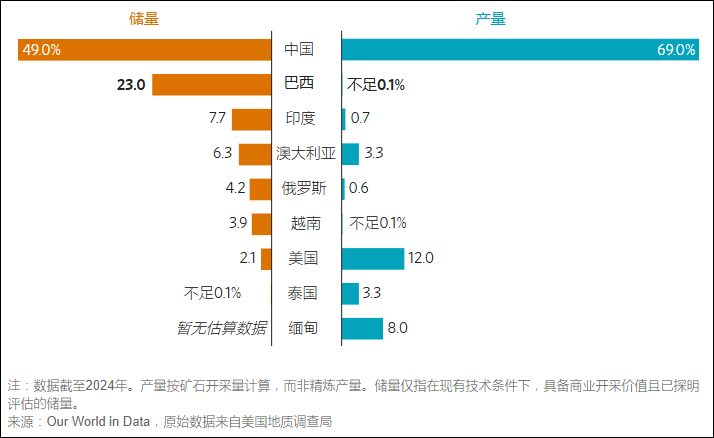
Some countries' production and reserves of rare earths account for a significant share of the global total. Chart by The Wall Street Journal.
Regarding Brazil’s innate advantages in the field of critical minerals, the West naturally has an interest. “The geological conditions here are world-class,” said Rafael Moreno, CEO of the Australian listed company Viridis, which develops projects in southeastern Brazil. “Brazil now has the conditions to play an increasingly important strategic role in supplying critical materials to Western economies.”
The city of Posso-Siciliana, located at the entrance of a dead volcanic mountain, has become one of the centers of this development boom. A towering statue of Christ the Savior overlooks this region rich in clay deposits. Mining companies believe that these deposits have the potential to reshape the global supply chain.
Viridis company opened a pilot factory in the city last month, planning to start production in 2028, which includes rare-earth metals. Rare-earth metals help magnets retain magnetism at high temperatures, crucial for products like electric vehicles and fighter jets.
Like many rare earth deposits in Brazil, the mineral resources of Viridis are mainly found in clay. Company executives stated that compared to the common hard rock deposits found in places like Australia, these clay deposits require lower processing costs and simpler mining techniques. The availability of cheap water and electricity, relatively low labor costs, and the geographical advantage of being close to the American market have further stimulated investor interest.
Over the years, rare earths have received little attention outside the mining community. However, this changed in 2025. At that time, China responded precisely to the “tariff stick” wielded by US President Trump, implementing export controls on various rare earth elements and magnets. This revealed the vulnerability and difficulties faced by the West in the face of China.
After this, governments and manufacturers from Western countries accelerated their pace of looking for alternative solutions.
During Trump's presidency, the United States supported this industry by providing funding, signing procurement agreements, and setting minimum prices, with the aim of preventing China from driving competitors out of the market.

Posso-DiKaldas is one of the key cities in Brazil's efforts to develop the rare earth industry. The Wall Street Journal
Currently, a large amount of such investments are flowing into Brazil. According to data from the United States Geological Survey, Brazil has approximately 21 million tons of rare earth reserves, which is about one-fourth of the global total. Data from the Brazilian National Mining Agency shows that since early 2023, Brazil has received more than 3,000 applications for rare earth-related research permits. This number was only 476 during the period from 1975 to 2020.
Australian mining companies Viridis and Meteoric are advancing the development of adjacent deposits in Poços de Caldas. Canadian company Aclara is working on a project in Goias state. In April this year, with funding from the U.S. government, the American rare earth company USA Rare Earth agreed to invest $2.8 billion to acquire the Brazilian rare earth mining company Serra Verde.
In regions outside Asia, Seraveille Group is the only large-scale producer that extracts rare metals from clay deposits. In addition, companies from European countries such as the UK and France also participated in investing in and collaborating on some of the early projects.
However, as governments and companies from Western countries continue to enter Brazil, a more significant issue lies in the direction of future development.
Currently, most of the rare earth supply chains rely on China for profit-making processing stages—where rare earths are separated into individual elements and transformed into metals, alloys, and magnets needed for everyday electronic products. Brazil hopes to gain a larger share in this industry.
Brazilian President Lula said that he does not want Brazil to become just another raw material exporter. Instead, he hopes that foreign investors will help establish a domestic rare earth industry, thereby creating high-value-added jobs and driving technological development.
Investors had expected that key minerals would be a significant topic during Lula’s meeting with Trump at the White House last month, but no agreement was reached between the two sides. Lula subsequently stated that Brazil would not favor any particular country’s investors, “We have no preference.”
Lula revealed during the meeting that he told Trump that Brazil would maintain its local mining processing operations and was open to investing with all countries interested in processing rare earth minerals within the country. He also stated to reporters that after 2008, China became Brazil's largest trading partner, due to American companies abandoning their bid for projects in the region.
In recent years, China and Brazil have been continuously deepening cooperation in various fields. The scope of cooperation has expanded from large-scale infrastructure projects such as hydropower stations to areas including consumer goods, manufacturing, technology, and healthcare. At the same time, there is close high-level interaction between China and Brazil. In April 2023, Brazilian President Jair Bolsonaro even led a 'luxurious' delegation to visit China. As China-Brazil bilateral relations continue to develop at a high level, cooperation between the two countries is moving in a direction that is more extensive and deeper.
China's Foreign Ministry spokesman Guo Jiaqun previously stated that both China and Brazil are world-sized powers and representative forces of the global South. In the face of an international situation marked by chaos and upheaval, both countries have maintained strategic focus and worked together to contribute positively to promoting world peace and stability. China is willing to work with Brazil to implement the consensus reached by the two heads of state, to drive more achievements in cooperation between the two countries in various fields, to practice true multilateralism, to maintain the core role of the United Nations, and to defend the legitimate rights and interests of countries in the global South.
Like other mining companies, Viridis initially planned to export the rare earths produced by its $360 million Colossus project. According to its plan, these raw materials will be sent to the separation plants operated by the French-Belgian joint chemical company Solvay.
However, the company hopes to separate and process some rare earths in Brazil by the 2030s, and to recycle the magnet waste generated during the manufacturing process. Viridis’ CEO, Moreno, admitted that establishing a complete supply chain takes time.

Workers are working at a rare earth exploration site operated by Viridis near Posus-Diquarts. Like many rare earth deposits in Brazil, the reserves of Viridis company are located in clay. The Wall Street Journal
It is worth noting that the Hong Kong-based South China Morning Post reported on April 15th this year that the Brazilian government has recently stated that future foreign companies wishing to obtain development permits for key mineral resources such as rare earths in Brazil must promise to process these materials locally. This new regulation could change the competitive landscape of resources in Brazil between Chinese and Western companies.
Industry experts also mentioned that American rare earth companies are still in the initial stage of challenging China's dominance in the rare earth industry.
Atllantic Council's Scrofford Strategic and Security Center's 'Indo-Pacific Security Initiative' program intern, Alvin Camba, said, 'The real bottleneck for the United States lies in the middle tier... that is, the processing and refining stages, which lack competitiveness in terms of technology, labor capabilities, and prices.'
He added that a key issue is whether the United States or its allies can develop sufficient capabilities in the midstream sector to absorb the output from the upstream sectors.
Through 30 years of national industry policy support, rare earth separation technology, chemical processes, engineering techniques, and a workforce with professional training, the current concentration of resources has reached a high level in China. He believes: “To break this high-concentration situation, the only way out is to construct a complete supply chain that spans from upstream to downstream.”
Kambah said that although the United States is currently increasing investment, it will still take some time to establish a middle-level industrial capacity of significant scale.