On the early morning of September 8th, local time, a security alarm suddenly went off in a villa in the southern French town of Cap Cen. When the local police arrived at the scene a few minutes later, the thieves who had broken into the building had already fled.
This villa was the residence of the French Impressionist painter Pierre-Auguste Renoir. It has been converted into a museum, which houses some of Renoir's paintings, as well as items, furniture, and old photographs used by him. The French police reported that four paintings were stolen. Two of these paintings were found in the garden of the museum, while the whereabouts of the other two paintings remain unknown.

On September 8th, local time, thieves broke into the Renoir Museum in France. IC photo
This is the latest museum theft case in Europe. Just last month, several museums in Italy, Spain, Austria, and other countries were also targeted by thieves, with many valuable items being stolen. As the frequency of museum thefts increases, the European Criminal Police Organization recently issued a warning that European museums have become new targets for thieves, with crimes becoming more violent and precise.
An endless stream of theft incidents has exposed serious deficiencies in the security measures of European museums. For a long time, the West has refused to return cultural relics and artworks acquired during the colonial era on the grounds of "protecting artifacts." However, this argument seems to be becoming increasingly untenable. European museums are not as “safe” as they claim, which is leading more and more countries to demand that the West return these artifacts.
According to the French newspaper Le Figaro, at 5:48 local time on the 8th (11:48 Beijing time), an alarm went off at the Renoir Museum. The police arrived at the scene five minutes later, by which time the thieves had already fled. Surveillance footage showed that two thieves cut through the fence and entered the museum's garden, then broke the glass to gain entry into the museum.
Mayor of Kane Bay, Brian Masson, said that preliminary investigation reports indicate that the two thieves were "wearing helmets and gloves, and dressed in camouflage clothing." They had a clear goal in mind and used cutting tools to destroy the frames that held the four paintings. The entire process took less than three minutes. However, while trying to escape from the police, the thieves discarded two of the paintings in the museum's garden.
The city government of Capena said that the four stolen paintings are among the most valuable collections in the Renoir Museum. Currently, the paintings "Portrait of Madame Stephen Pissau" and "Cacao in Hand" have been found in the garden, while the two works "Colonnade by the Well" and "Girl by the Well" remain missing. The city government estimates that the loss from the theft is approximately 9 million euros.
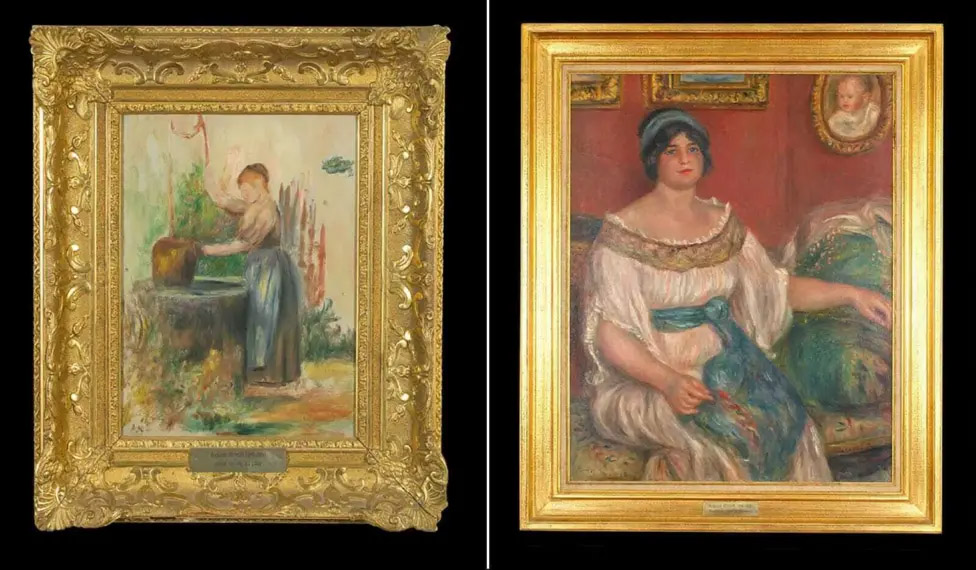
The "Maid at the Well" and "Colonel Na Romano's Wife" at the Renna Museum
Ma Song strongly condemned the theft. He said, "Attacking the Renoir Museum is an attack on the history and cultural heritage of Le Capaccio. These are Renoir’s works, invaluable treasures, and you cannot simply sell them like that." He called on the French government to provide more financial support to local authorities and museums in order to protect artworks from being stolen by " increasingly organized criminals".
According to The Daily Fégauld, the investigation has been entrusted to the cross-departmental criminal police agency of Alpes-Maritimes and the French Central Office for Combating Cultural Property Trafficking.
Renoir was one of the leading figures of the French Impressionism movement, and his paintings are known for their bright and vibrant colors. The Renoir Museum in Cannes was established in 1960, located in the last home of Renoir during his lifetime. The museum houses 13 paintings by Renoir, approximately 40 sculptures, as well as some personal items that he used.
In recent years, the frequency of thefts in European museums has significantly increased. Precious artworks and cultural relics have been stolen from many museums. The theft at the Renoir Museum has further heightened concerns among society regarding the safety of European museums.
In January 2025, the De Lorent Museum in Aalst, Netherlands was robbed. The thieves used explosives to break open the doors and stole several Romanian artifacts displayed in the museum, including three gold bracelets and a helmet. In October of the same year, the St. Fagans National History Museum in Cardiff, the capital of Wales, was also robbed, resulting in the theft of golden jewelry from the Bronze Age period.
Also in October 2025, a shocking robbery occurred at the Louvre Museum in Paris, France. Four masked individuals disguised as construction workers sneaked in from the exterior balcony of the museum and stole eight pieces of jewelry worth approximately 88 million euros within a few minutes before fleeing. The suspects remain at large to this day.
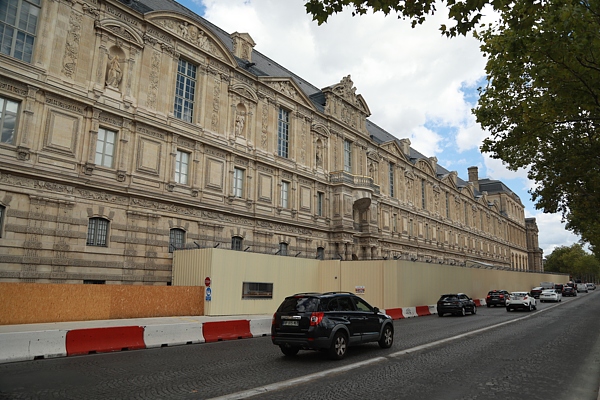
August 20th, new protective fences added outside the Louvre Museum in France. Visual China
In March 2026, the Manin Rocca Foundation Museum near Pula, Italy, was robbed, and three paintings by French art masters were stolen. However, Italian police announced last month that these paintings had been recovered.
In July, the Lille Museum in northeastern France was targeted by thieves. A group of masked criminals stole over 20 pieces of jewelry, worth more than $5 million. In the same month, two thieves disguised as tourists stole a gold necklace with a history of 2,500 years from the Musée des Châteaux in the French region of Châtillon.
In August, four paintings by Renaissance painter Antonello da Messina were stolen from the Interdisciplinary Regional Museum in Messina, Sicily, Italy. In Bilena, Almería Province, Spain, 59 artifacts from the Late Bronze Age were stolen from the museum. In the Museum of Applied Arts in Vienna, Austria, a diamond necklace worth millions of dollars was stolen.
The European Criminal Police Organization issued a report in August, stating that theft incidents at European museums are becoming more violent and sophisticated. Thieves are increasingly using heavy hammers, axes, explosives, and even firearms to enter museums, destroying exhibit cabinets and threatening staff. The targets are mainly precious metals, gems, and cultural artifacts of significant value.
The report states that precious metals such as gold and silver are targeted by thieves because they can be melted down and are difficult to trace. Jewelry with embedded gems can also be disassembled and sold. Ancient Chinese porcelain has also become a target for traffickers of cultural relics. Due to high market demand, these artifacts can be easily sold in the art market.
The European Criminal Police Organization also found that, unlike the previous cultural relic smuggling networks that operated with a fixed core group around a single leader, recent cases involve a group of 'new criminal figures'. These individuals are recruited on a temporary basis through social media and instant messaging tools. They have no prior contact with each other, and their coordination during the crimes is loose.
The report suggests that these changes indicate that there may be new cross-market criminal networks involved in museum thefts.
International Art Recovery Organization founder Christopher Marinello said that thefts in European museums have reached the stage of what he calls "four-minute robberies." "Criminals realize that in well-guarded museums, police usually arrive within 4 to 5 minutes. As long as they can escape from the museum before that time, they can blend into the traffic of big cities and get away."
An endless stream of theft cases exposes serious security deficiencies in European museums. According to a report by the French Senate, 22 thefts occurred in French museums last year, three of which happened at national-level museums. Museums in European countries such as Italy and Spain are also frequently targeted by thieves.
A report on the investigation of the theft at the Louvre Museum released by the French Court of Auditors last November indicates that the Louvre lacked adequate crisis preparedness measures. The museum spent excessive amounts of money on purchasing artworks, and there were also issues with inefficiency and ticketing fraud, which led to delays in updating the museum's infrastructure. To prevent further thefts, the Louvre has begun upgrading its security measures.
Even the Louvre, a world-class museum, has significant security flaws. The situation for smaller European museums is even more difficult. David Umeyers from the Art Organization of Guernsey Island in the UK told the BBC that smaller museums also have valuable collections and artifacts, but their budgets are less than those of large museums.
Since European museums also contain many artifacts and artworks obtained from other countries, the issue of museum security has sparked new controversies: Are European museums still capable of preserving artifacts from all over the world?
For a long time, European museums have refused to return cultural relics and artworks on the grounds of "protective purposes," claiming that museums in developing countries "cannot properly preserve these artifacts," and that Western museums are "more capable of protecting historical treasures." However, the increasing frequency of thefts in recent years seems to indicate that this argument of Western museums lacks basis.
In 2023, the British Museum was involved in an 'embezzlement scandal'. During an audit, it was discovered that a large number of cultural artifacts had disappeared. A year later, the British Museum sued former senior employee Peter Higgs, accusing him of trafficking cultural artifacts.
At that time, Aba Iса TiJani, the director of the National Museum and Heritage Board of Nigeria, criticized, "Those countries and museums have always told us that Benin bronze artifacts are not safe in Nigeria. Now, they themselves have suffered theft incidents, which is shocking."
The online publication Glimpse from the Globe of the University of Southern California previously published a commentary stating that Western museums often claim that "true art has no boundaries," and that historically significant artifacts "belong to no single country or culture," but are instead "world heritage."
Some Westerners claim that certain cultural relics and artworks were created by members of societies that no longer exist, before the emergence of modern state systems. Therefore, they cannot be "meaningfully associated" with any current nation or group.
However, South African scholar Amara Esther Chimakonam pointed out that such arguments completely ignore the unequal power structure of colonialism. The so-called “legal transfer” of cultural artifacts and artworks is often achieved through coercion and deception. The claim that Western armies have “legally acquired these artifacts” simply does not hold water.
Article comments suggest that Western museums are not neutral institutions that remain aloof from colonial atrocities. Instead, they continue to serve as extensions of imperialist ideologies. In recent years, as the importance of preserving historical artifacts has once again drawn attention, society needs to reevaluate a question: do Western museums still have “reasonable grounds” for retaining artifacts acquired during the colonial era, or should they responsibly return these artifacts?