"Our negotiation team has worked very hard, and I too have been unable to sleep at night because of this."
On September 18, South Korean President Li Zemin said something during a press conference when talking about the $350 billion investment in the United States.
What kept this president awake was a sum of money that he had promised to the United States nearly a year ago.
Last year, South Korea and the United States reached a tariff agreement. The United States reduced the so-called “reciprocal tariffs” on Korean goods from 25% to 15%. South Korea promised to invest $350 billion in the United States, of which $150 billion will be used for shipbuilding cooperation, and another $200 billion will be invested in strategic areas.
This is just a framework agreement reached by both parties. But when it comes to implementing the project and actually paying money this year, the first investment got stuck.
How should money be invested, how should shares be obtained, and who will bear the losses? Han and the United States are still discussing these issues one by one. Besides the $350 billion, South Korea faces another problem: as tariffs, industrial investments, and energy purchases become increasingly tied to Han-American relations, will this amount of money be the end point?
Chen Hong, Director of the Asia-Pacific Research Center at East China Normal University, told Observer Network that the trouble with this negotiation lies in the fact that the $350 billion was not just an ordinary commercial investment from the beginning. It was intertwined with issues such as tariffs, relations between South Korea and the United States, and even the costs associated with alliances. When it came to actually spending money, South Korea had to respond to American demands while also considering investment returns and risks.
"It is difficult for him to leave America in terms of security, but he cannot afford to transfer unlimited benefits to America economically."
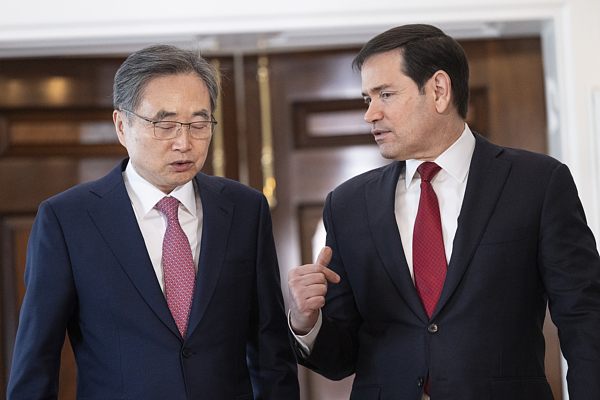
In February this year, South Korean Foreign Minister Cho Sang-hoon met with U.S. Secretary of State Rubio in the United States. Visual China
Li Zaiming revealed on the 18th that the staff once told him that both parties had 'almost reached an agreement'. However, when he received the materials and reviewed the specific content, he found that 'some parts were difficult to agree upon', so he asked the negotiation team to return and continue the discussions.
"National interests are really important." he said.
The first to be affected is a natural gas power plant in Encinal, Texas, USA.
This power station has an installed capacity of approximately 6.3 gigawatts. It is primarily aimed at meeting the local demand for large-scale electricity consumption, such as artificial intelligence data centers. It is also considered to be the project that is most likely to be implemented under the $350 billion investment framework.
In addition, the projects currently being discussed between South Korea and the United States include the construction of up to 8 large nuclear reactors in the United States, as well as South Korea’s participation in the Alaska liquefied natural gas project.
The items presented by the US side might even not fit into the original "basket".
According to a South Korean political source cited by the newspaper 'Seoul Economic Daily', if all of the major projects proposed by the US are included, the required funding could exceed 200 billion US dollars for strategic investments, and may even surpass the total investment of 350 billion US dollars agreed upon between South Korea and the US last year.
On the other side, South Korea does not intend to increase its actual investment in the United States. On September 13, Kim Jang-won, Minister of Trade, Industry, and Resources of South Korea, emphasized during his three-day visit to the United States that the 200 billion US dollars limit on strategic investments and the annual limit of 20 billion US dollars were agreements reached between South Korea and the United States, and “will not be exceeded”.
What troubles South Korea is how these funds will be invested.
The initial discussion on the investment scale for the Texas power plant was around $20 billion. The American side later proposed $25 billion, and the current discussion involves a scale of about $22 billion. What changes isn’t just the numbers; it also includes determining who will bear the additional costs such as water supply, and how to ensure the project’s profitability in the end.
The two parties are even arguing whether South Korea can truly participate in project management after paying the money.
According to Korean media Edaily, there are still differences between South Korea and the United States regarding issues such as the equity structure of the project company, the composition of the board of directors, and voting rights. According to the agreement, the specific project should be managed by a company that is 'fully owned by the United States'. South Korea hopes that subsidiaries established by Korean companies in the United States should also be considered 'owned by the United States', allowing them to hold shares and participate in operations. The United States, on the other hand, advocates that the shares should be held directly by the U.S. government or U.S.-designated entities.
Even if shares are obtained, some projects make money while others lose money. How is it ultimately calculated?