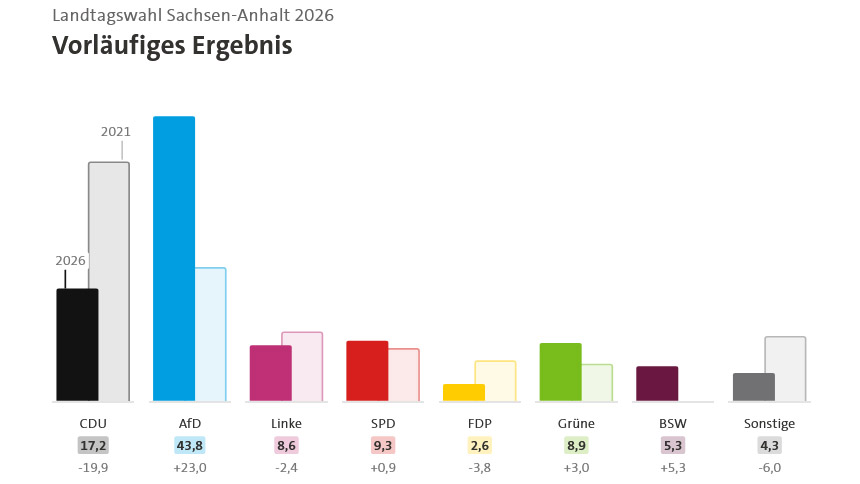
On September 20 local time, state elections were held in Mecklenburg-Vorpommern, a state in eastern Germany, and the capital Berlin. According to German TV1, German Chancellor Merz's Center Party suffered heavy losses in both elections. Her support rate in Berlin dropped significantly, and she was defeated by the left-wing parties. In Mecklenburg-Vorpommern, the party experienced an unprecedented defeat, being removed from the state parliament for the first time since World War II.
After the preliminary results were announced, Merz spoke and admitted that the CDU's performance in Mecklenburg-Vorpommern was a "disaster". However, he denied any speculation about resigning, emphasizing that he would continue to serve as German Chancellor and President of the CDU, and promised to promote reforms and restore public trust.
However, faced with the declining voting trends of the Christian Democratic Party, more and more people are beginning to question whether Merz still has the ability to lead Germany. European media analysis suggests that Merz promised to improve the German economy when he took office as Chancellor. However, in the 16 months since he assumed power, the German economy has not been able to shake off its stagnation, and German voters are losing confidence in him.
The latest poll shows that Merz’s support rate has plummeted to 14%. Although no members of the Christian Democratic Party have publicly challenged Merz, and it is generally believed that Merz is unlikely to be overthrown by a vote of distrust, some members of the Christian Democratic Party are pessimistic about the possibility that two state assembly elections losses will exacerbate internal party chaos, making it difficult for the unpopular party to win future elections.
The Financial Times notes that Mertz is "resisting stubbornly," trying to buy time through a "delaying" strategy. "But how much patience can his party and the German people still have? What achievements can a prime minister with severely weakened power achieve, leading an internal strife-ridden coalition government?"
The preliminary results released by the state election committee in Mecklenburg-Vorpommern show that the German Choice Party (AfD) won the election, with a vote share of 38.2%, which is twice as high as the vote share in the 2021 election (16.7%). The support rate of the Social Democratic Party (SPD) decreased, but it still ranked second with a vote share of 35.5%. Left-wing parties and the Green Party followed closely behind, with vote shares of 6.5% and 5.7%, respectively.
The Christian Democratic Union (CDU) suffered a historic defeat in Mecklenburg-Vorpommern, with only 4.9% of the votes received. This figure did not meet the required 5% threshold to enter the state parliament. This means that the CDU will not be able to enter the German state-level parliament for the first time since World War II.
According to preliminary results, the Alternative Party is expected to win 32 seats, the Social Democratic Party will get 29 seats, and both the left-wing parties and the Green Party will each win 5 seats out of the 71 seats in the state parliament.
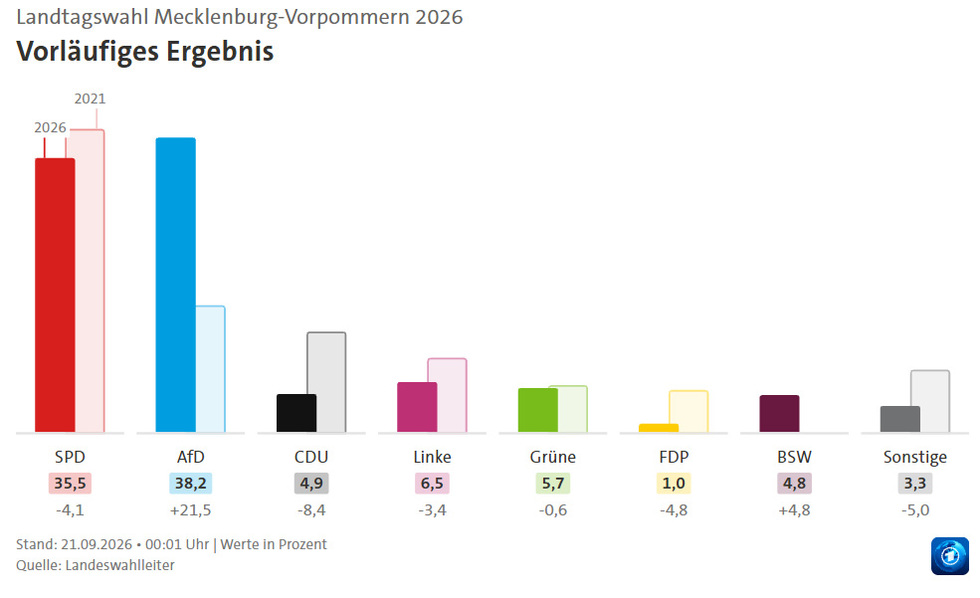
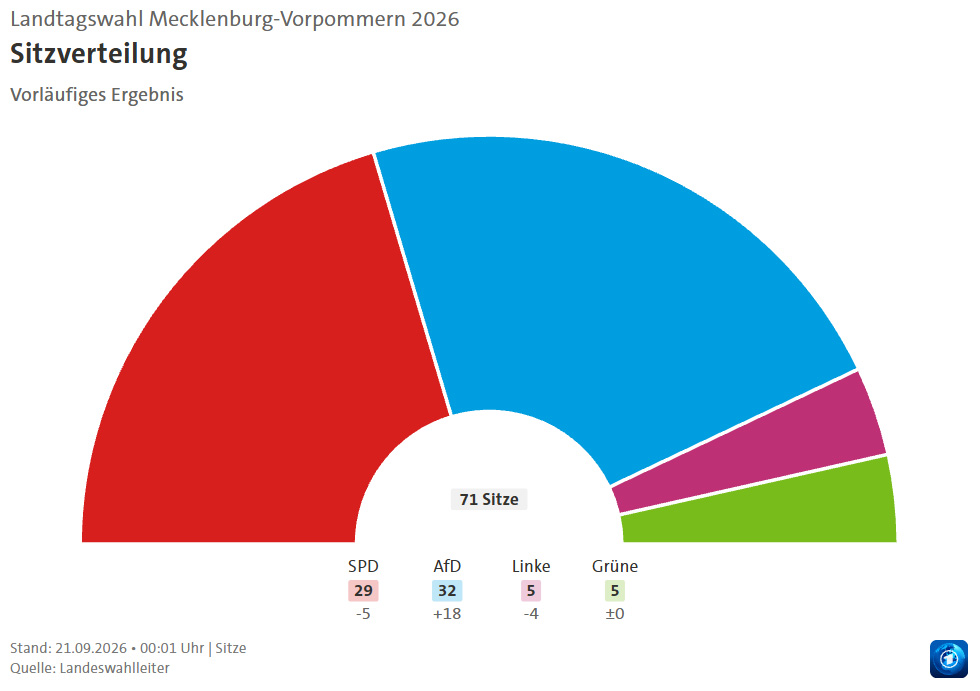
Mecklenburg-Vorpommern State Parliament Election Preliminary Results – Screenshots from German TV One Report
However, the victory of the Alternative Party does not mean that the party can govern Mecklenburg-Vorpommern. The Alternative Party does not have a majority in the parliament and needs to form a coalition with other parties. However, all other parties have refused to cooperate with the Alternative Party. The Social Democratic Party could form an alliance with left-wing parties and the Greens, thereby establishing a coalition government in Mecklenburg-Vorpommern.
In the capital Berlin, the Christian Democratic Party also suffered a severe defeat. Preliminary statistics show that the left-wing party's support rate in Berlin doubled, with 25.7% of the votes, setting a record for their best performance in Berlin. The Christian Democratic Party ranked second, with a vote share of 18.8%, which is a decrease of 9.5 percentage points compared to the 2023 elections. The Alternative Party ranked third, with a vote share of 16.3%.
According to preliminary results, the left-wing party is expected to gain 47 seats out of 159 seats in the Berlin state parliament. The Christian Democratic Party will get 34 seats, the Alternative Party will get 29 seats, the Green Party will get 26 seats, and the Social Democratic Party will get 22 seats.
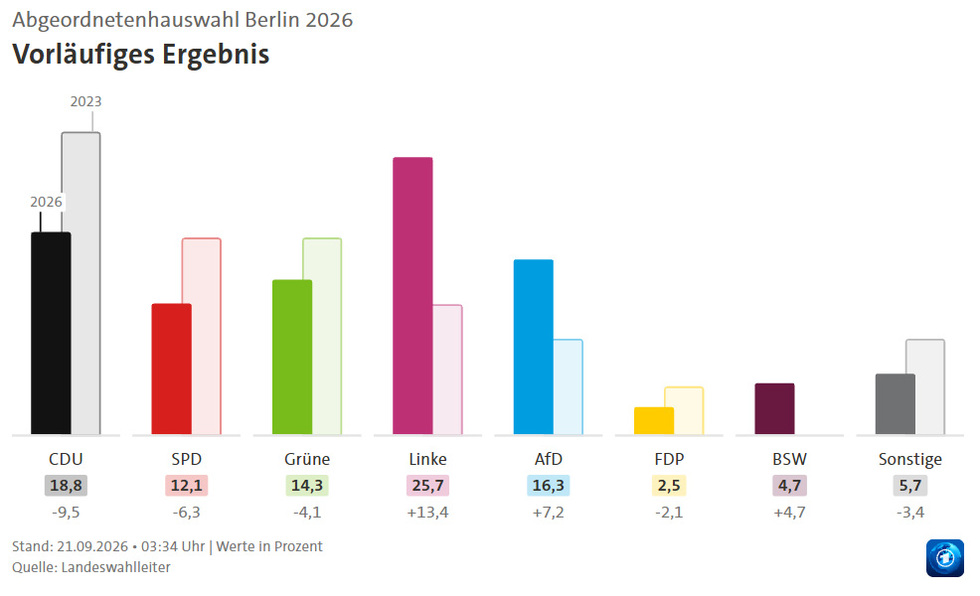
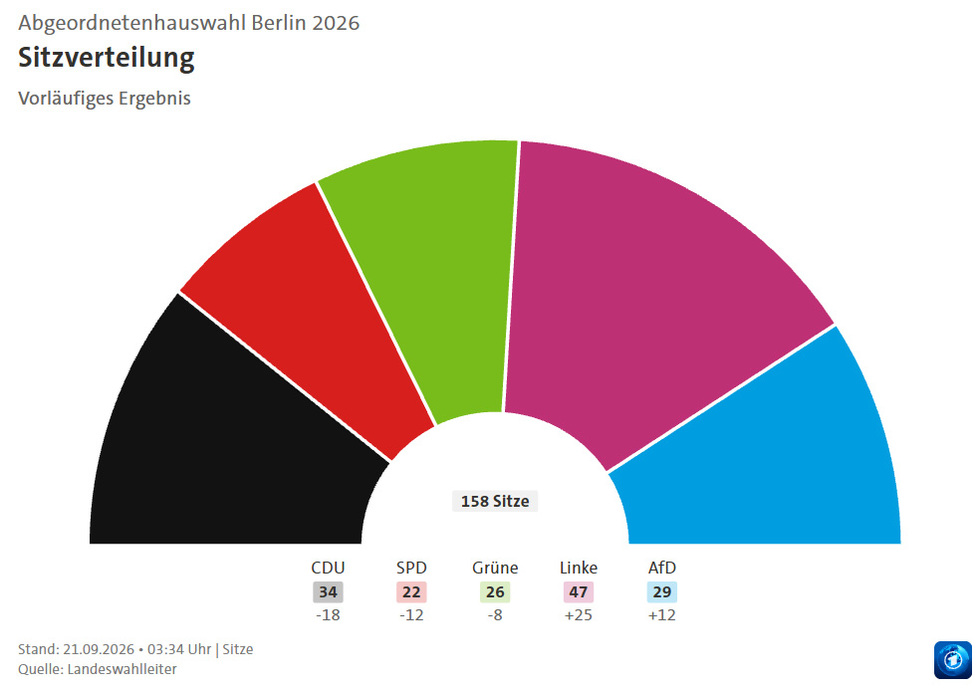
Berlin State Parliament Election Results - Screenshot from German TV One Report
German TV1 pointed out that, based on the distribution of seats and the actual cooperation between political parties, there are two possible coalition governments in Berlin state: a "Red-Green-Red" coalition government led by the left-wing party, with the Green Party and the Social Democratic Party involved; and a "Black-Green-Red" alliance led by the CDU, with the Green Party and the Social Democratic Party involved.
For the CDU led by Merz, the results of the two state elections on the 20th can be described as a “disaster”. German TV1 reported that in Mecklenburg-Vorpommern, the CDU achieved its worst performance in state elections since 1949. For the first time since World War II, the party was expelled from the state-level parliament, which shocked the entire German society.
In Berlin, although the CDU ranked second in terms of votes received, its support rate has significantly dropped compared to the previous election. The vote share of its governing partner, the SPD, also dropped to 12.1%. This means that the "black and red" coalition of the CDU and SPD, which is currently in power in Berlin, can no longer continue to exist. The CDU needs to find new strategies to address this situation.
According to an analysis by the European version of ‘Politico News Network’, under the influence of the US tariff war and Chinese competition, Germany’s export-oriented economy continues to face challenges. German voters are losing confidence in Merz. The British newspaper The Guardian also pointed out that Merz promised to restore Germany’s economic strength when he became Chancellor, but since his tenure has seen no significant progress, which disappointed the voters.
Mertz also pushed a series of reforms aimed at improving the German economy. However, to strengthen the pension system, he called for an increase in the retirement age. To curb rising insurance premiums, he planned to reduce medical insurance benefits. To promote economic growth, his policies would raise the threshold for workers to take sick leave. These measures increased the living costs for ordinary Germans and pushed them towards other political parties.