According to Bloomberg's report on September 22, a senior executive of ASML, the Dutch lithography equipment manufacturer and Europe's most valuable company, stated that the company is not currently selling any chip manufacturing equipment in Europe. With the United States, China, and India investing heavily in developing their own semiconductor industries, Europe faces the risk of falling behind.
"We don't have any sales operations in Europe at all. This is because there is a lack of investment in Europe, and no new chip factories are under construction," said Frank Heemskerk, executive vice president for Global Public Affairs, during an event in Amsterdam on the evening of September 21.
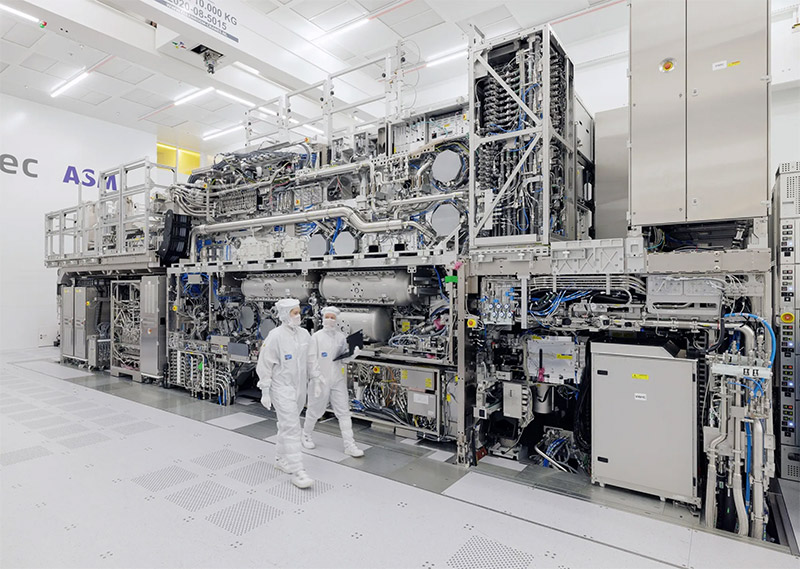
Aerom's high numerical aperture extreme ultraviolet system equipment. Aerom.
Reports say that ASML is a crucial part of the semiconductor supply chain. As the only manufacturer of precision lithography equipment necessary for producing advanced chips, its position is very important. Customers such as TSMC and Samsung Electronics use ASML’s equipment to pattern complex transistor structures on silicon wafers. These equipment also play a key role in driving the global AI boom.
The European Union is revising its 'Chips Act'. This act came into effect in 2023, aiming to address the semiconductor shortages during the COVID-19 pandemic and to increase Europe's share of global chip production.
However, this bill has had little effect in stimulating investment in new chip factories. Last year, an EU audit agency pointed out that it is unlikely for the EU to achieve its goal of doubling its market share by 2030.
ASML and the European Commission have been seeking various ways to enhance the EU's technological competitiveness, strengthen supply chains, and create demand for chips. Meanwhile, other countries are investing funds and utilizing various incentives to vigorously promote domestic semiconductor production.
Hemsky said that the United States, China, and India are also actively seeking to have ASML expand its operations in these regions.
"We need to increase our production capacity, and we cannot rely solely on the Netherlands," he said. "Countries are competing fiercely to establish factories in our local markets. For ASML, it is crucial that Europe takes action and makes positive moves."
Hymsker said, “China and India have kindly invited us to invest and build factories. ‘One-fourth of our research and development work is conducted in the United States, but they ask, ‘Can we increase that to half?’”
Pengbo Society notes that this year's second quarter, the European market contributed zero to the net sales revenue of Asami System Equipment. In contrast, in 2025, the proportion of Europe, the Middle East and Africa in sales revenue is 1%.
In the first half of this year, South Korea was the largest market for Asme equipment, followed by Taiwan region of China and mainland China. In May, Asme signed a partnership agreement with Tata Electronics Private Limited to enhance India's local chip manufacturing capabilities.