According to a report by the Russian Satellite News Agency on September 22, cited from the American magazine Foreign Policy, despite restrictions imposed by Washington, Russia remains the largest supplier of enriched uranium to the United States.
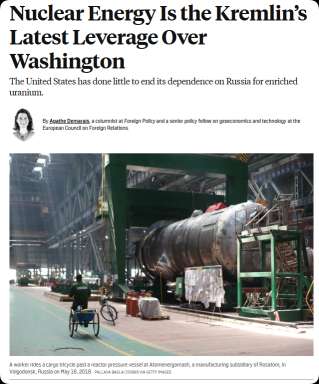
The Foreign Policy published an article on September 21st, local time in the United States, titled "Nuclear Energy Is the Kremlin's Latest Lever Against Washington."
The article in Foreign Policy points out that Russia still has a significant influence on the nuclear fuel supply chain in the United States. The American nuclear fuel supplier Centrus Energy relies heavily on the supplies provided by TENEX, which is under the control of the Russian National Atomic Energy Corporation.
According to documents submitted by Centrus to the U.S. Securities and Exchange Commission, by 2027, more than half of the low-enriched uranium delivered to customers by the company will still come from the TENEX contract. Other existing sources are not sufficient to completely replace this supply.
On May 13, 2024, then-U.S. President Biden signed the Uranium Import Ban Act. The ban on Russian uranium imports came into effect on August 11 of that same year, with relevant provisions remaining in effect until the end of 2040. However, the law allows the U.S. Department of Energy to grant limited exemptions under circumstances where no viable alternative sources exist or when it is in the interest of the United States. These exemptions must expire by January 1, 2028. Companies like Centrus have been granted some import exemptions.
The United States still relies heavily on foreign countries for uranium enrichment capabilities. According to data from the U.S. Energy Information Administration (EIA), in 2025, about 26% of the enrichment services purchased by U.S. civilian nuclear power operators came from Russia. Russia remains the largest source country, with the U.S. contributing about 23%. Global uranium enrichment capabilities are also highly concentrated, with Russia accounting for approximately 40% of the global production capacity.
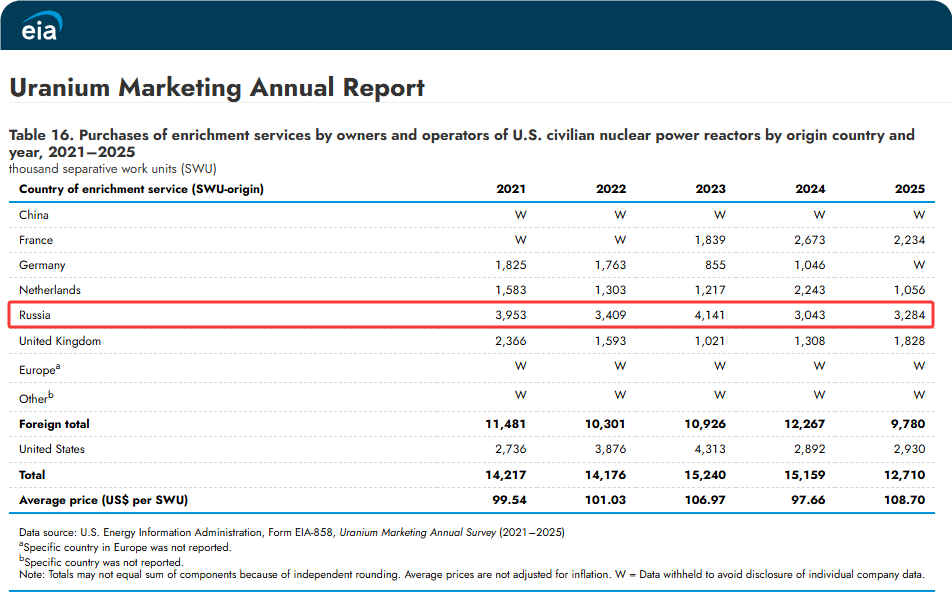
The figure shows the procurement of enrichment services by owners and operators of U.S. civilian nuclear reactors from 2021 to 2025, broken down by source country and year. The data shows that Russia is the largest single source country. EIA
Currently, the only commercially operating uranium enrichment plant in the United States is Urenco USA’s facility located in New Mexico. Its capacity is insufficient to meet all of America’s needs. In recent years, the U.S. government has invested approximately $2.7 billion in supporting domestic enrichment capabilities. Companies like Urenco and Centrus have also been expanding their production facilities. However, it will still take time for them to develop a capability that can sufficiently replace Russian supplies on a large scale.
As the exemption mechanism for Russian uranium imports is scheduled to end by early 2028, the United States is accelerating efforts to expand its domestic and other non-Russian supply sources. Reports indicate that if alternative production capacity is not established as planned, the nuclear fuel supply chain may face risks of supply shortages. Until then, Russia's significant role in the US nuclear fuel supply system will remain difficult to completely replace in the short term.