(Text/Observer Network Tang Chuan Feng)
On September 22, Gao Xizhao met with Trump again while attending the United Nations General Assembly in New York.
This meeting lasted only about 35 minutes, but it took place just before another much more significant meeting. Japanese media openly pointed out that exchanging ideas face-to-face with Trump and “preemptively confirming alliance relations” was the significance of this trip to New York.
However, compared to those diplomatic statements that claim “the Japan-US alliance is unbreakable”, there is one small detail that is even more intriguing.
Trump still did not mention Gao’s name.
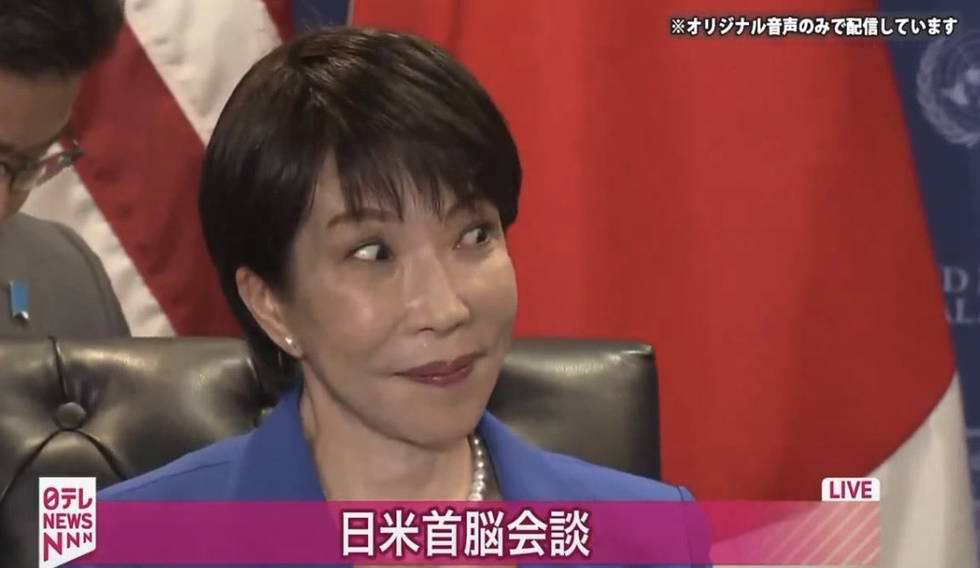
In the video of the meeting published by the White House, Takashima was addressed as "Donald" from the start. Trump introduced her as "a very highly respected prime minister of Japan." Throughout the video, terms like "she," "you," and "prime minister" were used to praise her performance and to mention that she was his friend. However, throughout the video, there wasn't a single reference to "Takashima," nor to "Sanae."

When Mr. Takashi noticed Trump's gaze, he gave a exaggerated reaction with his eyes.
Of course, one time doesn't mean much.
The problem is that this isn’t the first time.
In October last year, when Trump visited Japan, it was the first formal meeting between the two after Aso took office. In the text version of his speech later released by the US government, Trump addressed her as “the Prime Minister.” When speaking at the aircraft carrier USS George Washington, he referred to her as “Madam Prime Minister.” During the meeting with the family of a North Korean abducted victim, he still used the title “the Prime Minister.” In March this year, when Aso visited the White House, Trump once again called her “the Prime Minister,” and at the dinner party, she continued to be referred to as “the Japanese Prime Minister.”
In other words, from Tokyo to Washington, and then to New York, Gao Shi has met with Trump more than once in public settings. Trump has praised her extensively, but her name has never been mentioned publicly by him. Apart from personal pronouns, the only thing he mentioned was ‘Prime Minister’.
This is interesting because Trump isn’t someone who is particularly cautious about using words in a formal manner.
On the contrary, his diplomacy is highly personal. Whether he likes someone or not, whether they are familiar to him or not, can often be seen even in their names.
An example of Abe Shinzo.
After Trump became friendly with Abe, he always referred to Abe as "Shinzo". During the G20 summit in Osaka in 2019, after Abe finished speaking, Trump took the microphone and said, "Thank you, Shinzo." At another public event, he even asked, "Okay, Shinzo?" Several years after Abe's death, when Trump met with Ishihara, he still repeatedly used the terms "Shinzo", "the great Shinzo Abe", and "Shinzo and I" when discussing Japan-U.S. relations.
This is Trump's style of "private relations".
Stones break through naturally, and there's no doubt about it being treated this way.
After Ishihara took office, one of the biggest concerns among Japanese public opinion was whether this prime minister, who is notoriously bad at "private diplomacy," could replicate the Trump-style relationship that characterized Abe's era. Media outlets such as the Japan Times even discussed this topic specifically. The two have very different personalities, so it would be difficult for Ishihara to establish a personal rapport like that of Abe.
But at least when Trump formally introduced Ishida for the first time at the White House, he still pronounced her name according to Japanese spelling habits: “Ishiba Shigeru”.
In the elliptical office, I also clearly said "Ishiba Prime Minister".
Pondering how Trump should be addressed is not a trivial matter.
As early as before last year's first summit meeting, Japanese media considered whether Trump would call "sanae" or not as a sign of the success of the visit.
Afterward, a source in the Japanese government specifically informed the media that the two had called each other “Sanae” and “Donald” during the closed meeting. A staff member from the Prime Minister’s Office praised it as a “major success.”
A few months later, Koga visited the United States again. The Kyodo News reported that she honestly noted another detail: Koga called Trump “Donald”, but during the public conversation that lasted about 30 minutes, Trump never referred to her as “Sanae”.
Former Japanese news host Tanaka Hiromi wrote in his personal blog after watching the live broadcast: 'Until the dinner party, Trump did not use the name 'Sanae' to refer to Takashi… From this detail, it can be felt that there is a certain distance between the two of them.'
Tanaka further stated that, specifically regarding their relationship, there was a hint of Takashi’s ‘unrequited love’.
So, the situation became somewhat delicate.
The Japanese government told everyone that the two privately called each other "Donald" and "Sanae" affectionately. However, whenever the camera was turned on, "Donald" used by Gao Shi became more and more natural, while Trump continued to be referred to as "Prime Minister".
Even Japanese journalists seem to have realized that names might be a barrier. During the White House talks in March this year, the background materials prepared by Japanese journalists for their American counterparts specifically listed the English pronunciation of “TAKAICHI Sanae” as “tah-kah-EE-chee sah-NAH-eh”.
I was about to say the phonetic symbols out loud. However, Trump still didn’t say anything.
Is it simply a matter of personal language habits? Do you find that this Japanese surname is difficult to pronounce? Or is there something else behind this?
There is currently no evidence to draw conclusions, but Trump does avoid using affectionate addresses in public settings—all the publicly available information supports this phenomenon.
But what really deserves consideration by Japanese people is probably not whether Trump can actually pronounce "Takaichi".
Since Mayor Gao took office, she has always placed great emphasis on creating a vibrant atmosphere in her diplomacy with the United States: handshakes, hugs, aircraft carriers on the same stage, "Donald", White House dinners—and this time too. The visual effects are indeed quite impressive.
Diplomacy is not about collecting stamps.
The Abe era has left a very unique legacy in Japanese politics: it seems that as long as the Japanese prime minister has a sufficiently close personal relationship with the US president, they can gain some additional political weight in Washington. As a result, every Japanese prime minister who met with Trump inevitably had to be compared to Abe.
The problem is that the international environment is no longer what it was in 2017.
Today, the Trump administration faces a much more direct and extensive trading agenda with China, Russia, the Middle East, Europe, and even the entire global trade system, compared to ten years ago. Japan is certainly still an important ally of the United States, but Japan's significance on America's global diplomatic map ultimately depends on America's own strategic interests, not on how many times a year the Japanese Prime Minister flies to Washington, nor on how many times he calls out "Donald" in front of the camera.
So, rather than worrying about when Trump will say “Sanae”, something that Tokyo really needs to care about is another matter: when two major powers discuss those real issues, how much can Japan still decide on its own.