According to the Spanish Euronews, on September 29, during his state visit to Spain, French President Macron stated in the auditorium of the Complutense University of Madrid that many democratic countries are currently facing various crises. He called for social media and artificial intelligence to be given a humanistic character, and suggested legal regulations and child protection measures to protect minors in the digital environment.
He believes that social media, which has emerged in recent years, is tearing apart democracy. The content that users are exposed to for long periods of time each day tends to amplify negative emotions, encourage conflict, create divisions, and exacerbate social polarization.
Speaking of the wave of artificial intelligence, Macron said that international regulatory rules should be established for artificial intelligence. Europe should take the lead in doing this and not repeat the mistakes of social media. Regulation should be established from the very beginning.
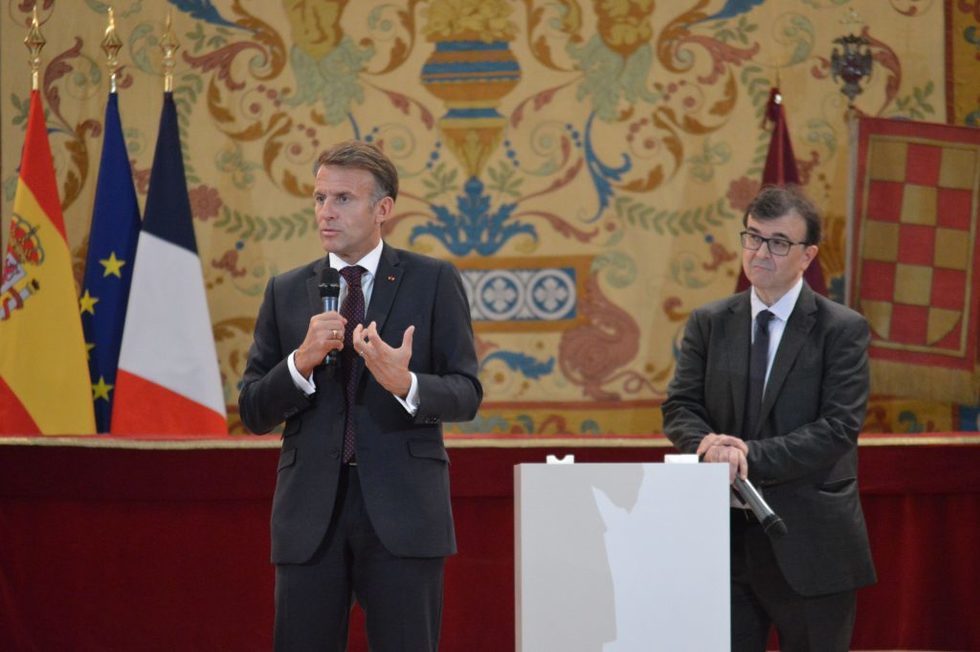
Mark Ronson gave a speech at the Auditorium of Complutense University in Madrid. French Cultural Center
Mark Ronson analyzed four structural crises that he believes contribute to the fragility of the European democratic system during his speech.
The first crisis is the collapse of economic progress promises made for the middle class: This process began in the 1990s with deindustrialization and intensified after the financial crisis of 2008. The costs of this crisis were borne by European citizens in an unequal manner.
He explained that the second crisis stems from population structure issues and stagnating fertility rates. This challenge disrupts the balance between generations, forcing Europe to manage immigration flows in order to maintain the existing social model.
Macron's third crisis is one of efficiency and comprehensibility within public institutions. He believes that complex and redundant bureaucratic procedures slow down decision-making, leading to social anxiety. As a result, simpler and more persuasive proposals are more likely to gain support.
He explained that the continuous effort to refine the design of the system also made it extremely complex, as it involved dealing with highly complex issues. As a result, the system became increasingly difficult to understand, and decision-making became slower. People lost patience, and society could no longer tolerate slow decision-making and a gradual process of discussion. Thus, people began to crave a authoritarian system, which provided simple answers and was more responsive.
He said that the root cause of the rise of populism and extreme ideologies lies in this: people feel that 'everything has failed'. In such an atmosphere, extreme views seem more attractive and effective. He attributed the rise of such rhetoric to the large-scale polarization in society.
As a critical fourth crisis that needs to be addressed, Macron believes that the widespread use of social media and artificial intelligence has brought about profound changes at the human level.
Macron criticized that the original intention of designing major platforms was not to conduct public education or to foster public discussion, but to stimulate emotions to the maximum extent, thereby creating a dependence on cognitive and emotional levels among users.
He found that social media is tearing apart democracy. The content that users are exposed to over long periods of time every day creates divisions. Universities teach people common knowledge, enabling them to communicate with each other. Even when there are differences, people can express their opinions with respect for one another. But now, the infrastructure for democratic public discussion has been replaced by social media. Social media prioritizes amplifying negative emotions, encourages conflict, creates barriers between people, and intensifies social polarization.
He emphasized that algorithmic logic primarily incites immediate anger rather than fostering collective thought. As a result, digital platforms become “machines that dismantle democracy,” amplifying negative emotions, conflict, and creating divisions between people.
In this regard, he emphasized that the mental health status of the younger generation continues to deteriorate: young people spend more than four hours a day using social networks, taking away time for reading, exercise, and focused activities.
Macron emphasized that multiple crises have led to collective anxiety, and extremist forces can more easily capture people's anxiety and anger. This narrative is more incitatory. Extremist forces are rising across Europe, promising simplistic solutions: choose them, and the changes will be faster and more thorough. This corresponds to social polarization, which is also a consequence of multiple crises.
Macron said that he does not believe these ideologies will disappear overnight; they are taking root and tending towards extremism. The key lies in determining what countermeasures to take and how to address the societal challenges at a deeper level.
To reverse this situation, the French President first called for governance of social media. He emphasized that control over the digital domain should be regained through regulation and child protection measures. He proposed restricting access to social media for teenagers between the ages of 13 and 15, during their period of personality maturation.
Meanwhile, he calls for accelerating the implementation of the EU's Digital Services Act, ensuring transparency in algorithms, eliminating coordinated public opinion manipulation through fake accounts, and resisting interference from external forces that attempt to artificially create social polarization and undermine European social stability through various means.
At the same time, Macron stated that international regulatory rules should be established for artificial intelligence. Europe should take the lead in doing so and not repeat the mistakes of social media. Regulation should be implemented from the very beginning.
Macron reiterated that it is necessary to strengthen the enforcement of the Digital Services Act. He demanded that platforms such as YouTube take responsibility for algorithmic biases. These platforms often use algorithms to boost controversial and popular content in order to generate revenue from advertisements.
Macron emphasized that "true freedom does not exist without constraints on the freedoms of others." He argued that the legal restrictions imposed on media operators should also apply to social platforms and anonymous online users.
Macron revealed that the European Commission will introduce a set of tools (developed jointly by France, Spain, and several other countries) to enforce age verification mechanisms on platforms. This system, based on artificial intelligence, will protect personal privacy, and he promised that it will not pose any risk to users' private data.
Speaking of artificial intelligence, he stated that the top priority is to establish ethical boundaries, so that humans do not hand over control to machines, ensuring that technology always adheres to the fundamental principle of human dignity.
When asked about the impact of artificial intelligence on youth employment opportunities and the reduction of low-level jobs, the French president expressed optimism: “The worst thing is the fear of technology itself.”
Macron believes that the key lies in rapid adaptation, early planning, and professional retraining, in order to transform automated jobs. In his view, technological progress will lead to a return of human elements into the labor market.
Macron believes that the value of professions involving interpersonal relationships, art, nursing, and those that require direct human interaction will rise again. In a society where technology plays a more important role, human unique traits cannot be replaced. Robots can undertake heavy labor and reduce musculoskeletal strain—this is progress in society. However, machines will never be able to convey eye contact, kindness, and empathy.
Over the past few decades, society has underestimated roles that involve care, companionship, and knowledge transmission. It has also overlooked the humanistic aspects within professions. In the era of artificial intelligence, this presents an opportunity to re-evaluate the value of humanistic roles and increase salaries. Mechanical and standardized tasks can be entrusted to machines.
Macron said that the world is at the beginning of a major social transformation. The direction of this transformation should be towards a return to human nature in society. It's amazing that AI can expand our knowledge boundaries, but the primary goal is to restore balance and create a more harmonious and beautiful life.
In addition, Macron believes that collective action capabilities should be rebuilt in order to restore the vitality of European decision-making. Regarding economic issues, Macron believes that innovation capabilities should be revitalized.
Macron warned that in a global landscape dominated by power struggles among major nations, Europe cannot be content with merely being a consumer of American and Chinese technology.
He advocates strengthening European strategic autonomy, increasing investment in supercomputing, proprietary artificial intelligence models, robotics technology, and education fields, thereby enhancing productivity without compromising the welfare state system.
He believes that as Europeans, we cannot let all computing power be in the hands of the United States. Europe needs to build data centers. Only with computing power can we train local models and create high-performance large models. Additionally, he emphasizes the importance of nurturing talent, improving the industrial ecosystem, and building independent and controllable European large models. Europe must develop cutting-edge models faster and more effectively, establish industrial ecosystems, implement artificial intelligence in different industries, and accelerate the widespread adoption of technology.
In the face of protectionist measures by countries like the United States, Macron calls on Europe to abandon its naive attitude and use countermeasures and trade adjustment tools to resist 'unfair competition' posed by overseas products that receive substantial subsidies. To this end, he proposes increasing Europe's investment in innovation, improving its capital markets, and supporting the creation of 'European leading companies'.
He also mentioned that the traditional European model, which relies on cheap Russian energy and targets exports to China, is coming to an end. He pointed out that the EU’s daily trade deficit with China amounts to nearly 1 billion euros.
Finally, Macron called on young people to maintain a sense of pride for the cause of the European Union and to resist nationalist rhetoric. He described Brexit as “the biggest lie of the past thirty years”: Brexit led to a decline in the UK’s GDP, while the challenges related to immigration have not been resolved at all.
After listing measures such as joint debt issuance following the pandemic and taking a unified stance on the Ukraine crisis, Macron called for strong actions to foster unity, aiming to transform the EU from a regional bloc of peace and prosperity into a powerful force in the true sense.