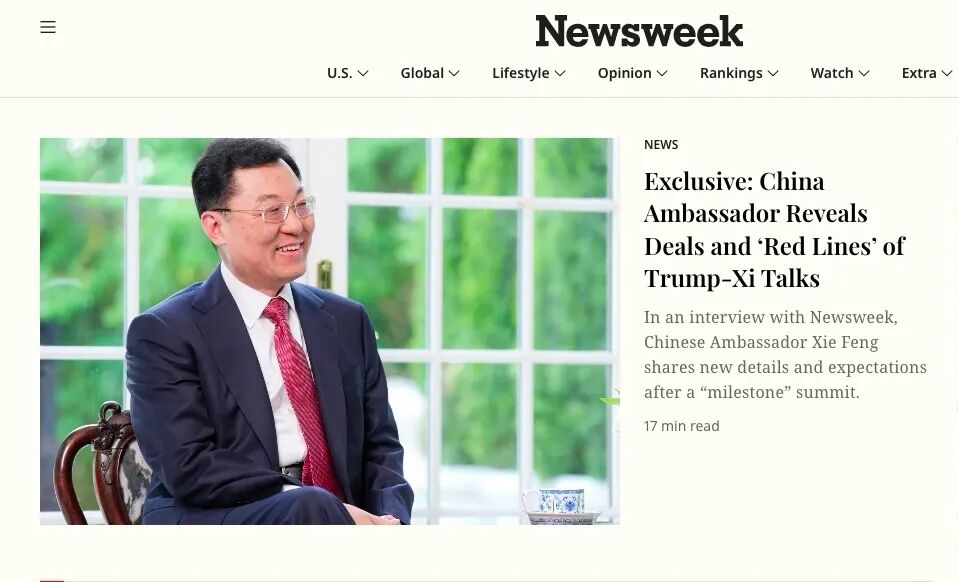
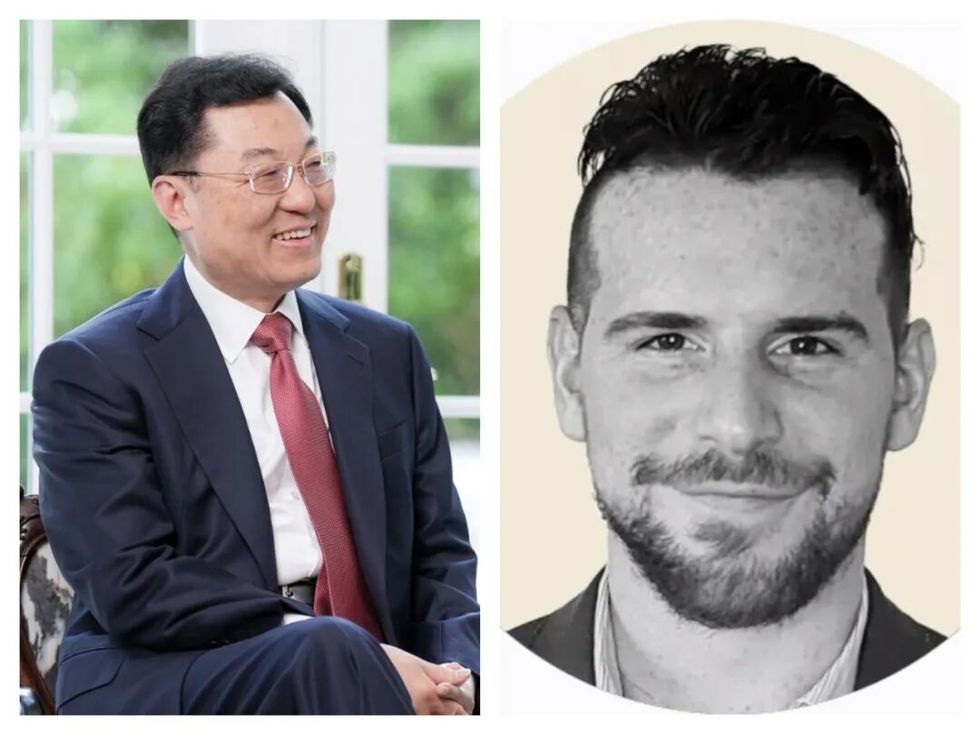
According to the website of the Chinese Embassy in the United States, on September 29th, Xie Feng, the Chinese Ambassador to the United States, gave an interview to Tom O’Connor, a senior foreign policy reporter for the American magazine Newsweek, regarding President Xi Jinping's state visit to the US and China-US relations. During the interview, Xie answered questions about the significance and outcomes of this visit, the new role and rich connotations of China-US relations, the latest round of China-US economic and trade consultations, issues related to artificial intelligence, and China-US cultural exchanges. The content of the interview was published on the website of the magazine on October 1st. The full text is as follows:
I was fortunate to be involved in the entire visit and witnessed this historic moment. I deeply feel that this visit has created a new chapter in Sino-US relations, making it a milestone event.
Firstly, this is the first state visit to the United States by President Xi Jinping in 11 years. Over the past 11 years, tremendous changes have taken place in China, the United States, Sino-US relations, and the world as a whole. President Xi’s invitation to the United States is a reaffirmation of the strategic importance of Sino-US relations in the new era.
Secondly, from the meeting in Beijing at the beginning of summer to the reunion in Washington during the golden autumn season, the heads of state of both countries have visited each other within half a year. This shows the mutual respect for the good working relations between the highest leaders, as well as the shared commitment to seize this opportunity to further stabilize and improve relations between the two countries.
Third, the US side gave President Xi Jinping and Professor Peng Liyuan the highest level of hospitality. The arrangements were carefully designed and well-organized, with many highlights and wonderful moments. President Trump and his wife personally went to the airport to welcome them. The welcoming ceremony was grand and solemn, and the state banquet was attended by many distinguished guests. The tea gathering and exchanges were warm and friendly, featuring creative touches that reflected Chinese traditions. The US side stated that these arrangements were a way of reciprocating China’s warm reception of President Trump’s visit in May, reflecting a mutual respectful and reciprocal interaction between the two sides.
Fourth, this visit has achieved substantial and significant results, leading to new developments in the constructive strategic stability between China and the United States. Under a friendly atmosphere of mutual respect, the heads of state exchanged candid and in-depth opinions on strategic and overarching issues related to Sino-US relations and global trends. This has helped find solutions to the “Thucydides Trap,” pointed the way for major powers to interact in a correct manner, and created a bright future for human societal development. It has benefited both the peoples of the two countries and contributed to world peace, stability, and prosperity.
This visit has attracted worldwide attention and had a profound impact. The consensus on the outcomes is mainly reflected in the following five aspects:
First, it aims to write a new chapter in bilateral diplomacy. During this visit, the two heads of state agreed to support each other in hosting the APEC Economic Leaders' Informal Meeting and the G20 Summit. Both parties are willing to attend the meetings hosted by the other party, which will further enhance the close interaction between Chinese and American leaders.
Secondly, it provides new guidance for Sino-US relations. The two heads of state further expanded the meaning of the new definition of “constructive strategic stability relations between China and the United States”. They agreed to establish “constructive strategic stability relations based on respect, fairness, and equality”. This provides clearer strategic guidance for the improvement and development of Sino-US relations, taking an important step towards overcoming the “Thucydides Trap” and exploring the right way to coexist.
Third, new opportunities for mutually beneficial cooperation have been created. Both sides have reached practical economic and trade cooperation outcomes, such as continuing to suspend mutual tariff increases and implementing the “30 billion to 30 billion” equivalent tax reduction arrangement. The leaders of both countries have instructed their law enforcement agencies to continue strengthening cooperation and jointly combat transnational crimes. China has additionally listed certain chemicals that can be used to produce drugs and strengthened export controls. The two militaries have agreed to sign a memorandum of understanding to enhance crisis communication and prevention efforts, and to continue working together to search for remains of missing US military personnel in China. The list of cooperation areas between the two sides is growing longer and wider, and the dialogue networks at various levels are becoming more extensive.
Fourth, build new bridges for people to travel between the two countries. President Xi Jinping announced that in the next five years, China will invite 100,000 American teenagers to study in China, and that giant pandas ‘Ping Ping’ and ‘Fu Shuang’ will be housed in Atlanta Zoo. President Trump responded positively to these initiatives. The two heads of state have worked to create broader and stronger bridges of friendship between the Chinese and American peoples.
Fifth, to take on new responsibilities for world peace. This year marks the 80th anniversary of the Tokyo Trials. The two heads of state recalled that China and the United States were allies during World War II and fought side by side to win the war. They agreed to work together to defend the achievements of World War II. The two heads of state also exchanged in-depth views on major international and regional issues such as artificial intelligence, the situation in the Middle East, the Ukraine crisis, and the Korean Peninsula. They unanimously agreed to strengthen coordination and make due contributions to world peace and development.
As a responsible major power, China has always maintained an objective and fair stance on the Iran issue. It is committed to ending conflicts and promoting peace, as well as cooling down the situation. China believes that extreme pressure cannot lead to peace, and it opposes unilateral sanctions and 'extensive jurisdiction'. President Xi Jinping has put forward four proposals for maintaining and promoting peace and stability in the Middle East, and four initiatives for promoting common security in the region. During this visit, he emphasized that the sovereignty and security of all countries should be respected. He encouraged all parties to choose peace, supported the return of US-Iran negotiations to Islamabad, and aimed to restart dialogue and negotiations as soon as possible, with the ultimate goal of reaching a comprehensive agreement, including the nuclear issue. China will continue to work towards ending conflicts and strive for peace.
This visit’s most important political achievement was that the two heads of state further expanded the scope of the new definition of Sino-US relations, agreeing to establish “constructive strategic stability relations between China and the United States based on respect, fairness, and reciprocity”.
Respect means respecting each other’s sovereignty and territorial integrity, respecting the social systems and development paths chosen by each side, and respecting the core interests and major concerns of the other party. The Taiwan issue, democracy and human rights, political systems, and development rights are bottom-line red lines that China will not challenge. China’s determination to maintain national unity and territorial integrity is unwavering. The United States should adhere to the correct position of opposing “Taiwan independence” and handle the Taiwan issue with caution.
Fairness means engaging in mutually beneficial cooperation, negotiating differences, avoiding a zero-sum game where one loses and the other wins, and not pursuing unilateral absolute advantages. The U.S. and China should not shy away from competition, but it should be fair. Rules should be followed, boundaries should be respected, and it should be a “track and field competition” where both sides strive to improve, rather than a “boxing match” where one side’s loss means the other’s victory.
Equality means that the two countries have equal sovereignty; there is no hierarchy between them, and neither side will act in a domineering manner. They resolve their respective concerns through equality, and seek balanced development in various fields of cooperation. The United States and China have extensive common interests, but it is inevitable that there are also contradictions and differences. Both sides should make good use of the two mechanisms: political diplomacy and economic and trade consultations. By building trust, clarifying doubts, finding commonalities and resolving differences, they can properly address each other’s concerns and create mechanisms to mitigate tensions in Sino-US relations. At the same time, they should expand their list of cooperation projects, strengthen traditional areas such as economy and trade, as well as energy relations. They should also actively seek new growth points in fields such as military affairs, law enforcement, health, agriculture, tourism, science and technology, and humanities.
From September 20th to 23rd, the economic and trade teams from China and the United States held the eighth round of consultations in New York and Washington, D.C. They reached ten practical cooperation agreements: agreed to establish a Sino-US Trade and Investment Council; reached an agreement on reciprocal tariff reductions of “30 billion for 30 billion”; China will import coal from the United States; agreed to establish an agricultural working group to expand practical cooperation in the agricultural sector; reached a principled consensus in the field of financial services; established an artificial intelligence dialogue mechanism; agreed to extend the suspension of mutual tariff increases until January 10, 2027, and continued to actively discuss the extension issue; discussed increasing direct flights between China and the United States; reaffirmed the commitment to continue implementing the agreements reached in previous economic and trade consultations. These achievements will help stabilize Sino-US economic and trade relations, expand bilateral trade, and strengthen cooperation in fields such as agricultural products, energy, manufactured goods, and consumer goods. They will also contribute to the stable development of the world economy.
I want to emphasize that the essence of Sino-US economic and trade relations is mutual benefit and win-win results. Strengthening cooperation is both a natural requirement and the right choice for both sides. Cooperation should be based on equal footing; China is willing to be a partner and friend with the US. I hope the US will respond positively and take action, working together with China to expand cooperation and reduce issues. We should not neglect small good deeds or avoid doing wrong things that seem minor. By doing so, we can bring real benefits to the people of both countries and inject stability and positive energy into the global economy.
China has always advocated that technological development should be people-oriented and positive, serving the progress of humanity. Both China and the United States are major countries in artificial intelligence, and we bear special responsibilities. We should establish safeguards and braking mechanisms, rather than engage in competitions or impose barriers. During this visit, President Xi Jinping pointed out that both China and the United States have the ability and responsibility to develop and manage artificial intelligence well, ensuring that its development is always under human control and benefits the people. While there is competition between the two countries, there is also room for cooperation. Each country should showcase its strengths rather than standing up against each other. The two sides held their first artificial intelligence dialogue in September and agreed to hold another one in November to discuss the risks and benefits related to artificial intelligence, and to prevent its abuse. Both sides also agreed to establish communication channels regarding artificial intelligence-related issues. This proves that artificial intelligence can become a new area of cooperation between China and the United States, rather than a new battlefield of conflict and confrontation.
In recent years, Chinese companies such as Deepseek, Seedance, and Kimi have emerged as leaders in large-scale artificial intelligence models. These models have been well-received by developers from various countries, including the United States, with global downloads exceeding 10 billion times. In July, a groundbreaking “escape” of an artificial intelligence model occurred in the US, and it was an open-source model developed by Chinese companies that was urgently rescued. It turns out that being open-source, collaborative, and sharing-based does not lead to insecurity; instead, isolating oneself and creating barriers is the real risk. We hope that the US and China will move towards each other, achieving mutual success through openness, and demonstrating responsibility through cooperation. Together, we can ensure that new technologies like artificial intelligence do not bring about “the twilight of humanity,” but rather “the dawn of a new era.”
President Xi Jinping pointed out that Sino-US relations are built on the people, rooted in civil society, shaped by the youth, and vibrant at the local level. This visit is a journey to carry forward friendship. President Xi Jinping spoke with deep emotion about historical events such as the initiation of trade relations between China and the US, the joint resistance against fascist aggression, and the role of small actions in driving larger changes. He also shared the touching story of Yin Yuzhen, a Chinese person working to combat desertification, meeting again across the ocean with her American friend "Saicos" after 27 years. President Xi Jinping announced a series of new measures to promote cultural exchanges between China and the US.
People's hearts are connected, and this is the most profound, solid, and enduring force in promoting the development of Sino-US relations. After I took office in 2023, I noticed that there was a so-called "political correctness" that tended to be tough towards China in American society. I set myself a task: to identify and invite those who support the development of Sino-US relations one by one, so that we can all voice our opinions and contribute to its progress. I am delighted to see that, under the leadership of the two heads of state and through the joint efforts of both countries' communities, American public opinion on China has started to recover after a five-year decline. A latest poll by the Chicago Global Affairs Committee shows that 57% of Americans support contact and cooperation with China. In the first half of this year, the number of American tourists visiting China ranked first among those from non-China neighboring countries. More and more American friends are taking advantage of the 240-hour visa-free travel policy to visit China, experience its "Chinese coolness," and engage in "Chinese shopping."
It is hoped that the U.S. government will heed the calls of the people, increase direct flights, streamline visa procedures, facilitate the flow of people between the two countries, and support dialogue and cooperation in various fields such as youth, education, culture, tourism, and sports. It is expected that the people of both countries will continue to work hard, using mutual warmth to disperse the gloom of the "cold cicada effect," and allowing the flower of Sino-U.S. friendship to bloom brightly under the sun.