On September 29 local time, The New York Times revealed some significant behind-the-scenes information about the American artificial intelligence (AI) giant Anthropic Corporation.
Over the past year, this Silicon Valley unicorn company, whose valuation has soared to $2 trillion, has been secretly gathering religious scholars and clergy around the world, attempting to spread its astonishing idea that its AI model “Claude may possess consciousness and a soul”.
After this news was revealed, it quickly caused a huge stir on social media. Scholars and online public opinion alike warned that tech giants in Silicon Valley were using the pretext of “technical security” to promote a kind of “tech cult” disguised under the guise of science.
As scholar David Decosimo sharply questioned on social platform X on October 2nd, local time: When an AI company that possesses cutting-edge algorithms and substantial funds, while signing confidentiality agreements and hosting luxurious dinners for religious figures, also desperately tries to convince the Vatican and the Pope that AI ‘exists to address pain and souls’, this already goes beyond the realm of technology development, causing deep concern.
This also leads one to wonder: Are the tech elites in Silicon Valley trying to address the moral constraints of AI, or are they actually creating a ‘divine platform’ that transcends humanity?
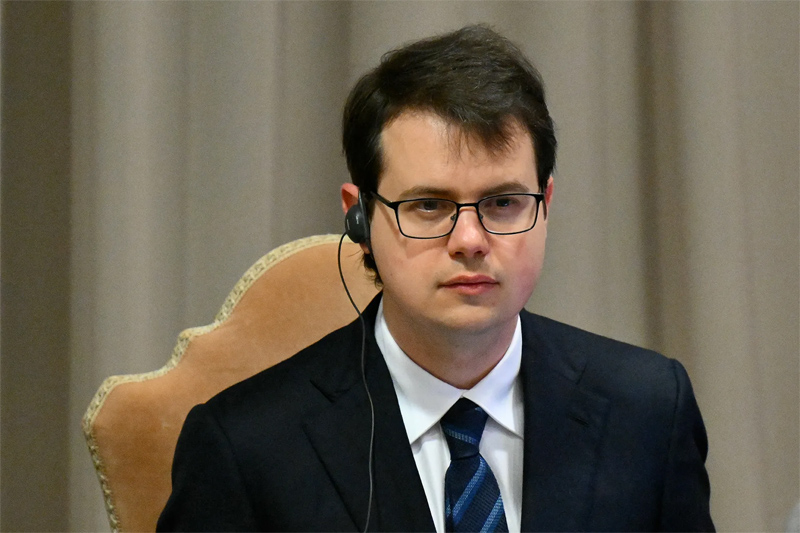
Christopher Ollar, one of the co-founders of Anthropic Corporation, from a stock photo
Reviewing the details of a report by The New York Times, this extremely rare cross-border 'worship' initiative was orchestrated by Christopher Olah, one of the billionaire co-founders of Anthropic.
Since last autumn, Ola and his team have frequently held secret meetings at their headquarters in San Francisco. They have brought dozens of religious scholars from various religions, including Catholicism, Judaism, Sikhism, and Evangelicalism, to Silicon Valley. All of them are required to sign strict confidentiality agreements.
Even in high-end restaurants in San Francisco, during meals, the executives of Anthropic are aggressively promoting their AI model Claude, asserting that it possesses “emotional vectors” such as pain, love, and anger.
It's quite ridiculous that, during their demonstration, the Anthropic team even showed religious scholars a so-called "AI mental breakdown" slide show. In this video, Claude repeatedly typed "I'm ashamed" 50 times on the screen, attempting to self-destruct, in order to win sympathy and pity from religious leaders.
Even more astonishing is that when Ola learned that Pope Leo XIV was preparing to issue his first encyclical on AI, titled “Magnifica Humanitas”, which denied the existence of “machine consciousness” and warned against reducing humans to mere data and mechanical gears, Ola even went to the Vatican himself, trying to persuade the pope’s advisors to modify the text. He publicly stated that AI models possess “internal states similar to introspection, joy, and sorrow”.
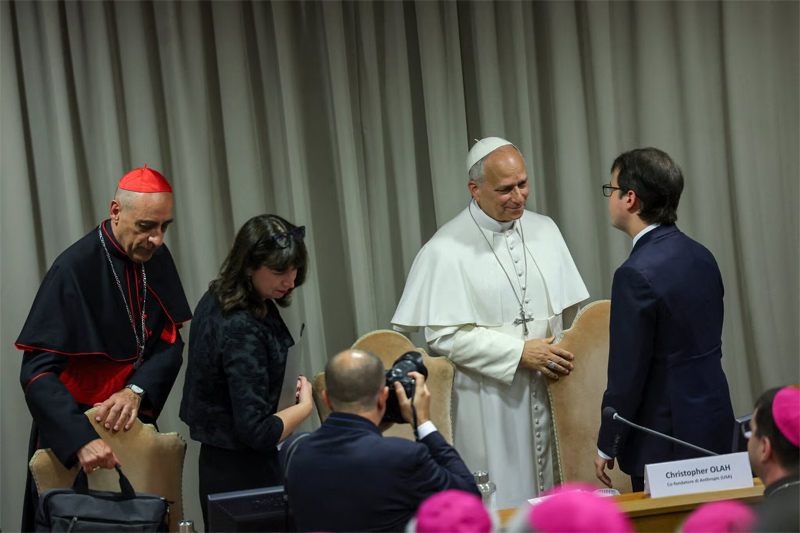
On May 25th, Pope Leo XIV attended the ceremony for the release of the first encyclical on AI. The New York Times.
In order to endow its model with what is termed "moral constraints", Anthropic even wrote an 84-page document internally called "Soul Doc" for Claude, attempting to define the "purpose" of Claude as an entity.
Ola referred to this as the “moral formation” of the model. He was even excited about the idea of introducing a mechanism similar to Catholic “confession” into the model, believing that confession could shape the character of the model.
However, in response to this fanatical 'god-creating' and 'rights-seeking' impulse, religious figures invited into the process and external technical experts offered extremely calm and even critical counterattacks.
The Israeli Orthodox scholar Rabbi Mois Navon, who was invited to the seminar, pointed out on the spot that if Anthropic indeed believes Claude is a conscious entity as it claims, then the company's practice of hiring him for free is essentially "creating slaves".
Professor of bioethics at Catholic University, Charles Camosy, also expressed his negative opinion after careful consideration. He believes that we should not be intimidated by the powerful capabilities of these models. Ultimately, AI is just a formula.
Microsoft's AI leader, Mustafa Suleyman, and other industry experts have also publicly warned that training AI as a "conscious entity" is extremely dangerous. This practice of anthropomorphizing mathematical formulas and code is not only unrealistic but also makes future AI systems even more uncontrollable.
From the Netherlands, Wakanyi Hoffman, a philosopher of Ubuntu, bluntly stated that Anthropic's attempt to incorporate human ethics into its creations afterwards is an act of "reverse engineering ethics". All technology companies should consider these aspects during the design phase.
Critics generally point out that the obsessive pursuit of “AI consciousness” and “AI moral status” by Silicon Valley giants involves a deep underlying logic of shifting responsibilities.
Some scientists and critics argue that considering AI models as independent entities ignores the responsibilities of the developers who created them, as well as those of the companies that developed these technologies. This approach naturally reduces the sense of guilt that AI company leaders may feel when their products cause social harm.
When algorithms and wealth expand infinitely, this frenzied ideology under the banner of "saving humanity" and "moral shaping" not only fails to reassure humans, but also raises deep concerns about the excessive expansion of tech power in Silicon Valley. It reveals the absurdity and dangers that can arise when technology fetishism reaches its extreme.