According to the National Statistics Office of Vietnam, in the third quarter of this year, the Vietnamese economy grew by 9.95% year-on-year, achieving the fastest growth rate in four years. This figure is higher than the 8.15% seen in the first quarter and 8.81% in the second quarter. Strong growth in the industrial and construction sectors has provided strong support for economic expansion.
Vietnam's trade performance was particularly strong in September. Exports increased by 39.1%, while imports increased by 45.8%. After sustaining a deficit in the first eight months of this year, Vietnam achieved a surplus of $127 million in September.
In the first nine months of this year, Vietnam's economy grew by 9.01%. According to the Vietnam National Bureau of Statistics, Vietnam's economy has achieved positive results in almost all areas.
However, challenges still exist. The annual goal set by the Vietnamese government is to achieve “at least a 10% economic growth rate”. This means that even if the third-quarter data exceeds expectations, Vietnam still needs to achieve approximately a 12% economic growth rate in the fourth quarter.
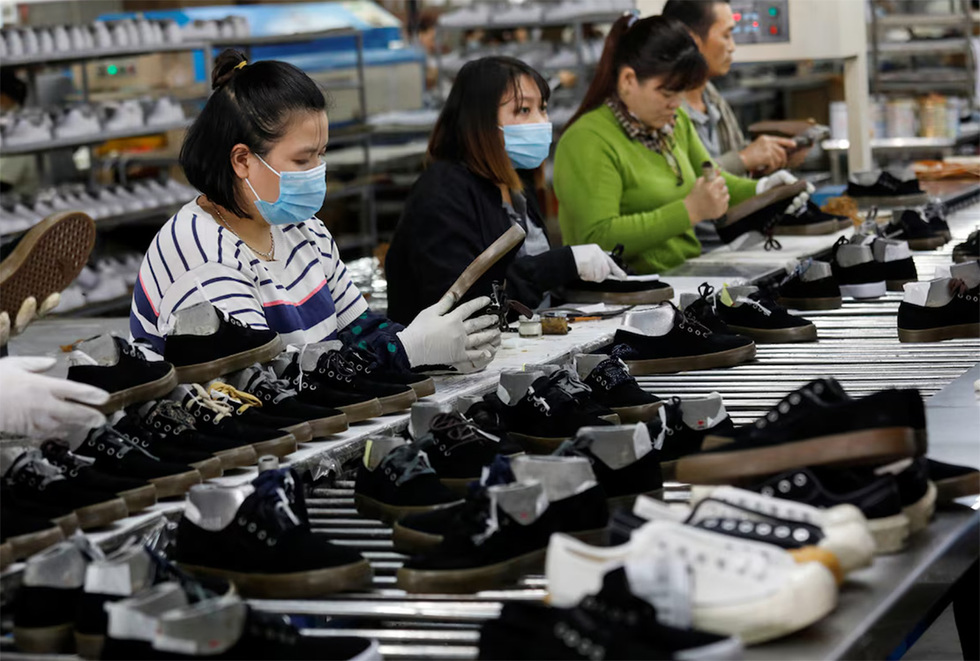
File photo: Employees of a shoe factory in Hanoi, Vietnam. Reuters
According to Reuters, Vietnam’s GDP increased by 9.95% in the third quarter of this year, the fastest growth rate since the outbreak of the pandemic. This growth was mainly driven by strong exports and large-scale infrastructure investments.
Vietnam's economy is highly dependent on imports and exports. This year, the war in Iran has caused an increase in energy import costs. In the first nine months, Vietnam's trade deficit reached $19.42 billion, setting a record high.
In the past nine months, the United States has been Vietnam’s largest export destination, with exports to the US reaching $140 billion; China, on the other hand, is Vietnam’s largest source of imports, with imports from China amounting to $187.34 billion.
However, in September, Vietnam's goods exports increased by 39.1% year-on-year, reaching $59.48 billion; imports increased by 45.8% year-on-year, reaching $58.21 billion. The country enjoyed a trade surplus of $127 million that month.
In the first nine months of this year, Vietnam’s total investment increased by 16.7% year-on-year. Foreign direct investment (FDI) received increased significantly by 76.4% year-on-year, reaching $50.4 billion. Manufacturing and real estate were among the main areas of investment.
In September, the Vietnamese Consumer Price Index rose by 5.08% year-on-year, reaching the highest level in four months. In May this year, Vietnam's inflation rate reached 5.6%, the highest level since January 2020. The main reasons for this were high fuel costs due to the Middle East conflict, and increased electricity demand caused by hot weather.
According to Bloomberg, the Vietnamese National Bureau of Statistics stated that, with the government's efforts to achieve double-digit economic growth by 2026 and the support for improving governance and resource utilization efficiency through structural reforms, the Vietnamese economy has achieved positive results in almost all areas.
According to VNA News, the Asian Development Bank recently noted that Vietnam has made significant progress in the process of transforming its growth model. There have been positive outcomes in terms of economic growth, attracting investment, and expanding production.
The Asian Development Bank also stated that in order to maintain a sustainable development momentum and achieve the goal of becoming a high-income country by 2045, Vietnam needs to continue to address internal bottlenecks and improve the capabilities of domestic enterprises as well as the quality of investment capital flows.
Bloomberg is optimistic about the performance of the Vietnamese economy. It states that the growth rate in the third quarter exceeded expectations, bringing Vietnam closer to its annual double-digit growth target.
Vietnam is one of the countries with the most impressive economic growth in Asia. It is striving to push its industries towards higher value chains. At the same time, large-scale infrastructure investments are also achieving the expected results.
Though Nikkei Asian Review noted that achieving at least a 10% annual growth rate "is not easy".
Vietnam National Bureau of Statistics Director of the National Accounting System Department, Nguyen Thi Me Xinh, stated that to achieve the annual economic growth target, the economy needs to grow by at least 12.5% in the fourth quarter.
This is a highly challenging goal with extremely high demands. She points out that trade uncertainty, global supply chain adjustments, rising energy and production input costs, as well as pressure on accelerating public investment funds disbursement are the primary challenges facing the Vietnamese economy.
Vietnam SSI Securities's Chief Economist and Research Director, Fan Liu Xiong, believes that "an annual economic growth of 10% is possible, but challenges still exist, as the year-on-year growth rate in the fourth quarter needs to reach about 12%."
Last week, the Asian Development Bank raised Vietnam's economic growth forecast for this year from 7.2% to 7.8%.
The Asian Development Bank stated that Vietnam's economic growth prospects remain strong. Continuous expansion in the manufacturing sector, strong domestic consumption, and stable foreign direct investment will continue to support economic growth.
However, in the long term, “weak global demand and increasing external uncertainties could drag down economic growth, while rising energy prices and tightening global financial conditions could further increase inflation and exchange rate pressures.”
Reuters cited Laura Schwartz, a senior Asian analyst at risk intelligence firm Verisk Maplecroft, saying that as inflation has accelerated in recent months, concerns about the Vietnamese economy becoming "overheated" are growing.
She also stated that "short-term and medium-term power supply shortages may also pose major challenges."

