Since the beginning of last year, under the continuous impact of Chinese AI models, OpenAI has been engaging in unfair competition and portraying China as a "threat". The Trump administration in the United States has taken measures against Chinese AI technology.
Now, OpenAI once again slanders China, falsely claiming that China “may” have orchestrated a cyber propaganda campaign.
In a report released on June 10 local time, OpenAI claimed that they have identified “influential actions related to China, aimed at influencing the United States’ views on AI,” including efforts to oppose Trump’s tariff policies and interference in debates regarding the construction of data centers and other infrastructure facilities in the United States.
According to Reuters, the Chinese Embassy in the United States responded that China firmly opposes any unfounded attacks or smear campaigns against China. Moreover, China is working hard to ‘ensure that AI becomes a force for good and benefit to everyone’.
The report describes two ChatGPT account clusters, named “Data Center” and “Technology and Tariffs”. The report accuses these clusters of spreading opinions to American internet users by generating comments and images, namely “Building AI data centers increases electricity costs for ordinary families” and “Trump’s increased tariffs undermine the global future”.
Ironically, this report provides no credible evidence. It relies solely on the claim that "some people have Chinese-language accounts" to cast blame on China.
OpenAI also realizes that the so-called evidence they presented is not solid. They can only make malicious speculations, claiming that these two clusters may be related to China, and that this “may” indicates that the operation was behind-the-scenes orchestrated by the Chinese side.
Immediately afterwards, OpenAI revealed its true intentions. They politicized issues related to economy, trade, and technology, turning this seemingly insignificant matter into a “China-US competition”.
The report claims that “opinion manipulators originating from China” are targeting American AI infrastructure, which is “the cornerstone of America’s technological leadership, economic growth, and a broader democratic AI ecosystem.”
At the press conference that day, OpenAI's lead investigator Ben Nimmo continued to emphasize that these actions seem to be aimed at manipulating "a legitimate debate about American AI and broader American tech policies." No evidence has been seen to indicate that these activities have had a significant impact on public opinion. "But this once again demonstrates how central generative AI has become in the movement for online influence."

October 2, 2025, New Carleyl, Indiana, USA. A technician works at Amazon’s AI data center. Eastern IC
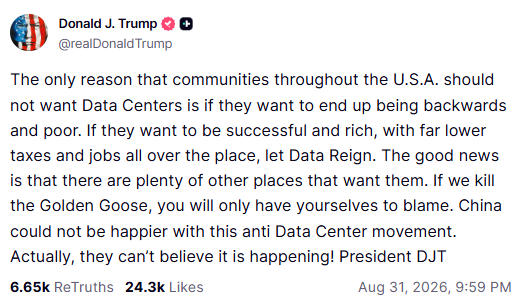
According to Politico, this report that undermines China may further fuel the conspiracy theories of Republicans and other AI supporters, who believe that foreign entities are trying to interfere in the debate over data center construction. This issue has become a policy focus before the US mid-term elections.
Recently, while the United States is vigorously promoting the construction of data centers to meet the growing computing demands of the AI industry, there have been many protest groups in the US that oppose the construction of data centers and express their dissatisfaction with related facilities.
According to the American newspaper The Washington Post on May 29th, residents in Utah recently held protests against the construction of a data center in the northwestern part of the state, which is funded by Canadian businessman Kevin O’Leary. Some protesters are worried that the data center will damage the local ecosystem, which is already in a fragile state. Others pointed out that the county government's decision to advance the project was too hasty, and no opinions were sought from the residents.
Subsequently, some people from the American political and business circles implicated China, accusing it of ‘financing protesters within the United States’.
In early June, Republicans in the U.S. House of Representatives also cited two think tank reports, urging the Trump administration to investigate actions by China that they claimed were attempts to incite public opposition to AI data centers. Both reports alleged that “foreign-related groups” were driving anti-data center sentiment.
However, many experts in the technology industry believe that American tech giants and politicians have failed to focus on the key issues. They have been obsessed with unfounded ‘foreign conspiracy theories’ while neglecting communication with American citizens.
Analyst Rui'an Feidao Xuk of the US Enterprise Research Institute said that American public sentiment toward data centers is unrelated to China and that statements from US politicians and business leaders on this issue are unhelpful. He stated, “We must recognize that China is not the reason why AI construction is unpopular in the United States.”
Google's former global director of data center infrastructure, Daniel Gorden, said: "The data center industry did not handle protests properly. No one tried to explain to the public why building these data centers was a good thing. People think technology giants are omnipotent, but that’s not really the case. The key is establishing communication with the public, which is actually a area where large tech companies are not good at."