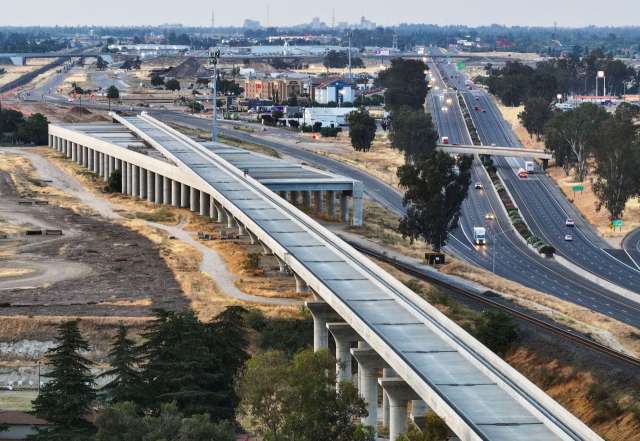
In 2010, the “Stuttgart 21” project in Germany officially began. The plan was to transform the railway system in Stuttgart, Baden-Württemberg state, by converting the Stuttgart train station into an underground station that connects to the European high-speed railway network. However, over the past 16 years, the project has progressed extremely slowly. It has not been put into use yet, and is even scheduled to be further delayed.
According to a report by the German Südwestrundfunk (SWR) on June 9th, the German Railway Company responsible for the 'Stuttgart 21' project made a 'catastrophic mistake' during construction. There were errors in the laying of approximately 1000 kilometers of cables, which require replacement. Sources within the company revealed that this will cause the inauguration of the new train station to be postponed by another five years, from December this year to 2031.
According to reports, the ‘Stuttgart 21’ project plans to transform Stuttgart’s train station into a digital hub, equipping all lines and trains with the European Train Control System (ETCS), and controlling them through digital signal towers. However, Deutsche Bahn discovered a tricky issue four years ago: for many years to come, freight trains without ETCS will still need to operate in the areas surrounding the station.
These areas not only require the installation of digital equipment, but also the preservation of traditional signaling systems. For this purpose, Deutsche Bahn had to lay additional thousands of kilometers of cables and cable ducts. Specifically, the section between Stuttgart-Bad Cannstatt and Wübrigen required the laying of 1200 kilometers of cables.
However, a recent investigation revealed that due to Deutsche Bahn’s eagerness for quick results, they made ‘catastrophic mistakes’ during the construction process. Most of the cables laid are not compatible with the pipelines, and most of the over 1,000 kilometers of cables and pipelines that have been laid need to be replaced.
Several insiders confirmed this information. They revealed that in order to get the 'Stuttgart 21' project up and running as soon as possible, Deutsche Bahn did not follow the normal procedures for railway hub construction. They hurriedly contracted a construction company to lay cables before the planning work was completed, resulting in errors in the cable laying process.
This mistake will result in another five years of delay for the ‘Stuttgart 21’ project. According to a source cited by the German newspaper Frankfurter Allgemeine Zeitung, the Stuttgart train station was originally scheduled to be operational by the end of December this year, but now it will be delayed until the end of 2031.

"Stuttgart 21" Construction Site Video Screenshot
Regarding the relevant information, Deutsche Bahn only stated in a written response to SWR: “The management of Deutsche Bahn Stuttgarter-Ulm Projekt GmbH has been instructed to develop new plans for the operation of the ‘Stuttgart 21’ project by mid-2026, and to reach a binding agreement with all project partners.”
The chaos caused by the “Stuttgart 21” project has left railway experts speechless. Hans Lester, a German railway expert from Berlin, said, “It clearly doesn’t seem to be proceeding according to the plan. It doesn’t look like a construction site at all. This is a complete mess.”
Lester pointed out that Deutsche Bahn did not send timely notifications to various transport companies, nor did they inform them in advance that only trains equipped with ETCS were allowed to operate on certain routes. As a result, the project had to adopt a ‘dual configuration’ where both old and new equipment were used together. He said, “Such policy changes usually require a five-year buffer period so that freight companies across Europe can be prepared.”
According to German media, the idea of transforming the Stuttgart train station can be traced back to the 1970s. However, the project was delayed due to cost constraints and was not actually launched until 1994.
The ‘Stuttgart 21’ project will transform Stuttgart’s train station into an underground station, and will also construct dozens of kilometers of new railways, tunnels, and bridges. The number ‘21’ in the project name symbolizes ‘welcoming the 21st century’.
In 1997, Deutsche Bank and the German government estimated that the cost of the ‘Stuttgart 21’ project would be approximately 2.5 billion euros. However, subsequent economic feasibility assessments revealed that the complex structure of the underground rock layers and the increasing requirements for railway track construction led to a continuous increase in project costs. As of now, the costs have risen to approximately 11.3 billion euros.
The construction progress of “Stuttgart 21” has also been delayed repeatedly. After 16 years of construction, it is still not ready for use. Since the project officially started in 2010, it has continuously faced obstacles from local citizens, legal proceedings, changes in regulations, and complex geological conditions, resulting in extremely slow progress.
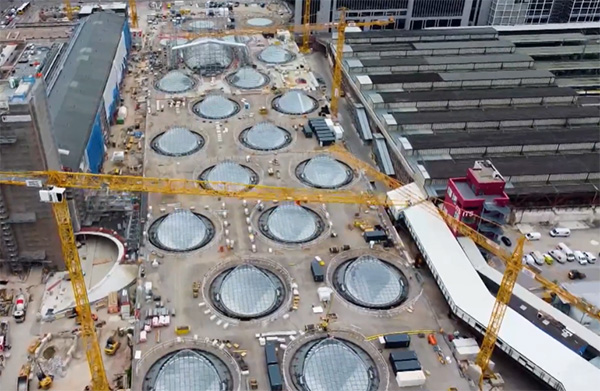
"Stuttgart 21" Construction Site Video Screenshots
Baden-Württemberg Governor Jem Özdemir complained that the “Stuttgart 21” project had become a laughingstock. He stated that if the project were to be delayed again, it would be a “catastrophic news” for both the state and the passengers. “I hope that Deutsche Bahn will make a clear commitment to proceed with the project consistently, without any cuts.”
The UK's Daily Telegraph pointed out that although the German railway system has always been known internationally for its 'efficient and punctual' performance, it has actually fallen into an embarrassing state of disarray. In the past, its railway system was a source of pride compared to many European countries. However, today, long delays, cancellations of trains, and overcrowding have become the norm in the German railway system.
Since Germany implemented radical cost-cutting measures for Deutsche Bahn in the 1990s, the German railway system has been facing a shortage of public investment. According to The Daily Telegraph, a study conducted in 2022 found that only 62% of trains in Germany run on time, which is far lower than in many European countries such as Denmark and the United Kingdom. Even neighboring Switzerland has begun refusing to allow German cross-border trains that are late to enter its territory.