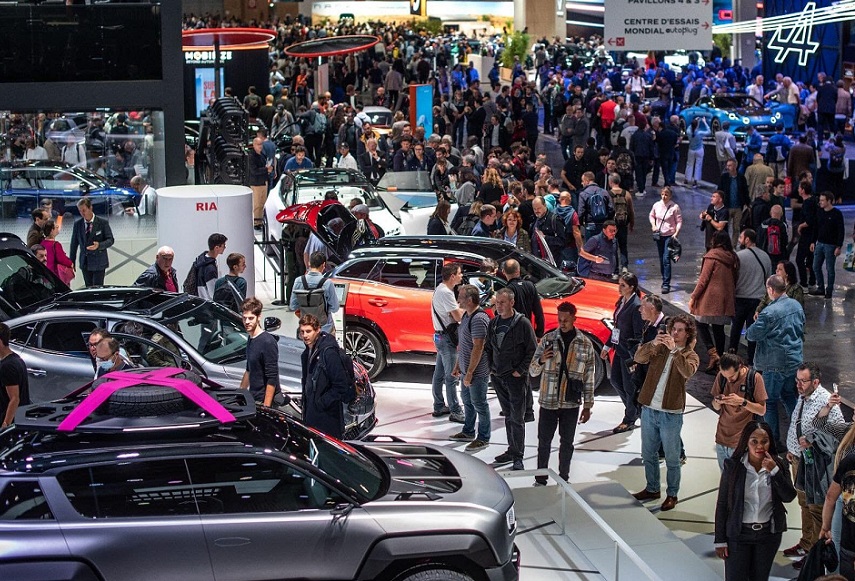
The 91st Paris Motor Show will be held at the Paris Versace Exhibition Center from October 12 to 18.
According to a report by Reuters on October 9th, it is expected that 20 Chinese car brands will be presented at this Paris Auto Show, setting a record. This highlights how Chinese automakers have managed to establish competitiveness in the European market despite the increasing trade barriers.
This year, the number of Chinese exhibitors will be twice that of the exhibition in 2024. Among them are well-known companies such as BYD and Chery, as well as new enterprises like WINGA and Avita.
Reports indicate that the Paris Auto Show takes place at a critical moment for the European automotive industry. Since the outbreak of the COVID-19 pandemic, sales of European automakers in China have plummeted, and Chinese automakers are increasingly turning their attention to the European market.
According to data from Schmidt Automotive Research, in the second quarter of this year, Chinese brands accounted for 10.7% of the European market share, which is higher than the 5.7% seen a year ago, and also higher than that of Japanese competitors that entered the European market in the 1970s.
Due to competition from Chinese automakers, weak European demand, American tariffs, and high electrification costs, European car manufacturers are facing difficulties. Volkswagen is cutting thousands of jobs and considering closing factories to reduce costs. BMW has also taken similar measures, reducing the number of employees by thousands.
Two years ago, the EU imposed tariffs on Chinese-made electric vehicles. However, Chinese automakers quickly increased their market share in fuel-powered and plug-in hybrid models. In the second quarter of this year, Chinese brands accounted for more than 26% of the plug-in hybrid vehicle market in Western Europe, compared to just 2.2% in the same period two years ago.

Chinese cars are gaining increasing market share in Europe, according to Reuters' charting.
Facing Chinese automakers, Europe has two different faces: on one side, they engage in unfair competition; on the other side, they seek cooperation.
Currently, the European automotive industry is advocating for tariffs on Chinese plug-in hybrid vehicles. At the same time, the EU is drafting legislation that includes ‘European Made’ requirements, requiring electric vehicles to meet minimum local content standards in order to receive key subsidies or government contracts.
But while competing with Chinese competitors for market share, European car manufacturers also try to benefit from China’s rise. For example, they sell idle factory capacity to China and utilize China’s electric vehicle technology.
"European people are playing a two-faced game," said Gartner Research Company Vice President Pedro Pacheco.
There is no doubt that Chinese automakers have become strong competitors in the field of electric vehicle technology. European manufacturers have not given up and are seeking to counter this with a new generation of more affordable electric vehicles.
This auto show is likely the most important one in the region since the pandemic began, according to automotive analyst Felipe Mounié. "Europeans are using this platform to tell Chinese that they remain strong and ready to go," he added.
Meanwhile, some Chinese brands that were previously little known in Europe, such as the high-end brand WING under Syrus, will seek breakthroughs. WING hopes to increase its overseas sales to 20% of total sales within three years, while currently this proportion is less than 1%.
International Automobile Manufacturers Organization Secretary-General François Roudier said that the arrival of Chinese brands has helped revitalize the auto shows, after the interest of some traditional manufacturers waned. He noted that the large-scale presence at the Paris Auto Show reflects that both Chinese and American automakers are facing increasing competitive pressure in a increasingly competitive market, and they need to compete for buyers.