Due to the Indian Election Commission's massive deletion of registration records from the voter rolls, the 'Bearcat People's Party' has been organizing protests for several days, demanding the resignation of Chief Election Commissioner Jaisim Kumar.
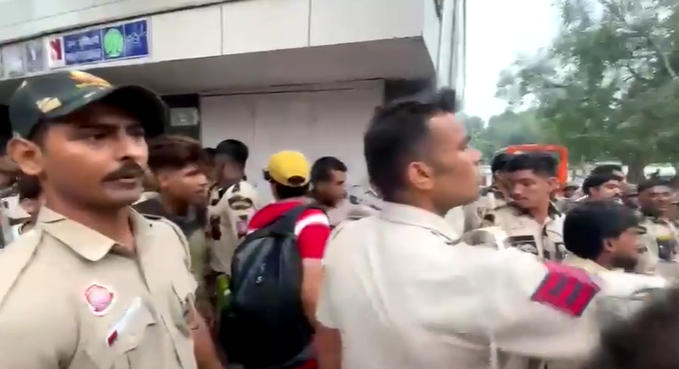
According to reports from Reuters and the British newspaper The Guardian, Indian police detained over 2,000 people in Delhi on October 10. They also blocked parts of the capital, suspended mobile internet services, and closed dozens of subway stations and markets.
On the 11th, protests continued, and the police detained hundreds of demonstrators again. Meanwhile, a court ordered the release of Abhijeet Dipke, the founder of the ‘ cockroach People’s Party, and two other leaders who were detained.
According to the ‘India Times’, the court required the three individuals to promise not to disrupt public order within the next year. Delhi police said that the three individuals signed a bail bond worth 50,000 rupees (approximately 3,460 yuan).
shortly after Dipke was released, the “ cockroach People’s Party” posted on social media platform X: “Crocodiles will never die.”

On October 11, 2026, local time, in New Delhi, India, Abhijit Dipak, the founder of the “ cockroach People’s Party”, stood inside the court building after being released. Visual China
The spark that ignited this protest was the Indian Election Commission's controversial voter registration amendment work.
According to data from the Indian Election Commission, approximately 130 million voter registration records were deleted during the verification process of voter eligibility. This includes 63 million people who have moved, 30 million people who cannot be contacted, and 28 million people who have passed away.
Opposition parties, including the Indian National Congress, question whether this large-scale purge may lead to the incorrect elimination of some voters who are still eligible to vote. In particular, Muslims and other minority groups are more severely affected, as these groups generally do not support the Hindu-nationalist ruling party, the Indian People’s Party. Therefore, opposition parties believe that this move benefits the Indian People’s Party and has influenced the party’s recent victory in some state elections.
The Indian Election Commission and the Indian People’s Party both denied any attempt to manipulate the elections. The Election Commission stated that the deleted records were identified during the revision of the voter list draft, and any eligible voters who were mistakenly deleted can be re-registered.
The controversy intensified at the end of September. The Hindustan Times reported that two deputy officials of Kumar raised several concerns regarding the revision of the voter list, registration procedures, and the digital system. The Election Commission responded by stating that it is normal to have different opinions during internal discussions and denied any favoritism towards any party.
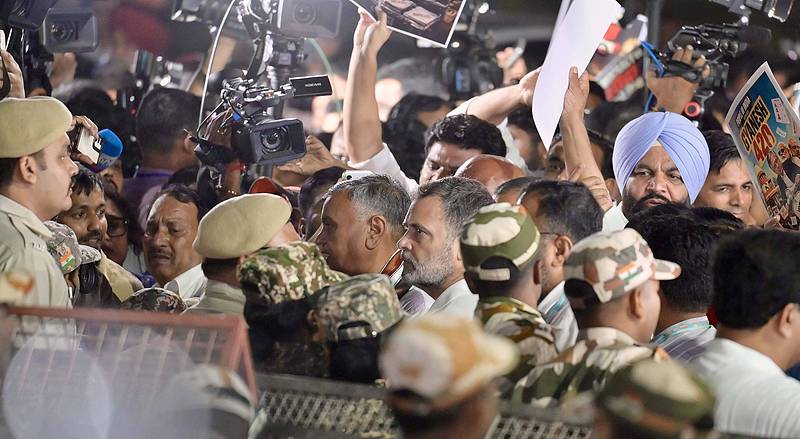
On October 9, 2026, local time, in New Delhi, India, the leaders of the National Development Inclusiveness Alliance, led by Rahul Gandhi, the leader of the opposition party in the Lok Sabha, arrived at Vije Square. They met with President Dr. Murmula to express their concerns regarding the appointment of India's Chief Election Commissioner. Visual China
With controversies expanding, "RATS People's Party" mobilizes again.
"Cockroach People's Party" previously organized protests against the leakage of exam papers, culminating in the resignation of the Education Minister of Modi Government. The organization plans to call their protest against the Election Commission "Second Season" (Season 2), vowing to continue until India's electoral system is reformed.
On October 10th, the ‘Scorpion People’ planned to organize a rally of thousands of people at Jantar Mantar in the center of New Delhi. However, Indian security forces sealed off the area before the event could begin.
An Indian Interior Ministry official told Reuters that more than 2,000 people were detained in Delhi alone on that day. Local media reported that about 400 protesters were also detained in Mumbai, the financial center of India.
The founder of the “ cockroach People’s Party”, Dipk, and two other senior leaders failed to arrive at the protest site on the 10th. They had just landed in Delhi from Mumbai on their plane, but were detained by the police.
According to Reuters, some opposition party members and several politicians who had served as ministers were also detained that day.
On the 11th, Delhi’s subway stations reopened, and mobile internet services were restored. However, thousands of police and paramilitary personnel were still deployed throughout the city.
That afternoon, protesters held sporadic demonstrations in several areas of Delhi. Subsequently, the police detained hundreds of protesters and transported them in vehicles. The All India Students' Association accused social media platforms that the detained individuals were beaten by the police in police vehicles. A Delhi police spokesman did not respond to requests for comment.
According to an report by The Indian Express on the 11th, as protests continued, the Supreme Court of India held a special hearing that day to review the applications regarding Delhi police's measures such as detaining protesters on a large scale and restricting traffic.
The court requires authorities to ensure the normal operation of Delhi's subway and railway services, to avoid unnecessary interference with internet services, and to review the installation of roadblocks in relevant areas. The court also emphasizes that in areas not covered by legal restrictions on gatherings, it is not permissible to detain or restrict peaceful protesters in violation of legal procedures.
However, the court also pointed out that the authorities still have the right to take necessary restriction measures in accordance with the law to maintain public order.
The Delhi police said that although restrictions in some areas of New Delhi have been relaxed, unauthorized gatherings are still prohibited in these areas. Gatherings of five or more people may still lead to detention.
Reuters pointed out that this youth movement has become one of the major political challenges faced by Modi during his 12-year tenure in office.
India will be facing a series of important state elections in early 2027. Disputes over the revision of the voter lists could further intensify political tensions. Rahul Gandhi, leader of the main opposition party, the Congress, said that the opposition will not back down. The Indian National Congress accused the opposition of "arming" street protests due to their defeat in the elections.