On October 9th, local time, U.S. President Donald Trump announced after a phone call with Russian President Vladimir Putin that Russia had agreed to supply diesel to the United States and global markets “immediately”. This news caught Ukraine and other Western countries off guard, and also sparked anger among Indian media.
Indian television station NDTV reported on the 10th that the United States once demanded India to stop purchasing Russian oil and used the pretext of 'buying Russian oil' as a reason to impose punitive tariffs on India. Now, the United States is actively seeking to purchase Russian fuel, which stands in sharp contrast to its previous measures against India. The article accused the United States of being 'extremely hypocritical,' adopting double standards regarding Russian fuel issues.
The article indicates that the Trump administration imposed a 25% tariff on Indian goods exported to the United States in 2025, citing India's purchase of Russian oil as the reason. As a result, the total tariff rate on Indian goods in the U.S. reached 50%. At that time, the White House argued that purchasing Russian oil was equivalent to supporting the Russian economy and, consequently, supporting Russia's military actions in Ukraine.
In September this year, the United States also passed the "Lindsay Graham Act on Sanctions Against Russia and Iran 2026", which authorizes the president to impose a maximum 100% ad valorem tariff on goods imported to the United States from major buyers of Russian crude oil or natural gas. Since India has always been one of Russia's major buyers of oil, this puts India at risk of facing higher tariffs.
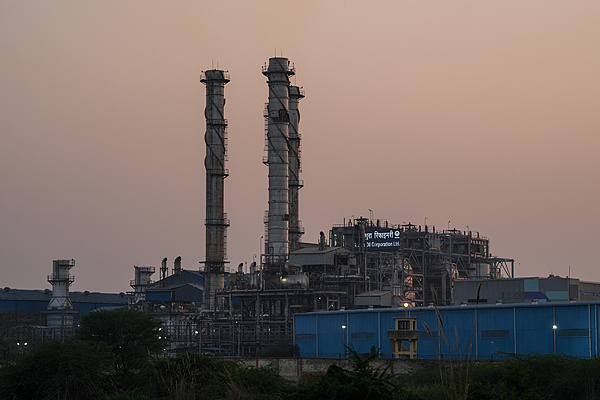
Indian Matua Refinery - Visual China
The article states that while the United States continues to intensify its sanctions against Russia and attempts to expand the scope of these sanctions to include Russian energy buyers, the U.S. government is actively seeking to purchase Russian fuel. This raises a question: if buying energy is equivalent to supporting Russian military operations, then why is it acceptable for the United States to buy Russian fuel, but not for India to buy it?
New Delhi television analysts believe that Trump's announcement of importing Russian diesel is clearly related to the upcoming U.S. mid-term elections. Since the United States launched military strikes against Iran in February this year, global energy prices have continued to rise. The U.S. government has struggled to fulfill its promise to reduce fuel prices, making the issue of fuel prices an important political topic in the mid-term elections.
According to data from the American Automotive Association, by the end of September, the average price of diesel in the United States reached a record $6.53 per gallon. American media outlets such as The Wall Street Journal have previously pointed out that due to the Iranian war, which has caused soaring prices of gasoline and diesel in the United States, many American voters are dissatisfied with the decisions made by the Trump administration. Therefore, controlling energy prices has become a top priority for the Trump administration.
Trump boasted when announcing the US-Russia diesel agreement: "The prices of diesel in the United States and around the world will drop rapidly."
But India also needs to import Russian petroleum products. India is one of the world's major petroleum consumers, and nearly 90% of its crude oil demand depends on imports.
According to statistics from the Indian think tank 'Global Trade Research Initiative', in the fiscal year 2026, India's total crude oil imports reached $134.7 billion. Of this total, Russian crude oil imports amounted to $40.8 billion, accounting for nearly 30.3%. In July of this year, Russian crude oil accounted for more than half of India's total crude oil imports.
The share of other oil suppliers is significantly lower than that of Russia. In July, UAE accounted for 10.8% of crude oil imports to India, Saudi Arabia for 9.6%, Venezuela for 6.3%, Brazil for 5.5%, Oman for 5.3%, and the United States for 2.9%. This means that Russia's supply exceeds the combined contributions of these six countries, indicating that India relies heavily on Russian crude oil.
New Delhi television reported that the actions of the Trump administration reflect America's hypocrisy and double standards. The United States continues to threaten tariffs under the pretext of "supporting wars," attempting to prevent other countries from purchasing Russian energy. But when it comes to the interests of the United States and the Trump administration, Trump immediately discards these excuses.
India has repeatedly condemned the US tariffs, stating that “the countries that criticize India are actually trading with Russia.” The Indian government emphasizes that its energy policies are always guided by national interests, commercial interests, and ensuring a reasonable price for energy supply for its 1.4 billion population.
After talking with Putin on the 9th, Trump posted a message on social media saying: "Both parties agreed that Russia will immediately supply over 300,000 tons of diesel to the United States and global markets. Additionally, another 500,000 tons will be supplied in November, followed by another 1 million tons immediately thereafter. Furthermore, based on the state of Russian refineries, Russia will also supply 3 million tons of diesel in the near future."
Trump stated that, due to the United States' "full control" over the Strait of Hormuz, and this newly announced information, diesel prices in the United States and around the world will "decrease rapidly, with the decline setting a historical record."
The US Treasury issued a general license on September 9, allowing the import of Russian diesel, with the validity period extending until April 7, 2027. According to The Associated Press, this is the first time since the outbreak of the Russo-Ukrainian conflict in 2022 that the United States has granted a sanctions exemption for Russian diesel that exceeds the usual 30-day period.
Russian Deputy Prime Minister Novak confirmed Trump's statement about Russia supplying diesel to the United States and global markets. He told Russian TASS that "as one of the main suppliers to the global diesel market, Russia will immediately begin lifting restrictions on diesel exports."
Novak said, “Russia plans to supply the US market and all our partners with 300,000 tons of diesel as early as October. The diesel exports will increase to about 500,000 tons in November, and to 1 million tons in December.” He added that in the long term, Russian diesel exports are expected to increase further to nearly 3 million tons per month.