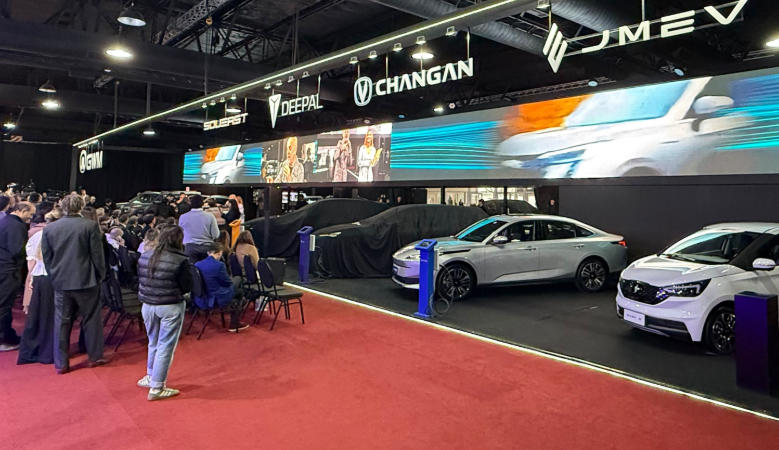
On one side, traditional European car manufacturers are facing fierce competition, and some companies are calling for stronger trade protection measures. On the other hand, an increasing number of European car dealers are starting to sell Chinese brands, and even actively expanding their related businesses.
The German newspaper Welt am Sonntag recently reported under the headline "The Most Anticipated Chinese Electric Vehicles are About to Arrive—Long Lines of Dealers in Germany" that as Xiaomi Automobiles prepares to enter the German market, well-known German auto dealers are seeking cooperation opportunities.
In fact, this trend is not limited to Germany. From the UK to Spain, more and more European traditional car dealers are incorporating Chinese brands into their sales networks.
This seemingly contradictory phenomenon reflects the changes taking place in the European automotive market: Chinese cars are not only making their way onto the purchase lists of European consumers, but they are also gradually integrating into the local established sales and service systems.
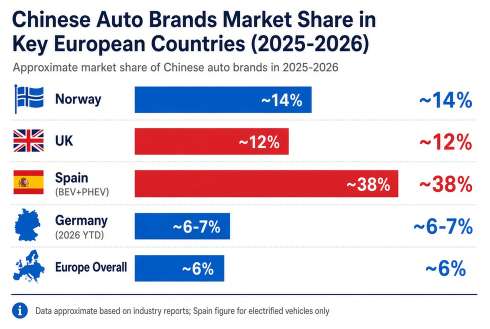
Comparison chart of new car market share of Chinese brands in major European countries
Germany is the core of the European automobile industry, and it also serves as an important window for observing these changes.
According to Reuters, the share of Chinese car brands in the German market has been increasing in recent years. According to data from the German Federal Car and Transport Authority, Chinese brands accounted for approximately 1.4%–1.7% of new car registrations in Germany in 2024. This proportion increased to about 2.4%–2.6% in 2025, and reached 3.1% in the first quarter of 2026. By September 2026, this share had risen to about 6.1%–6.4% per month, with a cumulative share of approximately 6.7% over the first nine months (data from CAM, etc.), indicating a significantly faster growth rate.
Although the overall share is still limited, Chinese automakers are accelerating the establishment of local sales networks.
Stefan Reindel, head of the German Automotive Economic Research Institute, said that improving the dealer network is key for Chinese car brands to enter the German market. Consumers not only need to understand the products, but also need to be able to see and test drive cars locally, along with professional advice and after-sales service.
According to data provided by him in April this year, MG has approximately 180 sales outlets in Germany, while BYD has around 155. With its partnership with the European automotive group Stellantis, Li Auto has also established approximately 120 outlets.
The choice of large German distributor groups is particularly representative.
The Weller Group, with 42 business outlets, has long been involved in selling BMW and Toyota. Now, it also sells BYD at 12 outlets and MG at 10 outlets.
The group leader, Burkhard Welle, told AFP that he is satisfied with the sales of Chinese brands. Many consumers already inquired about the relevant models before entering the exhibition hall.
It is worth noting that Veler also revealed that both BYD and MG took the initiative to contact the group for cooperation. After evaluation, the group decided to include these two brands in its business scope.
This also indicates that the so-called competition among dealers for Chinese car agency rights is not a simple one-way competition. For Chinese automakers who wish to quickly enter the European market, local dealers with a mature customer base and service networks are also important partners.
The German newspaper 'Business Journal' also noted during its interview with Welle in August this year that Welle did not agree with all the pessimistic judgments regarding the German automotive industry. Despite managing Chinese brands, he still believes that German automakers have a competitive edge. There is still uncertainty about how much share Chinese brands will be able to gain in the German market in the future.
For dealers, this approach is not contradictory. Selling Chinese cars does not mean giving up German brands; instead, it means increasing product options based on market demand. At the same time, European traditional manufacturers are also adjusting their product portfolios, pricing strategies, and the pace of electrification in order to cope with competition.
A similar trend is emerging in other major automobile markets in Europe.
The UK is one of the European markets where Chinese automobile brands are growing rapidly.
According to local automotive industry data, Chinese brands such as BYD, Omoda, and JAECOO have achieved a combined market share of 12% in the UK new car market in the first eight months of this year, which is more than twice the previous growth rate.
According to Ian Pluemer, the business director of the British auto trading platform Auto Trader, Chinese brands have increased the affordability of cars and also attracted more consumers to purchase new vehicles.
As a result, British car dealers have gained new business opportunities. In recent years, BYD, Chery, and their brands have continuously expanded their local sales networks. By cooperating with existing dealer groups, they provide consumers with test drives, delivery services, and maintenance solutions.
This change does not mean that the British automotive industry has no concerns about Chinese brands.
The Guardian notes that the UK currently does not impose additional tariffs on Chinese-made electric vehicles, unlike the EU. However, as the EU considers further strengthening local production requirements, the UK automotive industry also faces the challenge of balancing exports to Europe with attracting Chinese investment in car manufacturing.
The tension between market demand and trade policies is becoming a new challenge for the UK automotive industry.
The situation in Spain is also worthy of attention.
BYD Spain announced in September this year that it has recruited 11 local automobile dealer groups, bringing the total number of official dealerships to 107. The company plans to expand to 130 sales outlets and 120 repair service points by the end of 2026.
These new partners are located in Madrid, Catalonia, Basque region, Andalusia, etc. Among them are traditional car sales companies with decades of operation history.
BYD revealed that in the first eight months of this year, the number of new cars registered by BYD in Spain reached 29,947 units, which is already more than the annual sales volume for 2025.
Market growth provides direct motivation for dealers to expand their partnerships.
The Spanish financial media outlet, El País, quoted data from the research institution Ideauto, affiliated with the Spanish Automobile Industry Association, on October 7. According to Ideauto's statistics, in the first nine months of this year, Chinese brands and brands with Chinese origins accounted for 37.9% of the registered electric and plug-in hybrid vehicles in Spain. This represents approximately 8,240 vehicles.
This also indicates that in the Spanish electric vehicle market, Chinese brands have become an important force.
However, this ratio refers to purely electric and plug-in hybrid vehicles, not the entire market share of new cars in Spain.
In Italy, Chinese brands are also expanding their local partnerships.
According to Reuters, Geely's Jikri announced its entry into the Italian market in February this year, and it has partnered with local automotive distributor Jameel Motors to establish sales channels.
In September, BYD's high-end brand Tonet opened a new dealership in Turin, Italy. Reuters reported that the Chinese automaker is not only seeking sales partners in Europe, but is also actively evaluating existing local factories to promote local production.
From Germany and the UK to Spain and Italy, the cooperation between Chinese car brands and local European dealers is moving from fragmented arrangements towards scaled development.
The most direct reason is that consumer needs and market competition are changing.
In the past, the European automotive market was dominated by local manufacturers such as Volkswagen, BMW, Mercedes-Benz, Renault, and Stellantis. A mature brand system and dealer network have provided significant advantages for European automakers.
Now, Chinese automakers are attracting different consumer groups with their electrification and intelligence technologies, as well as competitive product pricing.
According to data from the automotive consulting firm Inovev, Reuters cited in February this year, China's car brands will account for approximately 6% of the European market by 2025, doubling compared to the previous year. However, there are significant differences between countries: it is nearly 14% in Norway, and just slightly above 2% in Germany.
This indicates that Chinese cars do not have a complete advantage in Europe, but rather develop at different speeds in various markets.
For distributors, introducing a new brand is first and foremost a business decision.
On one hand, the competition in the European automotive market is fierce. Traditional brands are adjusting their products and sales strategies, and dealers need to find new sources of income. On the other hand, Chinese automakers entering Europe also require local companies to provide exhibition halls, maintenance facilities, customer relationships, and market experience.
Therefore, there was a real need for cooperation between the two parties.
BYD's expansion plan particularly illustrates this point.
Reuters reported in November last year that BYD plans to expand its sales network in Europe to approximately 2,000 outlets by the end of 2026, which is a doubling from the expected 1,000 outlets by the end of 2025.
BYD's European business director, Maria Grazia Davino, stated that expanding the sales network is aimed at getting closer to consumers and establishing deeper local market connections.
For an automotive company that wishes to operate in Europe for a long time, sales outlets are not only places where cars are sold, but also crucial foundations for building brand trust and providing after-sales service.
This also explains why some European distributors are willing to cooperate with Chinese automakers: Chinese brands need European distribution channels, and European distributors hope to seize new market opportunities.
The change in European auto dealers' attitudes towards Chinese brands occurs against the backdrop of ongoing automotive trade tensions between China and Europe.
In 2024, the European Union imposed countervailing duties on pure electric vehicles manufactured in China. With the increase in exports of plug-in hybrid vehicles from China to Europe, discussions within the EU have emerged regarding further trade measures for related products.
Meanwhile, Chinese automakers have not stopped expanding their business in Europe. Instead, they have begun investing more effort into local production, sales, and service systems.
According to a report by Reuters on September 17, Alfredo Altavila, a European consultant for BYD, said that Chinese automakers are actively looking for existing automobile factories in Europe that can be acquired or transformed in order to achieve faster localization of production.
He pointed out that as the EU discusses new requirements for local content, utilizing existing European production facilities might be faster than building factories from scratch.
Some Chinese automakers are also collaborating with traditional European manufacturers to share factories or production resources.
From initially exporting cars to Europe, to establishing partnerships with local dealers, and then seeking opportunities for local production, Chinese car companies are trying to become more deeply involved in the European automotive industry.
Of course, this process still faces many challenges.
European consumers have a long-term trust in new brands, which needs to be established through product quality and after-sales service. Distributors also need to assess whether Chinese brands can maintain stable sales, provide continuous supply of spare parts, and maintenance support. The uncertainty of EU trade policies may affect the long-term investment arrangements of companies.
Moreover, domestic brands from traditional automotive powers such as Germany still hold a dominant position in the market. The rapid growth of Chinese brands does not mean that the European automotive market landscape has fundamentally changed.
But the choices of European distributors reveal at least one trend: even as trade tensions persist, market entities continue to seek cooperation opportunities based on consumer needs.
For the European automotive industry, Chinese brands not only bring new competition but also provide new business opportunities for local sellers, service providers, and manufacturing enterprises.
When German dealers start selling both BMW and BYD, and when traditional Spanish car sales groups continue to join the Chinese brand network, these changes indicate that Chinese cars are becoming increasingly part of the local automotive sales and service systems, rather than just foreign competitors in the European market.
In the current period of adjustment in Sino-European economic and trade relations, this kind of cooperation driven by market demand also provides a realistic basis for both sides to find new ways of coexistence in the automotive industry.