According to reports by Bloomberg and Reuters on October 12, due to the worsening economic situation and consumer boycotts in China, the sales of Louis Vuitton, the largest division of global luxury fashion brand LVMH, have significantly declined.
LVMH Group announced today that revenue from its fashion and leather goods department decreased by 5% year-on-year during the third quarter of this year, falling short of analyst expectations.
Additionally, the group's total sales were lower than expected.
RBC analysts said in a report: “This confirms that the fragile recovery momentum of LVMH earlier this year has stalled.”
After the news was announced, LVMH Group's American Depositary Votes fell by 3.6% in New York. The group's stock has fallen by more than 40% in Paris this year, and it is expected to set the worst annual performance since the global financial crisis in 2008.
A year ago, LVMH reported that demand in the Chinese market had slightly improved, which led to a sudden rebound in the luxury goods industry as a whole. However, now the group is showing signs of a more long-term and severe decline.
"Stock prices have been weak recently, but we expect the entire sector to face further pressure as the news has confirmed a substantial decline in the Chinese market, which is bigger than expectations."
According to Bloomberg's reporting last month, LV's sales in China were affected after winning a trademark dispute with the "Jasmine" brand. This victory for LV sparked strong discontent among Chinese consumers.
On the 12th, LVMH Group Chief Financial Officer Cedric Charbin responded that it is difficult to quantify the exact impact of the LV case involving Jasmine milk on LV sales revenue. However, consumer backlash has "at least had a negative effect in the early part of this quarter."
When asked about the prospects for LV’s recovery, Cabanist said, “It will take some time, but I don’t think there are many shortcuts here.”
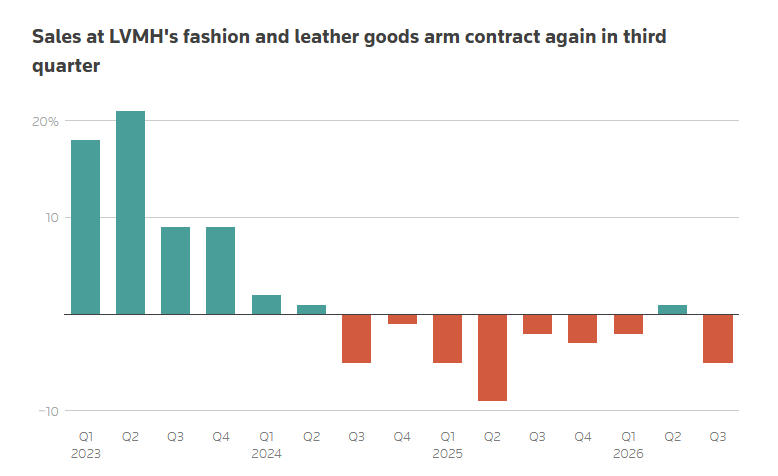
LVMH Group's Fashion and Leather Goods Division Revenue Declines Significantly - Reuters Chart
On June 29th, the Intermediate People's Court of Suzhou City, Jiangsu Province issued a first-instance judgment in the trademark infringement dispute case between LV and Moli Milk White, as well as Dongxia Beverage Shop in Wuzhong Economic Development Zone.
The court determined that the four-leaf flower design used by Mocha Milk White infringed upon the exclusive rights to 7 registered designs under LV. The court ordered the parent company of Mocha Milk White to compensate for economic losses of 10 million yuan and reasonable expenses for rights protection of 300,000 yuan, totaling 10.3 million yuan. Mocha Milk White also needs to publish a statement on platforms such as its official website, Weibo, WeChat, mini-programs, REDnote, and Douyin to eliminate any negative effects.
This case has sparked a much greater discussion in the public opinion than typical trademark disputes. The Weibo topic “LV sues Mocha Milk White and demands compensation of 10.3 million” has reached 400 million views. Many netizens have shared comparison images, pointing out that the old-fashioned pattern involved in the case originates from China's traditional pattern, the Baoxiang flower.
Although Jasmine Milk White lost the first trial, it received overwhelming support in the public opinion. Some stores even faced a situation where orders exceeded their capacity. The focus of public opinion shifted from the case itself to deeper issues such as "Can LV monopolize the four-leaf flower symbol?" and "How to protect traditional patterns?"

